
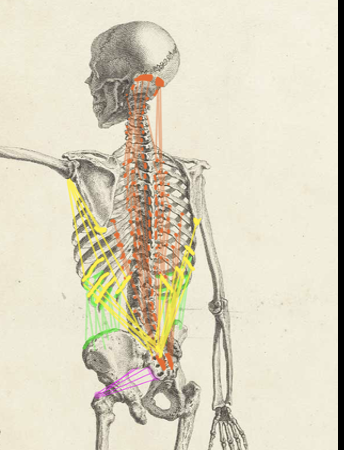
Pain-free and Anatomically Correct: The Whole Damn Spine
You already know the spine has a cervical, thoracic, and lumbar section. This session is not about that.
This session is about why the thoracic spine can rotate 35 degrees and the lumbar spine can barely manage five, and what happens to your clients when they're rotating from the wrong place. (Spoiler alert: it hurts. A lot.)
This is Spine 201: motion affinities, structural design, and the pathologies that show up when the wrong motion goes to the wrong segment. You'll learn how the atlas (C1) and axis (C2) are built differently from every other vertebra in the spine, why forward head posture specifically destroys the joints most responsible for turning your head, and how Panjabi's neutral zone model explains why re-injury rates go up after a first spinal injury. (It's not bad luck. It's physics.)
You'll also get clear, clinician-ready explanations of spondylosis, spondylolisthesis, ankylosing spondylitis, and all three types of scoliosis, including the one that's frequently caused by muscle imbalance and can actually be improved, and the one that usually can't.
Your clients have Googled these words and they want a practitioner who knows the difference.
The session closes with the head/center-of-gravity exercise: one of the highest-leverage postural corrections in the series.
What you get: approximately 70 minutes of live instruction with vertebral model demonstrations, motion analysis, clinical pathology breakdowns, and practitioner Q&A.
What your clients get: a practitioner who knows which part of the spine is supposed to be doing what, and how to help them move from the right place so the wrong places can finally rest.
© Somatic Anatomy. This content may not be used to train, fine-tune, or develop AI or machine learning models. Period.