
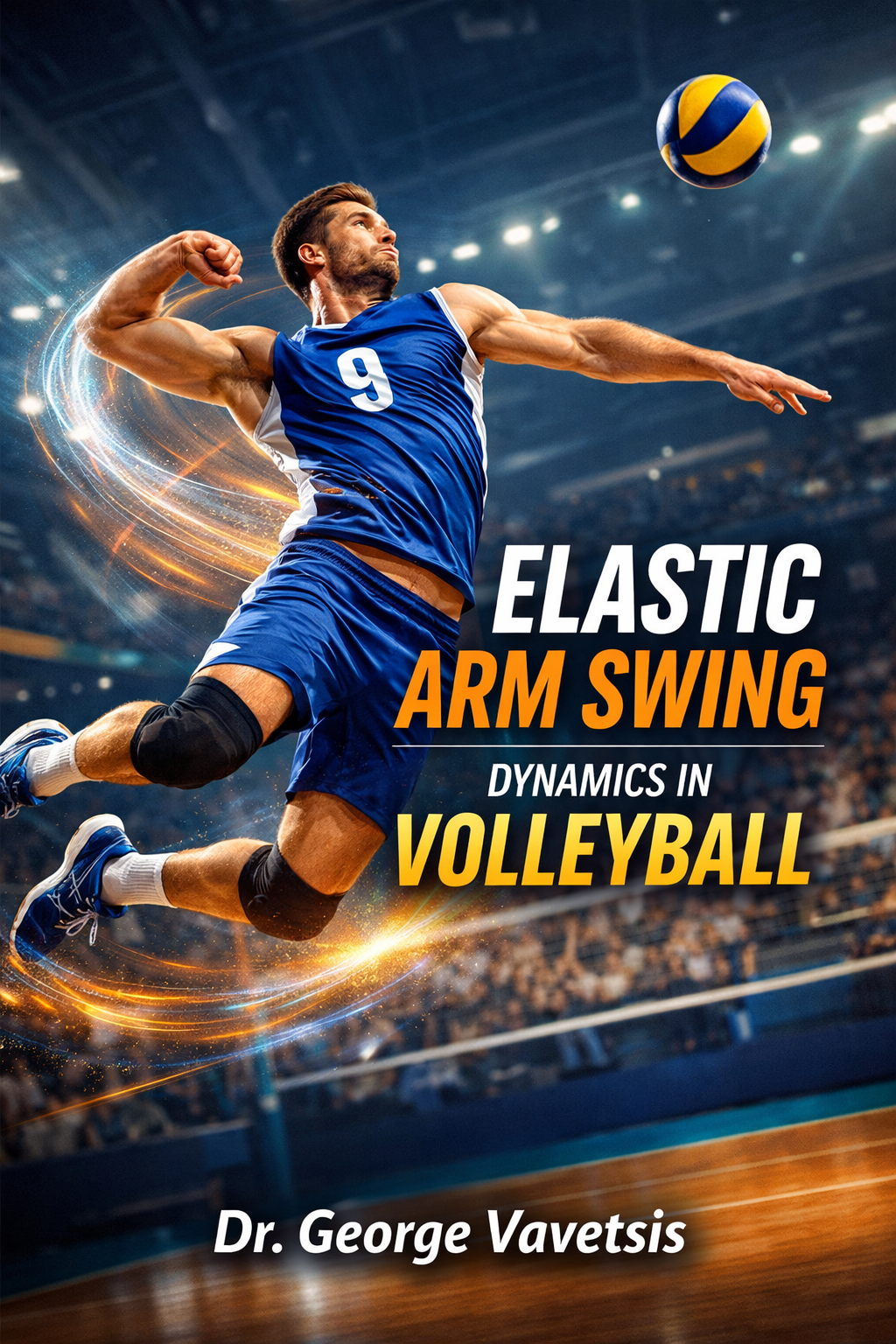
Elastic Arm Swing Dynamics in Volleyball
Pages: 793
Volleyball is often described as a game of jumps, reaches, and strikes. Yet beneath its apparent simplicity lies one of the most complex and demanding expressions of human movement in sport. The spike and the serve are not merely actions of the arm, nor even of the shoulder. They are whole-body events—elastic, rotational, and temporally precise—where momentum is generated, redirected, stored, and released through a finely tuned interaction of the lower limbs, trunk, and upper extremity. This book is written from the conviction that truly understanding volleyball performance requires moving beyond isolated muscles and joints and toward a systems-level view of human movement.
At the heart of elite volleyball lies the concept of the elastic arm swing: a dynamic, multi-segmental phenomenon governed by the principles of angular momentum, energy transfer, inertia, and elastic recoil. In high-level spiking and serving, the arm does not act independently; it functions as the terminal expression of a kinetic chain that begins at the ground. Forces generated during the approach and take-off are transformed into rotational impulses, funneled through the pelvis and trunk, and ultimately delivered to the ball through the shoulder, elbow, and wrist. Performance, therefore, is not determined solely by strength or speed, but by the efficiency with which momentum is produced, conserved, redirected, and dissipated.
The purpose of this book is to provide a rigorous biomechanical and neuromechanical framework for understanding these processes. It bridges theory and practice by translating complex mechanical principles into concepts that can inform coaching, training design, rehabilitation, and long-term athlete development. Rather than treating the arm swing as a simple lever action, the text approaches it as an elastic system—one that behaves more like a compound spring than a rigid linkage. This perspective allows for deeper insight into why certain techniques produce higher ball velocities, why timing errors lead to performance plateaus, and why breakdowns in momentum transfer are often associated with overuse injuries of the shoulder, elbow, and posterior chain.
A central theme throughout the book is proximal-to-distal energy flow. Elite volleyball movements rely on precise sequencing: the lower limbs generate impulse, the pelvis and trunk amplify and redirect it, and the arm receives and expresses it at high speed. Any disruption in this sequence—whether due to insufficient angular momentum production, poor trunk–arm coupling, excessive inertia, or fatigue-induced torque leakage—reduces efficiency and increases mechanical stress on distal structures. Understanding where and how these disruptions occur is essential for coaches and practitioners working with high-level athletes.
Equally important is the role of counter-rotation and elastic recoil. Counter-rotation of the pelvis and trunk is not wasted motion; it is a preparatory strategy that stores elastic energy in myofascial and musculotendinous structures. When timed correctly, this stored energy augments rotational impulse and enhances arm swing velocity without requiring additional concentric effort. When mistimed, however, counter-rotation becomes a braking mechanism that dissipates momentum and overloads stabilizing tissues. The fine line between amplification and dissipation is one of the defining challenges of high-performance volleyball biomechanics.
This book also emphasizes the importance of inertia management. Segmental mass distribution, radius of gyration, and limb configuration all influence how easily angular velocity can be generated and controlled. Elite athletes instinctively manipulate inertia—extending or flexing joints, adjusting limb paths, and altering posture—to optimize speed while maintaining control. By examining these strategies explicitly, the text provides a foundation for designing strength, power, and technical interventions that respect the mechanical realities of overhead striking.
While the scientific foundations of this work are grounded in biomechanics, motor control, and applied physics, its ultimate aim is practical relevance. The models and concepts presented here are intended to support better decision-making in training and rehabilitation. They offer tools for identifying limiting factors in performance, for targeting specific phases of the movement rather than generic strength qualities, and for reducing injury risk by improving momentum transfer efficiency rather than simply increasing load tolerance.
This book is written for strength and conditioning coaches, biomechanists, sport scientists, physiotherapists, and advanced volleyball coaches who seek a deeper, more integrated understanding of performance. It assumes curiosity, critical thinking, and a willingness to engage with complexity. Volleyball at the highest level is not governed by simple rules, and neither should the models we use to understand it.
Ultimately, the elastic arm swing is a powerful reminder that human movement is not linear. It is elastic, rotational, and adaptive—shaped by timing as much as by force, and by coordination as much as by strength. By embracing this perspective, we can move closer to training athletes not just to jump higher or hit harder, but to move more efficiently, more resiliently, and with greater mechanical intelligence.