
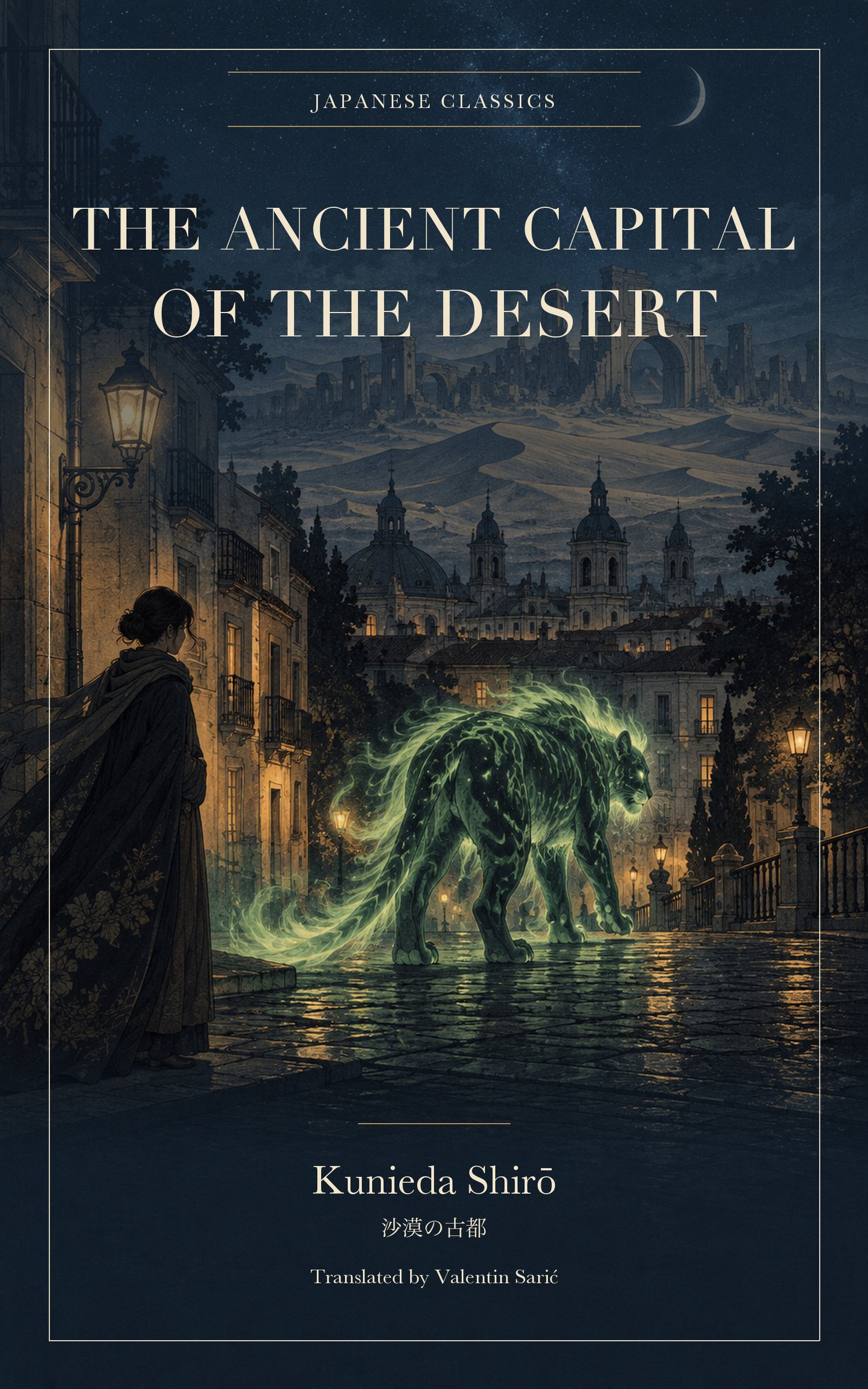
The Ancient Capital of the Desert
At two o'clock in the morning a beast covered in phosphorescence walks through Madrid, and a man in a house near the governor's residence screams one word nobody understands. The private detective Lezard takes the case because the mayor's wife asks him to, and by the time it is solved the novel has left Spain for good.
What follows is one of the strangest adventure serials of the Taishō period. An expedition crosses Siberia by rail and river and camel to the Lop desert of Chinese Turkestan, where a scholar's parchment says an ancient Uyghur capital lies buried under the sand with forty vaults of treasure beneath it, guarded by a pair of stone lion-dogs. Travelling with them as ship's cook is Zhang Jiaoren, a Chinese revolutionary who has his own reasons and his own copy of the map. Half the book is his — extracts from a memorandum-book that keeps surfacing, once at the edge of a lake he has vanished into. From the desert the story goes on to Peking and a secret society for the conquest of the world, to the Shanghai waterfront and an orang-utan carried through the streets in a black chest, and finally to the forests of Borneo, to a race of tailed ape-men, to prehistoric animals in a lake, and to a shrine on the dunes with the same two lion-dogs standing in front of it.
Kunieda Shirō wrote it for the monthly Shinshumi through 1923, eight instalments in eight months, and the tempo never slackens: forty-four short sections, a reversal or a corpse in most of them, and an ending that hands one man an empire and asks the reader to accept that he keeps it. The novel is finished — unusually for Kunieda, it runs to a full close.
First English translation, complete and unabridged, in seven books, with the author's own errors of geography, zoology and chronology kept and footnoted rather than tidied away.
English-language digital edition. Translated by Valentin Sarić.
You receive: a 182-page PDF and an EPUB edition.
Digital download only. No physical book is shipped.