



Margin Trading Explained — Measured (PDF Guide)
You know margin is the money you post and that running out of it ends the position. What nobody told you is how quickly ordinary movement spends it, or that funding and fees are quietly spending it too the whole time you hold.
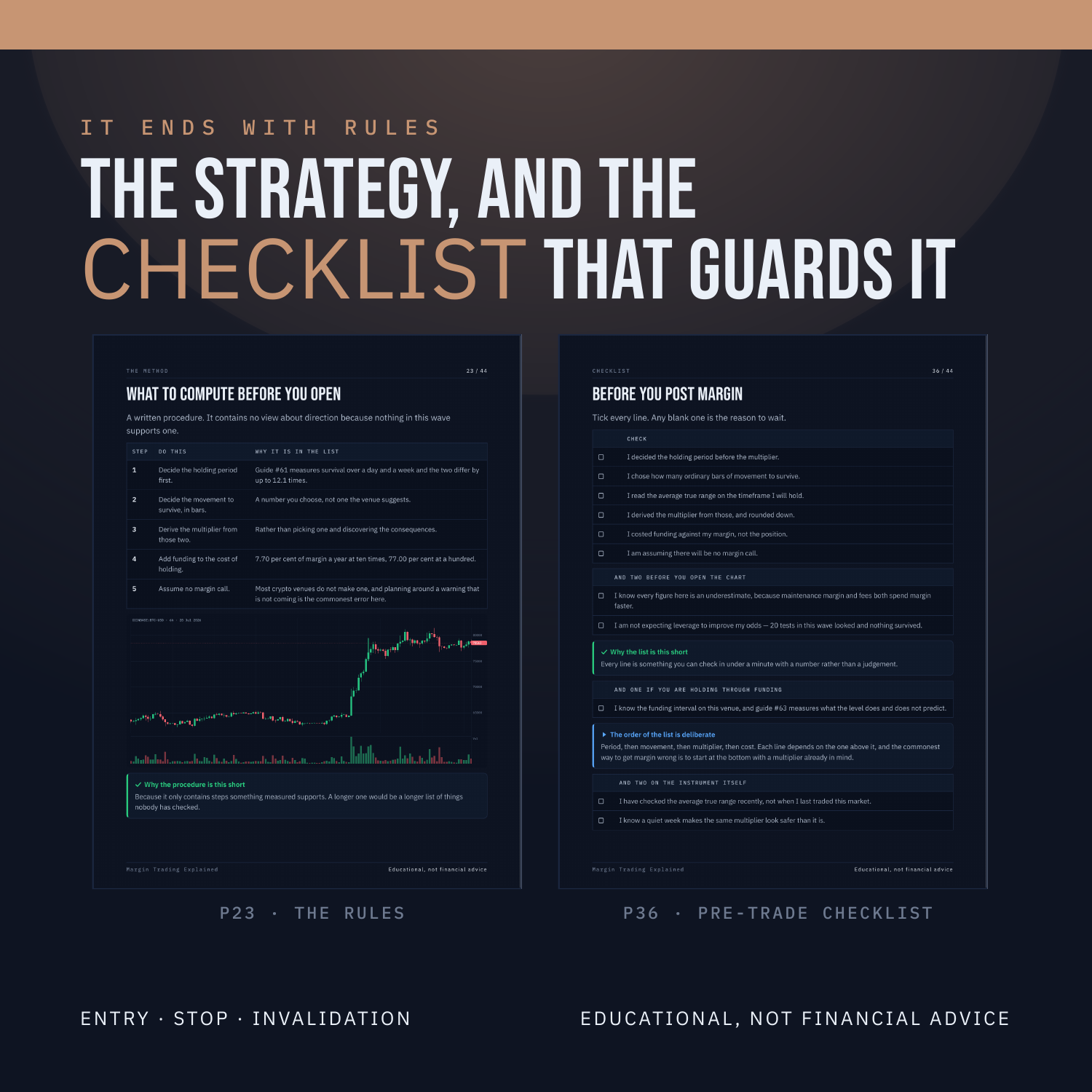
This guide measures the three things that consume margin - price movement, funding and fees - across 88,000 bars of real market history on ten instruments at four multipliers. The result is a table you can read your own number off, and it is arithmetic rather than a forecast. This is a 44-page PDF that teaches Margin Trading from the first thing you see on the screen through to a written strategy with an entry, a stop and an explicit rule for when the trade is wrong.
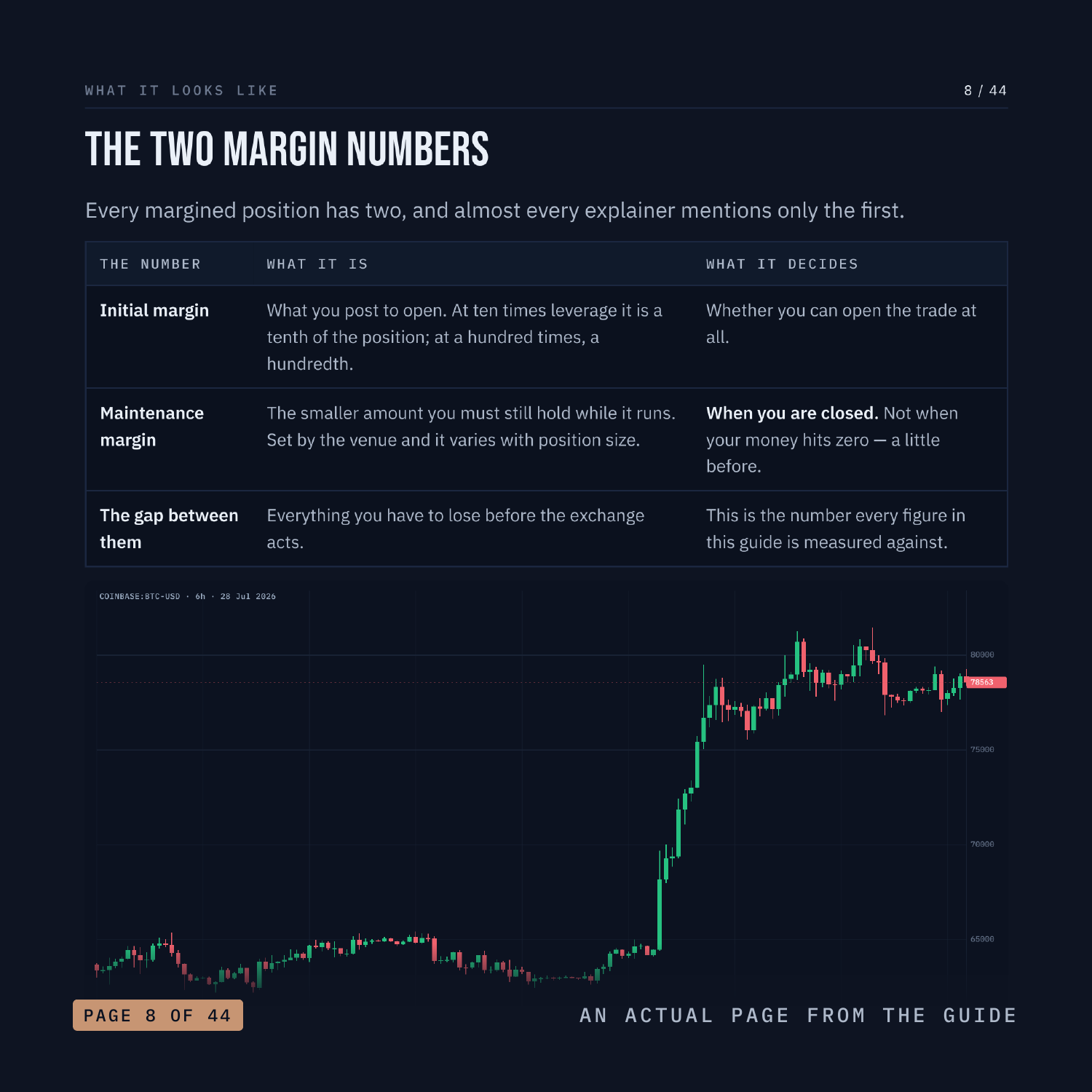
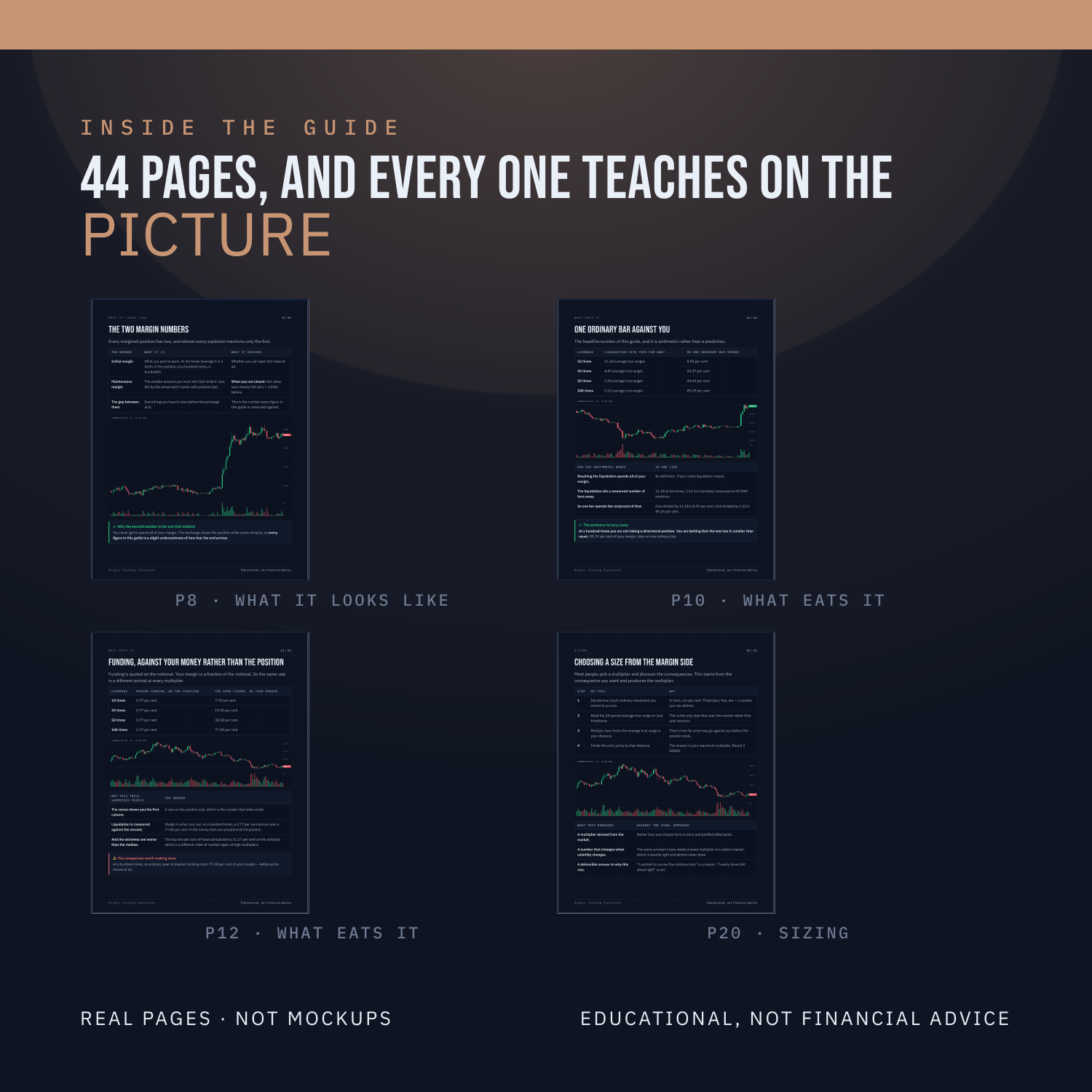
Nothing is taught underneath a chart. Every label sits on the candle, the line or the level it is describing, on real BTC, ETH, SOL and LINK charts. There are three quizzes on real charts, each followed by the same chart re-shown annotated with the reasoning, plus faded practice pages where the first steps are filled in and you finish the rest.
WHAT'S INSIDE
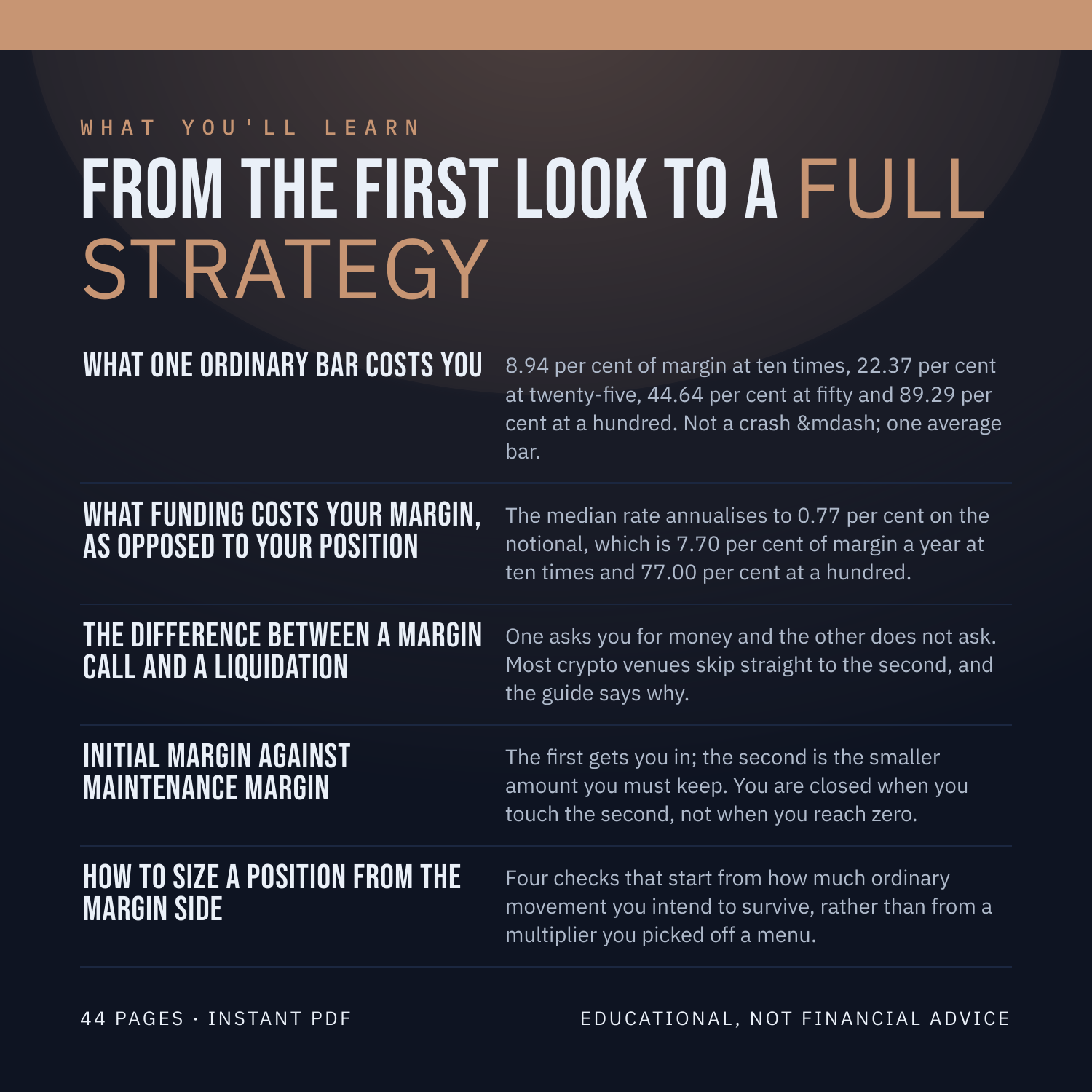
What one ordinary bar costs you - 8.94 per cent of margin at ten times, 22.37 per cent at twenty-five, 44.64 per cent at fifty and 89.29 per cent at a hundred. Not a crash - one average bar.
What funding costs your margin, as opposed to your position - The median rate annualises to 0.77 per cent on the notional, which is 7.70 per cent of margin a year at ten times and 77.00 per cent at a hundred.
The difference between a margin call and a liquidation - One asks you for money and the other does not ask. Most crypto venues skip straight to the second, and the guide says why.
Initial margin against maintenance margin - The first gets you in; the second is the smaller amount you must keep. You are closed when you touch the second, not when you reach zero.
How to size a position from the margin side - Four checks that start from how much ordinary movement you intend to survive, rather than from a multiplier you picked off a menu.
WHAT YOU'LL BE ABLE TO DO
Say what margin is and name the three things that consume it.
Compute what one ordinary bar costs your margin at any multiplier.
Convert a funding rate into a share of your own money, not the position's.
Tell a margin call from a liquidation, and know which one you face.
Size a position from how much movement you want to survive.
AN HONEST NOTE
Margin Trading is a clue, not a crystal ball. It describes what price has already done. This guide contains no win rates, no historical-test results and no promises about what you will make, because nobody can verify those and you should not trust anyone who prints them. What it hands you instead is a set of rules you can test yourself on TradingView in an afternoon. Educational, not financial advice.
Instant download. 44 pages, PDF.