

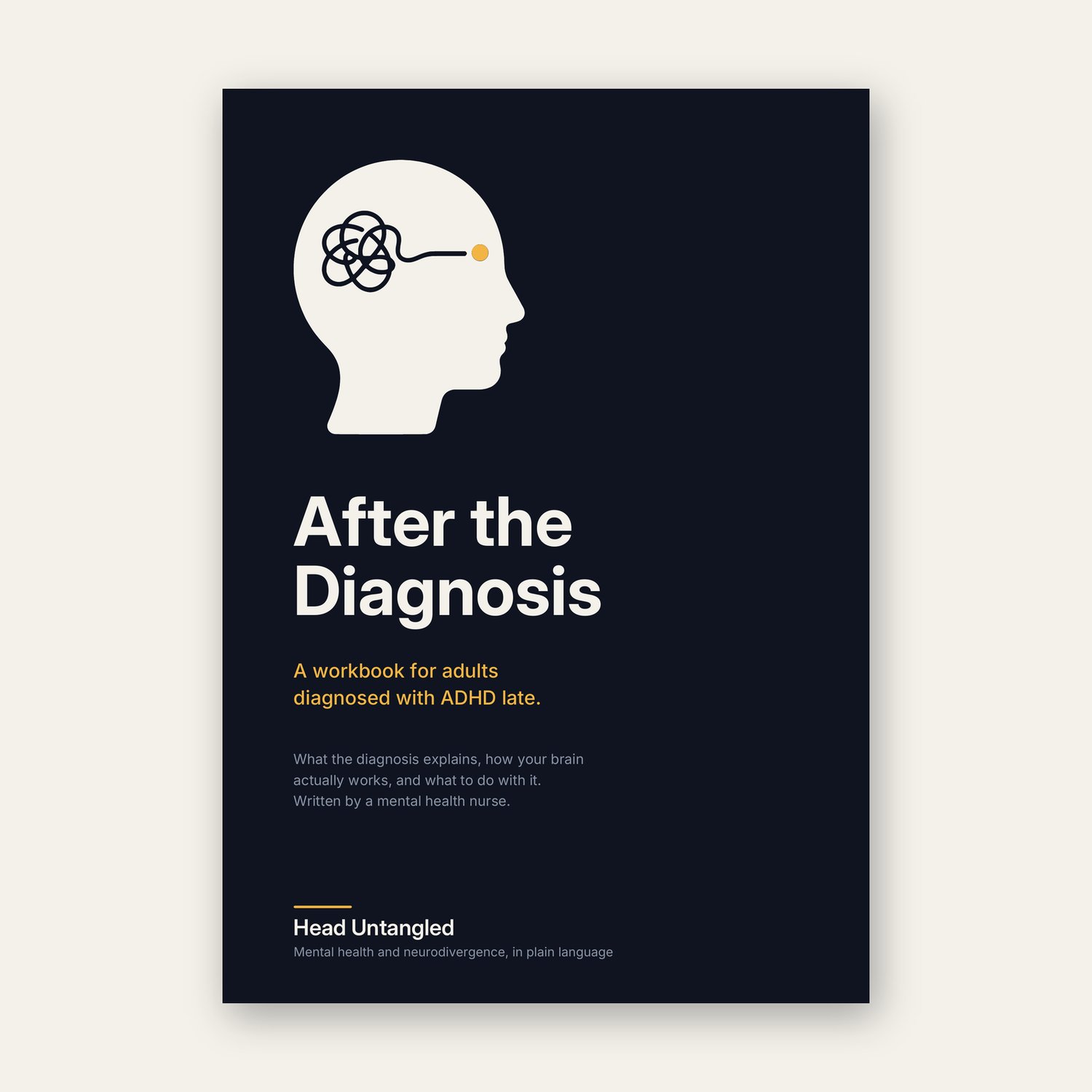
After the Diagnosis: a workbook for adults diagnosed with ADHD late
The diagnosis explains a lot. It doesn't tell you what to do next. This does, in order.
Part 1, The first few months: relief and rage, what the diagnosis explains and what it doesn't, the sentences you're done with, where it shows up for you, what you've already tried, who you are without the coping, and telling people (which is optional).
Part 2, How your brain actually works: regulation rather than motivation, attention and time, the big feelings, name the layer, the RSD reset, the rumination reducer, and an RSD debrief.
Part 3, Deciding what better looks like: the friction scan, values and expectations, good enough as a skill, a capacity check, the anti-overwhelm agreement, keystone goals, and the goal shrinker with a first move in seventy-two hours.
Part 4, Getting things done: tiny priorities, task mountain, the time map, a focus session that ends cleanly, eight kinds of stuck with a fix for each, the tiny actions menu, and coaching yourself without the bully.
Part 5, People and systems: the work email, the partner script, the boundary builder, the admin script, micro-repairs and the two-text rule, arrive–anchor–exit, and support without talking.
Part 6, The long game: the showed-up log, the weekly review, the monthly adjust, tech with jobs, the ninety-day plan, the reset plan, the smallest restart, and when to add people.
Part 7, The repeat pages: tiny priorities and the showed-up log a week to a page, a weekly review, an RSD debrief, and notes. Print more whenever you need them.
66 pages, A4 and US Letter both included, laid out for double-sided printing with room for binding, readable in black and white, with writing lines spaced for real handwriting. A printable PDF: print it, or write on it in a PDF app that supports annotation (it has no fillable fields).
Written by a UK-registered mental health nurse with over twenty years in inpatient services, who has ADHD and was diagnosed late, as an adult. AI tools assisted with drafting, source-checking and layout; every page was reviewed and approved by the author. Nothing in it is about medication; that conversation belongs with your prescriber.
ADHD often travels with anxiety and low mood. If low mood is everywhere, nothing feels enjoyable, your sleep or appetite has changed and stayed changed, or you've had thoughts of not wanting to be here, please talk to your GP. If you are struggling or in crisis, contact your GP or local emergency services, or call Samaritans on 116 123 (UK and Ireland).
Educational, not advice. Your own clinician knows your situation best. For personal use.