
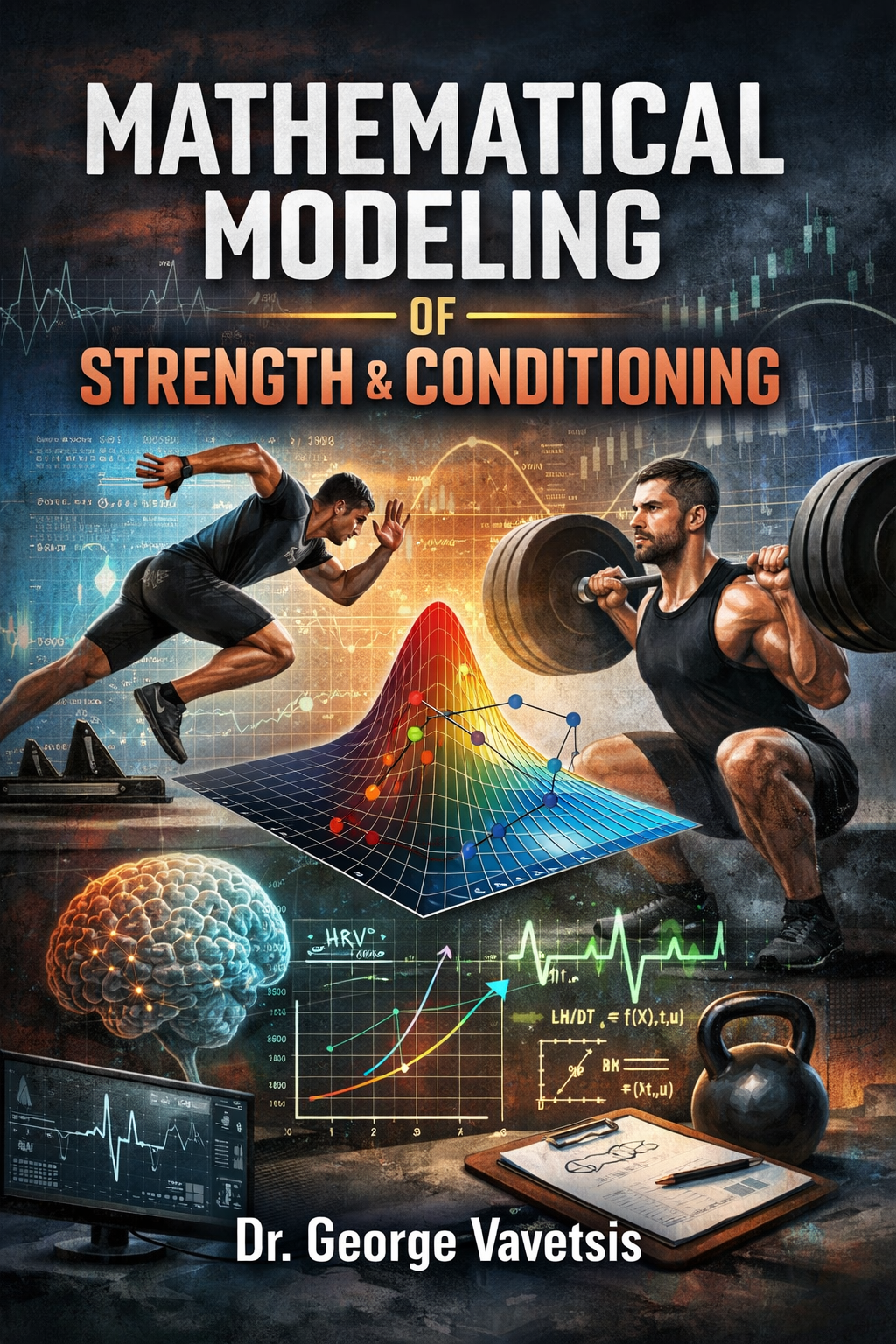
Mathematical Modeling of Strength & Conditioning
Pages: 3176
The evolution of strength and conditioning (S&C) has entered a transformative era—one defined not merely by empirical observation or experiential coaching intuition, but by the rigorous integration of mathematical modeling, systems theory, and computational analytics. In high-performance sport, where marginal gains define competitive superiority, the capacity to quantify, predict, and optimize adaptation is no longer a theoretical luxury; it is a practical necessity.
At its core, athletic performance is not a linear construct. It is a manifestation of a highly complex, nonlinear, adaptive biological system—one that integrates neuromuscular, metabolic, biomechanical, and neurocognitive subsystems into a dynamically evolving whole. Traditional paradigms of training prescription, often grounded in simplified dose–response relationships, fail to capture the inherent variability, sensitivity, and interdependence that define human performance. As highlighted within the foundational concepts of nonlinear dynamical systems, even minimal perturbations in training load, recovery, or psychological stress can lead to disproportionately large deviations in performance trajectories .
This book positions strength and conditioning within the framework of applied dynamical systems theory, where the athlete is conceptualized as a state-space system evolving over time under the influence of internal states and external inputs. Here, variables such as neuromuscular readiness, tendon stiffness, heart rate variability, and metabolic capacity are not isolated metrics but components of a multidimensional state vector governing performance behavior. Training itself becomes a control input—a structured perturbation designed to steer the system toward an optimal attractor state.
Rather than prescribing training based solely on fixed intensities, volumes, or percentages of one-repetition maximum, practitioners are invited to consider trajectory-based adaptation. Performance is no longer viewed as a static endpoint but as a path within a high-dimensional phase space, where directionality, velocity, and stability of movement through this space determine success. The challenge, therefore, shifts from simply “loading the athlete” to controlling the evolution of the athlete’s state.
Central to this paradigm is the concept of nonlinearity. Load-response relationships in sport are inherently history-dependent, meaning that identical training stimuli can produce vastly different outcomes depending on prior exposure, fatigue accumulation, and recovery status . This necessitates models capable of capturing delayed effects, cumulative interactions, and feedback loops—features that are fundamentally absent in linear frameworks. Through nonlinear differential equations, state transition models, and phase-space representations, this book provides the tools to conceptualize and operationalize these dynamics.
Equally important is the recognition of hidden states—latent variables such as central fatigue, readiness reserve capacity, and tissue strain burden that cannot be directly observed but significantly influence performance. Advanced modeling techniques allow for the estimation of these hidden states, enabling practitioners to move beyond surface-level metrics and toward a deeper understanding of the athlete’s internal condition. This transition from observable outputs (e.g., CMJ height, sprint time, bar velocity) to inferred internal states represents a critical advancement in performance diagnostics and decision-making.
Another cornerstone of this work is stability analysis. Drawing from Lyapunov theory and control systems engineering, stability is defined as the system’s ability to resist or recover from perturbations. In practical terms, this translates to the athlete’s capacity to maintain technical consistency, force output, and coordination under conditions of fatigue, stress, or environmental variability. Understanding whether small deviations amplify or dissipate over time provides invaluable insight into injury risk, performance robustness, and readiness for competition.
Moreover, the integration of phase portrait analysis offers a powerful visualization of training adaptation. By mapping variables such as fatigue versus readiness or force versus velocity, practitioners can observe the emergence of attractors, limit cycles, and instability zones. These patterns reveal whether the athlete is progressing toward optimal performance, stagnating within suboptimal states, or approaching critical thresholds of maladaptation. Such insights enable proactive intervention—adjusting training before performance decline becomes evident.
From a practical standpoint, this book is not an abstract mathematical treatise but a coaching instrument. Each theoretical construct is translated into actionable strategies for load management, monitoring, and program design. State-space models inform weekly loading decisions; sensitivity analyses guide micro-adjustments in training variables; and trajectory morphology dictates whether to intensify, maintain, deload, or redirect training emphasis. In this way, mathematics becomes not an end in itself but a means of enhancing coaching precision.
The integration of modern technology further amplifies these capabilities. Wearable sensors, force plates, GPS tracking systems, and biochemical assays generate vast streams of data. Yet, without a coherent modeling framework, this data risks becoming noise rather than insight. By embedding these measurements within a dynamical systems architecture, practitioners can transform raw data into meaningful representations of athlete state, enabling real-time monitoring and adaptive decision-making.
It is also essential to acknowledge the philosophical dimension underpinning this work. At its highest level, strength and conditioning is not merely about physical preparation—it is about orchestrating complexity. The coach becomes a systems architect, navigating uncertainty, managing variability, and guiding the athlete through a landscape of potential outcomes. This requires not only technical expertise but also a deep appreciation of the interplay between structure and emergence, control and adaptability.
In conclusion, Mathematical Modeling of Strength & Conditioning seeks to redefine how we understand and apply training science. It challenges practitioners to move beyond reductionist approaches and embrace the complexity inherent in human performance. By integrating mathematics, physiology, biomechanics, and coaching practice into a unified framework, this book provides a pathway toward more intelligent, responsive, and effective training systems.