
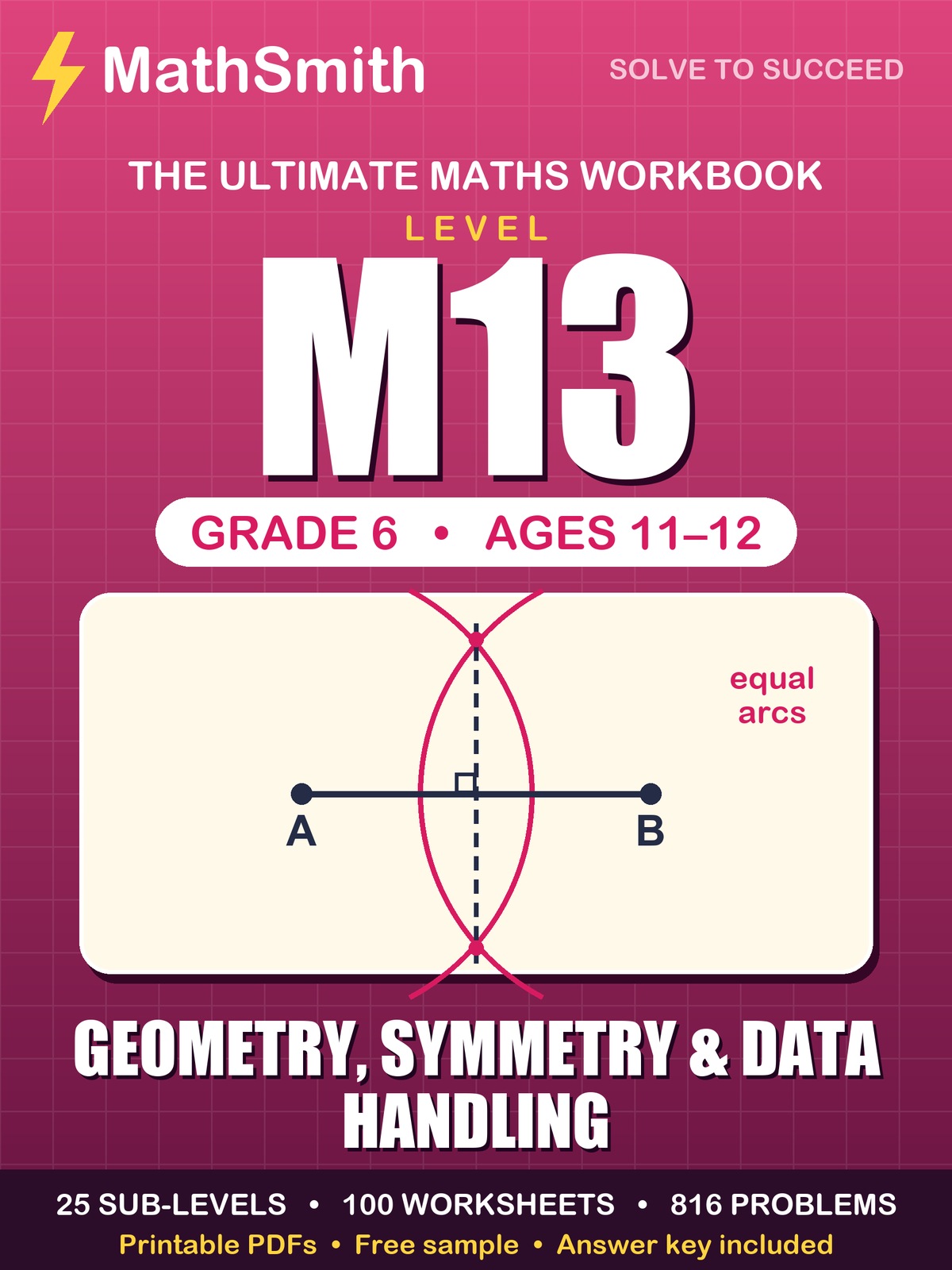
Gr 6 Maths Worksheets (Ages 11-12) | Level M13: Geometry, Symmetry & Data Handling
🎓 Launch offer: 80% OFF every MathSmith workbook with code LAUNCH80 (first 1000 orders). Click Add to Cart, then enter LAUNCH80 in the discount box before you pay.
Not sure which level your child needs? Take the free 40-question placement test: https://ebooks.thecodecrafters.net/placement
See free sample pages first: https://ebooks.thecodecrafters.net/
Help your child build absolute confidence and mastery in mathematics. This comprehensive workbook from MathSmith takes a highly structured, "one-rung-at-a-time" approach to Geometry, Symmetry and Data Handling, ensuring students fully understand concepts before moving forward.
Instead of overwhelming learners with random equations, this workbook uses a carefully scaffolded, predictable learning ladder. It is perfect for homework, structured independent study, or mastery practice.
📊 What Is Included?
1 Complete Level (Level M13)
25 Structured Sub-levels for gradual progression
100 Printable Worksheets
816 Total Problems for thorough practice
Full Answer Key online, unlocked by the order ID on your Payhip receipt, for quick, stress-free marking
🗺️ Curriculum Breakdown
This collection focuses deeply on mastering Geometry, Symmetry and Data Handling through a carefully curated system:
What a shape is made of (3 Sub-levels): A point, a line, a ray and a line segment are drawn with the same pencil and told apart entirely by their ends - an arrowhead means it carries on for ever that way, a dot means it stops here. Then the only two things two lines can do, and the only two things a curve can do. A child who thinks two lines might meet twice is thinking of a curve, which is why the curve comes next and why open, closed, crossing and simple are asked as two independent questions rather than as one.
Polygons, and the angle at a corner (2 Sub-levels): The first rungs where a drawing carries letters and the letters are the answer. A polygon's sides and its vertices always come to the same number and both are asked, on the same shapes, because noticing that is most of the point; the diagonal is the new thing and is never drawn. An angle is named with three letters and the middle one is its corner - never asked for in full, because ABC and CBA are the same angle and a key that takes one marks the other wrong.
The shapes, by name (4 Sub-levels): Triangles twice - by their sides and then by their angles, which are two different classifications of the same shape and a child who has met only one will insist an isosceles triangle cannot be right-angled. Then the five quadrilaterals, drawn so that the name is decidable by eye, and the circle's parts, where two of them are lines and two are pieces of the space inside and the page has to shade the difference or the question has two right answers.
Reading a length and reading an angle (4 Sub-levels): M9 measured with both instruments and this comes back to them widened rather than repeated: the whole protractor scale rather than its comfortable middle, and the reflex angle, which is the one opening a protractor cannot reach in a single reading. It is drawn as the SAME two arms with the other opening marked, because that is the only honest picture of one. Perpendicular closes the strand and opens the constructions.
Solids, and solids opened out (3 Sub-levels): M9 counted the faces of these without naming most of them, so the naming comes first here and the counting after it - a prism counted before it was named was counted as a shape rather than as a kind. The nets leave the cube and the cuboid to M9 and take the four this level names for the first time: two circles and a rectangle can only be a tin.
Folding a shape onto itself (2 Sub-levels): A printed capital letter is a drawing, so these are asked in words - an H in the question is the same H a child would be shown, and a figure of it would be the question printed twice. Drawing the reflection ends in a number rather than in a picture, because a drawing cannot be marked and a count that only comes out right if the other half was really drawn can be.
The construction: the level's new notation (4 Sub-levels): The only notation in the series made with an instrument rather than a pencil, and the only one whose whole content is a sequence. A pair of compasses does not measure anything - it carries one distance - so the copied segment is exact in a way a measured one never is, both crossings of the bisector are the same distance from both ends because the compasses did not move between the arcs, and sixty degrees comes free because three equal settings make an equilateral triangle. The arcs stay on the page in every drawing and the line through them is never drawn: 'show' says how many steps to sketch and there is no key at all for saying "and the answer".
Counting what happened (3 Sub-levels): M6.18 to M6.22 with the numbers an order of magnitude bigger, and one thing that is new. A heap of readings in the order they happened answers nothing and the same readings counted by value answers everything, so half of the first rung hands over the raw list and asks for one row of a table that is not there yet. The key on a pictograph and the scale on a bar graph are pinned rather than chosen here, because what is new is the size of the numbers and not the idea.
🎯 Who Is This For?
Parents looking to provide structured math support at home.
Homeschoolers searching for a sequential curriculum to guarantee zero gaps in math skills.
Teachers & Tutors looking for bite-sized, scaffolded printables for classroom morning work or targeted intervention.
📖 How To Use This Workbook
Print the workbook, read each rung's method page, and let your child work inside the printed frame. Then check the answers your way: in the printable answer-key PDF included in this download, or online, one page at a time, with the order ID on your Payhip receipt (valid for six months). Please keep the answer key for the adult marking the work and do not share it with your child: the workbook only works if they have worked each answer out for themselves.
Step-by-step manual and video guide: https://ebooks.thecodecrafters.net/manual/
Check the answers: https://ebooks.thecodecrafters.net/answers
⚙️ Digital Delivery Details
Format: four instant-download PDFs (free sample, sample answers, workbook, full answer key). The answer key is also available online.
Print Ready: Easily printable on home or school printers.
Usage: Licensed for individual family or single-classroom use.