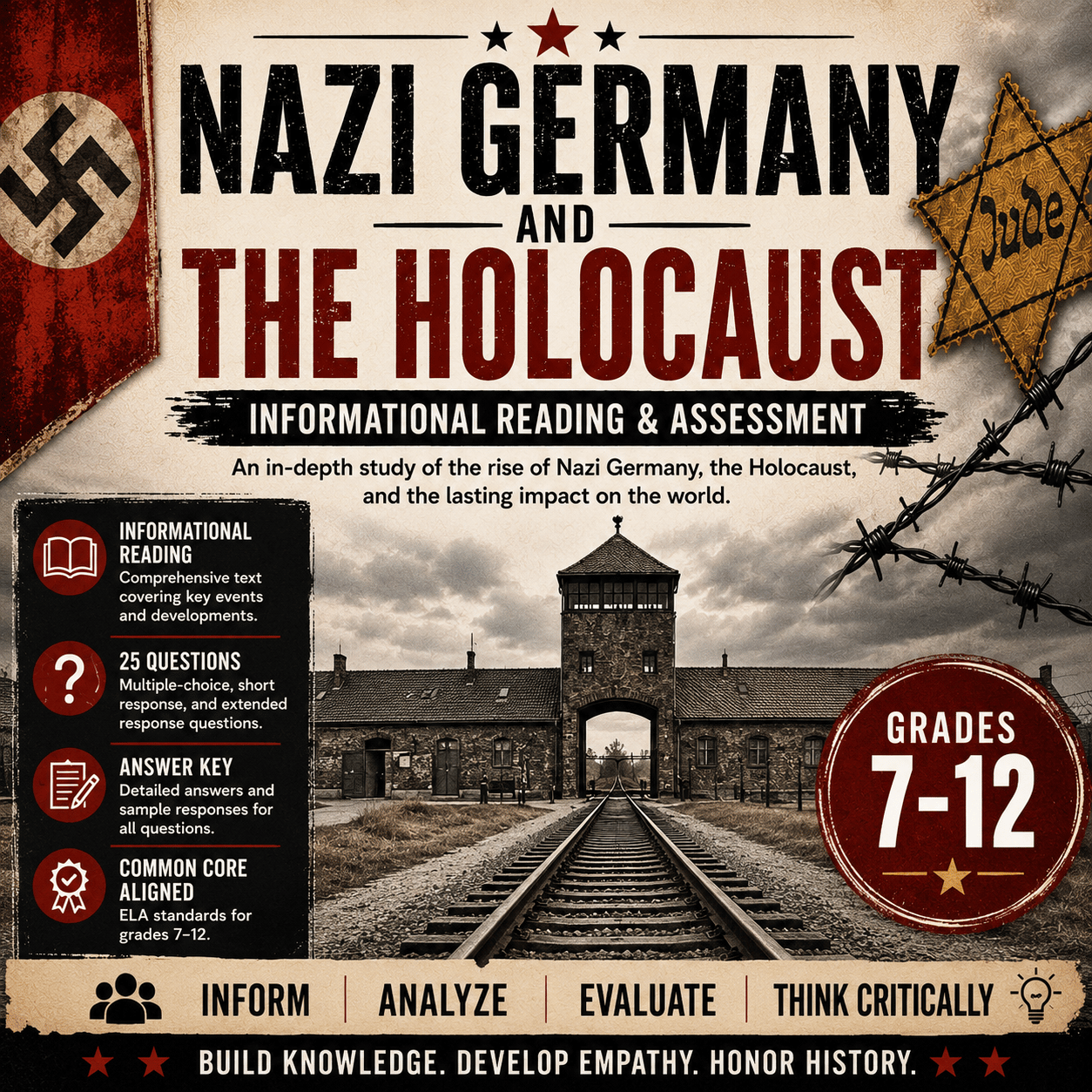
Nazi Germany & the Holocaust Reading Comprehension and Assessment | WWII | Grades 7–12
Nazi Germany and the Holocaust | World War II Informational Text, Reading Comprehension & Assessment
Help students develop a deeper understanding of one of the most significant and tragic periods in world history with this comprehensive Nazi Germany and the Holocaust Reading Comprehension and Assessment Resource for Grades 7–12.
This thoughtfully developed 18-page printable PDF examines the rise of Adolf Hitler and the Nazi Party, the transformation of Germany into a dictatorship, the systematic persecution and murder of six million Jewish people, and the lasting historical significance of the Holocaust.
Designed for middle school and high school World History, Social Studies, ELA, and homeschool instruction, this resource combines historical nonfiction with rigorous reading comprehension, critical thinking, historical analysis, and evidence-based writing.
Students examine how economic instability, political extremism, propaganda, antisemitism, discriminatory legislation, and unchecked government power contributed to the Holocaust while exploring the importance of human rights, justice, remembrance, and individual responsibility.
⭐ WHAT’S INCLUDED
✔ Comprehensive Historical Informational Reading
An in-depth nonfiction passage examining Nazi Germany and the Holocaust, including historical background, major events, persecution, resistance, liberation, and the Holocaust’s lasting legacy.
✔ 25-Question Reading Comprehension & Assessment
- 20 Multiple-Choice Questions
- 3 Short-Response Questions
- 2 Extended-Response Writing Questions
✔ Complete Answer Key
Includes correct multiple-choice answers and detailed sample responses for short-answer and extended-response questions.
✔ Historical Analysis & Evidence-Based Writing
Students analyze historical causes and consequences, evaluate the influence of propaganda and government policies, and construct written responses supported by evidence from the informational text.
✔ Common Core ELA Standards Alignment
Includes a dedicated standards-alignment reference for Grades 7–12, supporting informational reading, writing, speaking, listening, and critical thinking.
⭐ KEY HISTORICAL TOPICS COVERED
Students explore:
Germany After World War I
- The Treaty of Versailles
- Economic hardship and hyperinflation
- The Great Depression
- Political instability under the Weimar Republic
The Rise of Nazi Germany
- Adolf Hitler and the Nazi Party
- The Reichstag Fire
- The establishment of a dictatorship
- Nazi ideology and antisemitism
- Joseph Goebbels and Nazi propaganda
- The Hitler Youth and government control
Persecution and the Holocaust
- The Nuremberg Laws of 1935
- Kristallnacht: The Night of Broken Glass
- Jewish ghettos and forced displacement
- The Einsatzgruppen and mass shootings
- The Wannsee Conference
- The Nazi regime’s systematic genocide
- Concentration and extermination camps
Resistance, Liberation & Remembrance
- The Warsaw Ghetto Uprising
- Individuals who resisted Nazi persecution
- Allied liberation of concentration camps
- The Nuremberg Trials
- Holocaust remembrance and human rights
- The importance of challenging prejudice and discrimination
⭐ SKILLS STUDENTS DEVELOP
✔ Reading comprehension and informational text analysis
✔ Identifying historical cause-and-effect relationships
✔ Analyzing propaganda and political influence
✔ Evaluating historical decisions and consequences
✔ Understanding chronology and historical developments
✔ Making inferences and drawing evidence-based conclusions
✔ Developing analytical and argumentative writing skills
✔ Examining human rights and civic responsibility
✔ Supporting written responses with textual evidence
⭐ PERFECT FOR
- Middle School World History
- High School World History
- World War II History Units
- Holocaust Education and Remembrance
- Grades 7–12 Social Studies
- ELA Historical Informational Text Instruction
- Holocaust Literature Background Lessons
- Homeschool History Curriculum
- Independent Reading and Assessment
- Historical Analysis and Writing Practice
- Cross-Curricular History and Literature Instruction
⭐ IDEAL COMPANION TO HOLOCAUST LITERATURE
This resource provides valuable historical background for students studying literature connected to Nazi Germany and the Holocaust, including:
📖 Night by Elie Wiesel
📖 The Diary of Anne Frank
📖 The Book Thief by Markus Zusak
📖 Maus by Art Spiegelman
Students gain essential historical context that helps them understand the experiences, circumstances, and themes explored in these literary works.
Note: This resource is a historical informational text and assessment, not a novel study. Copies of the literary works are not included.
⭐ WHY TEACHERS WILL APPRECIATE THIS RESOURCE
Meaningful historical instruction with ready-to-use reading and assessment materials.
Teaching the Holocaust requires historical accuracy, sensitivity, and opportunities for thoughtful reflection.
This resource approaches the subject through historical context, factual explanations, and structured comprehension activities that encourage students to examine how discrimination, propaganda, and government policies contributed to genocide.
Rather than focusing solely on dates and historical figures, students explore the consequences of prejudice, the importance of individual responsibility, and the continuing relevance of Holocaust remembrance.
The combination of informational reading, multiple-choice questions, short responses, and extended writing prompts provides educators with opportunities to assess both historical understanding and literacy skills.
📚 RESOURCE DETAILS
Grade Levels: 7–12
Subjects: World History, Social Studies, ELA
Topics: Nazi Germany, Holocaust, World War II, Human Rights
Format: Printable PDF
Total Pages: 18
Assessment Questions: 25
Multiple-Choice Questions: 20
Short-Response Questions: 3
Extended-Response Questions: 2
Answer Key: Included
Standards: Common Core ELA Grades 7–12
Preparation: Print and teach!
Content Advisory: This resource addresses genocide, antisemitism, persecution, discrimination, and mass murder. Educators should review the material before instruction to ensure its suitability for their students.
🌼 305HippieChic | Print. Write. Think. Learn.
Support meaningful Holocaust education through historical understanding, critical thinking, evidence-based analysis, and thoughtful reflection on the importance of human dignity and human rights.