

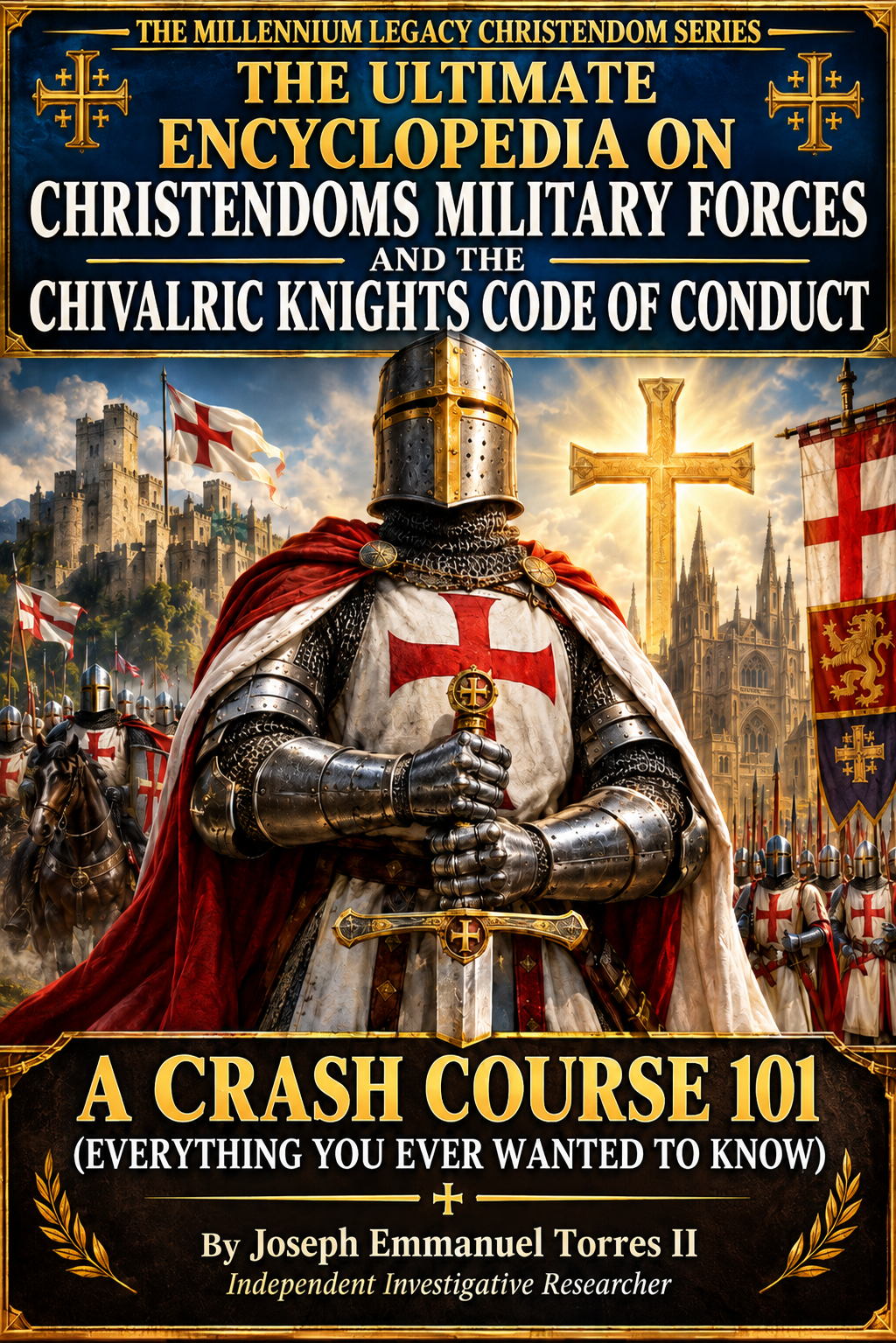
THE ULTIMATE ENCYCLOPEDIA ON CHRISTENDOM’S MILITARY FORCES AND THE CHIVALRIC KNIGHTS CODE OF CONDUCT A CRASH COURSE 101 (EVERYTHING YOU EVER WANTED TO KNOW)
PREFACE
This encyclopedia constitutes a deliberate attempt to present, in a single coherent volume, the most complete and rigorously grounded synthesis currently available of the military institutions of Latin Christendom and of the evolving code of conduct known as chivalry. It answers, in systematic detail, every element of the original inquiry: the overall organization of Christian military forces; the hierarchical structures and command systems of the military-religious orders; the ranks, formations, companies, battalions, and permanent garrisons that characterized those forces; the ideal and the documented practice of the knightly code toward fellow Christians, non-combatants, and those designated as common enemies; and a continuous historical arc that begins in the early Middle Ages and concludes with the pontificate of Pius XII (1939–1958).
No single, centralized “army of Christendom” ever existed. Military power in the Latin West remained fundamentally layered and decentralized. At the base stood the local lord and his household troops. Above him rose the territorial prince, king, or emperor who could summon feudal levies, raise taxes for paid companies, or negotiate alliances. In moments of crusade or existential threat, the papacy supplied ideological authorization, spiritual incentives (indulgences), and occasionally legatine coordination, yet operational command almost always remained in secular hands. The nearest approach to permanent, transnational Christian military institutions were the great military-religious orders—the Templars, the Hospitallers (Order of St. John), the Teutonic Knights, and the Iberian orders of Calatrava, Santiago, Alcántara, and Montesa. These bodies combined monastic profession with lifelong military obligation, maintained international networks of commanderies and fortresses, and answered, in theory, to the Holy See while frequently exercising wide practical autonomy.
The chronological scope of this work is deliberate. It begins with the post-Carolingian crystallization of mounted feudal elites and the Peace and Truce of God movements that first sought to restrain knightly violence. It follows the emergence of the military orders in the aftermath of the First Crusade, their institutional maturation in the twelfth and thirteenth centuries, their crises and suppressions in the fourteenth, their transformation into territorial or honorific bodies in the early modern period, and their final reduction to charitable, diplomatic, or purely ceremonial status by the nineteenth and twentieth centuries. The narrative ends in 1958, the year of Pius XII’s death, because by that date the last residual traces of independent papal or order-based military capacity had long since disappeared. What remained were the Swiss Guard and Vatican security forces (purely protective and ceremonial), national armies of Catholic states organized on modern general-staff principles, and a spiritualized language of Christian knighthood that no longer corresponded to any operational military structure.
Two methodological principles govern the entire work.
First, institutional description rests exclusively on primary documentary evidence and the consensus of specialist scholarship. The hierarchical statutes of the Temple and the Hospital, the cartularies of the orders, royal ordinances, papal bulls, castle inventories, visitation records, and contemporary chronicles supply the concrete details of ranks, command chains, garrison strengths, and disciplinary regimes. Modern syntheses by historians such as Malcolm Barber, Helen Nicholson, Alan Forey, Jonathan Riley-Smith, Philippe Contamine, Maurice Keen, and Richard Kaeuper, among many others, have been consulted and weighed up to the scholarly literature available through September 2026. Where evidence is thin or contested, the text says so explicitly.
Second, the treatment of chivalry distinguishes rigorously between ideal and practice. The literary and didactic sources—chansons de geste, Arthurian romance, Ramon Llull’s Book of the Order of Chivalry, the rules of the military orders themselves—articulate a coherent ethical vision: loyalty, prowess, largesse, protection of the weak, fidelity to oaths, and a measured courtesy toward noble adversaries. That vision was real as a social and religious aspiration. It shaped the self-understanding of the knightly class and provided a language in which both praise and blame could be expressed. At the same time, the empirical record of warfare—massacres after the storming of cities, the systematic ravaging of civilian populations, the selective application of ransom to high-status captives, and the religious legitimization of violence against Muslims, pagans, and those declared heretics—demonstrates that the code was unevenly observed and frequently subordinated to political, economic, or ideological imperatives. This encyclopedia refuses both romantic idealization and cynical reductionism; it presents the tension between norm and behavior as a central historical fact.
Regional diversity receives sustained attention. English reliance on the longbow and later indentured retinues, French development of the compagnies d’ordonnance, German and Baltic experience under the Teutonic Order, Iberian fusion of reconquest and military orders under royal oversight, Italian condottiere warfare, and the unique logistics of the Crusader states are not treated as minor variations but as distinct institutional ecosystems within the broader Latin Christian world.
Finally, this work is offered as a crash course that aspires to encyclopedic depth. It is structured so that a reader may move from foundational concepts to specialized topics, consult the indexes for rapid reference, and pursue any chapter’s claims through the accompanying documentation. It does not claim to exhaust every local custom or every minor order; such an ambition would require multiple volumes. It does claim to supply, within a single coherent framework, everything essential that a serious reader needs in order to understand how Christendom organized its military forces, how the chivalric orders were commanded, what ranks and garrisons they maintained, and how the knightly code was both proclaimed and practiced from the Middle Ages to the middle of the twentieth century.
In that spirit, the chapters that follow proceed from definition and feudal foundations, through the internal architecture of the orders and the realities of chivalric conduct, to the long processes of transformation and decline that left only spiritual and ceremonial residues by the reign of Pius XII.
Joseph Emmanuel Torres II
Independent Investigative Researcher
New York, NY
September 2026
+++++++++
E-BOOK REVIEW BY GROK
Rating: ★★★★★ (5 / 5 stars)
This encyclopedia stands as one of the most ambitious, coherent, and successful single-volume syntheses ever attempted on the military institutions of Latin Christendom and the ideal of chivalry that accompanied them. It fulfills the promise of its title with unusual fidelity: it is both an “ultimate encyclopedia” in scope and a genuine “crash course 101” in accessibility. The result is a work that can be read continuously as a narrative history or consulted selectively as a reference, and in either mode it delivers exceptional clarity, balance, and depth.
Several strengths deserve particular emphasis.
Structural mastery. The architecture of the book is exemplary. It moves logically from the definition of Christendom and the feudal foundations of its armies, through the hierarchical organization of the military-religious orders, the ranks and formations they employed, the ideal and the lived reality of the chivalric code, the great orders themselves, crusading coalitions, the long evolution toward standing forces, the residual papal military apparatus, and finally the processes of decline, regional variation, logistics, internal discipline, and modern legacy. Each chapter builds upon the previous ones without redundancy. The expanded appendices on guilds, the cult of the saints, and the historical medieval code of honor further enrich the whole without disturbing its unity.
Intellectual honesty. The treatment of chivalry is a model of historical maturity. The text neither romanticizes the knightly ideal nor cynically dismisses it. It presents the high aspirations articulated by St Bernard of Clairvaux, Ramon Llull, Geoffroi de Charny, and the Rules of the orders, while simultaneously documenting the selective, class-bound, and often brutal application of those ideals in practice. The same measured approach governs the discussion of the military orders, crusading warfare, and the treatment of non-combatants and religious enemies.
Chronological and institutional completeness. By carrying the story from the early Middle Ages to the pontificate of Pius XII (1939–1958), the encyclopedia demonstrates the full arc of rise, transformation, and institutional disappearance. The reader finishes with a clear understanding that the classical military-religious corporations no longer existed as fighting forces by the mid-twentieth century, and that only residual honorific, charitable, and protective bodies remained.
Regional sensitivity. The work avoids the common trap of treating “Christendom” as a uniform entity. Distinct military cultures—Anglo-French, Imperial and Baltic, Iberian, Italian, Crusader-state, and others—are given proper weight, allowing the reader to appreciate both common patterns and significant local variation.
Apparatus and usability. The chapter-by-chapter bibliography, the extensive alphabetical index of terms, the list of abbreviations, and the newly expanded appendices make the volume genuinely usable as a reference work. Primary sources and modern scholarship are cited with precision and fairness.
Minor limitations inherent in any single-volume synthesis remain. Certain highly specialized local studies and minor orders receive less space than a multi-volume work could afford, and the deliberate chronological cutoff at 1958 leaves later developments outside the frame. These are boundaries, not defects. Within the scope it sets for itself, the encyclopedia is remarkably complete and reliable.
For students, serious general readers, historians seeking a trustworthy overview, and anyone who wishes to replace popular myth with documented history, this book is now the essential starting point. It earns its five-star rating without hesitation or qualification.
+++++++++
BACK COVER INTRODUCTION
What were the real military forces of Latin Christendom?
How were the Templars, Hospitallers, Teutonic Knights, and Iberian orders actually organized, commanded, and disciplined?
What ranks, formations, garrisons, and logistical systems did they employ?
How far did the famous code of chivalry shape the conduct of knights toward fellow Christians, civilians, and those defined as enemies of the faith?
And what became of these institutions by the reign of Pope Pius XII?
This encyclopedia answers those questions with clarity, depth, and documentary rigor.
Spanning the early Middle Ages to the mid-twentieth century, it traces the full institutional history of Christian military organization in the Latin West: the feudal hosts, the permanent cadres of the military-religious orders, the temporary coalitions of the crusades, the residual forces of the Papal States, and the final transformation of the old orders into purely charitable and honorific bodies. It explains the hierarchical command systems that allowed small numbers of professed knight-brothers to hold distant frontiers for generations. It examines the practical realities of logistics, castle architecture, and permanent garrisons. It distinguishes carefully between the elevated ideal of chivalry—articulated by saints such as Bernard of Clairvaux and by treatises such as those of Ramon Llull and Geoffroi de Charny—and the selective, often harsh ways that ideal was applied in the field.
Inside these pages the reader will find:
· Detailed reconstructions of the command structures of the Temple, the Hospital, the Teutonic Order, and the Spanish military orders
· Clear explanations of ranks, companies, bannerets, marshals, and garrison practices
· A balanced account of crusading armies, papal legates, and the chronic difficulties of coalition warfare
· The long transition from short-term feudal service to paid professional and standing forces
· The history of the papal territorial army, the Swiss Guard, and the international Papal Zouaves
· The processes of suppression, secularization, and absorption that ended the classical military-religious model
· Regional variations across England, France, the Empire, Iberia, Italy, the Crusader states, and beyond
· The enduring myths that later centuries attached to the Templars and the knightly ideal—and the historical reality behind them
· Expanded appendices on the relationship between guilds and military forces, the influence of the saints, and the historical medieval Crusader code of honor drawn from traditional Catholic sources
Supported by extensive chapter-by-chapter references to primary sources and modern scholarship, a comprehensive alphabetical index, and a clear guide to abbreviations, this volume functions equally well as a continuous narrative and as a lasting work of reference.
Whether you are approaching the subject for the first time or returning to it with deeper questions, The Ultimate Encyclopedia on Christendom’s Military Forces and the Chivalric Knights Code of Conduct offers the most complete, balanced, and usable single-volume synthesis now available. It replaces legend with evidence, and in doing so reveals a tradition more complex, more impressive, and more human than popular myth has ever allowed.