

Guide on Preparing Your Young Child for Learning (Ages 2–4)
Preparing Your Young Child for Learning (Ages 2–4) Guide for Parents
A Systems-Level Guide to Cognitive, Emotional, and Environmental Readiness
Most “school readiness” advice pushes toddlers too early—and quietly undermines learning.
This guide explains what actually prepares children ages 2–4 to learn later: regulation, executive function, emotional safety, movement, repetition, and environment design—not early academics.
If you want calmer days now and stronger learners later, this is your foundation.
What This Guide Is (And Is Not)
This guide IS:
- A neuroscience-informed, systems-level explanation of how learning readiness develops
- Written for parents, caregivers, microschool founders, and early learning facilitators
- Focused on ages 2–4, before formal academics should dominate
- Grounded in how the nervous system, environment, and adult behavior interact
This guide is NOT:
- A worksheet pack
- A “teach your toddler to read” manual
- A quick-fix behavior program
- A checklist of academic milestones
This is a perspective shift, not a productivity hack.
What You’ll Learn
Inside this 70+ page guide, you’ll understand:
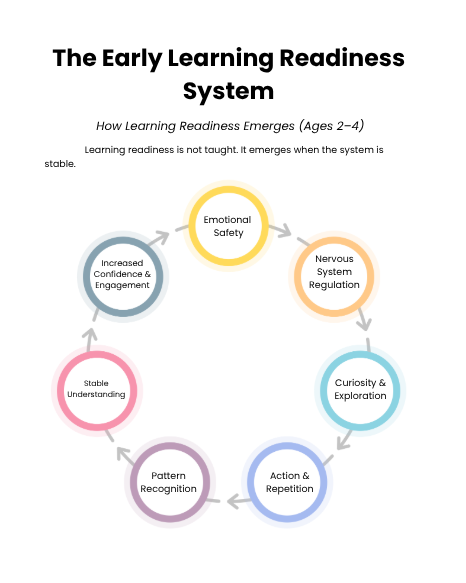
- Why learning readiness is a nervous system state, not motivation or intelligence
- Why regulation always comes before cognition
- How toddlers learn through action → feedback → repetition, not explanation
- Why forcing focus, stillness, or early academics backfires
- How movement, play, and repetition literally build the brain
- Why emotional safety is learning infrastructure—not “gentle parenting fluff”
- How environments silently teach through affordances
- Why rushing creates fragile learners, even when intentions are good
- What prepared children actually look like (hint: not early performers)
This guide reframes “school readiness” as system stability, not early output.
Who This Is For
This guide is ideal if you are:
- A parent of a toddler (ages 2–4) who feels pressure to “do more”
- A caregiver confused by conflicting early learning advice
- A microschool or parent-led program founder
- An educator who wants stronger foundations before academics
- A parent of a neurodivergent child who senses typical advice isn’t working
If you’re asking “Am I doing enough?” — this guide answers that question honestly.
What Makes This Different
Most early learning resources focus on what to teach.
This guide focuses on what must be stable first.
It treats:
- Adults as learning infrastructure
- Environment as silent curriculum
- Behavior as feedback, not defiance
- Play as serious neurological work
- Readiness as durability, not speed
That difference matters long-term.
What You’ll Walk Away With
After reading this guide, you’ll:
- Stop second-guessing your child’s development
- Understand why certain struggles keep repeating
- Know how to design calmer, more effective daily rhythms
- Reduce power struggles without “training” your child
- Build foundations that make later learning easier, not harder
This is how you prepare children to become learners, not performers.
Format & Details
- 📘 Digital PDF download
- 📄 Over 70 pages of structured, parent-readable content
- 👶 Focused on ages 2–4
- 🧠 Research-aligned, systems-based approach
- 🏫 Includes a Microschool Implementation Appendix
- 🌍 Suitable for home, childcare, and parent-led learning environments
Important Notes
- This guide is educational, not medical or therapeutic advice
- Every child develops at their own pace
- No worksheets or child-facing activities are included—this is intentional
- Designed to be read slowly and revisited
If this guide resonates with you, it pairs naturally with:
- Parent readiness checklists
- Calm routine design tools
- Environment setup guides
- Foundational microschool programs
A Helpful Next Step (Optional, Not Required)
If you find yourself thinking:
- “I understand this now… but I want help applying it.”
- “I wish someone would design this system with me.”
- “I don’t want to guess what environments or rhythms to use.”
You may be ready for a structured implementation, not more information.
👉 Early Explorers Virtual Learning Program (Foundations)
This program takes the principles from this guide and builds them into a ready-made system:
- Environment design
- Daily rhythm (not rigid schedules)
- Regulation-first learning foundations
- Minimal screen use
- Parent-led, calm, developmentally aligned structure
This is not live instruction for your child and not worksheets.
It’s a system parents use with their child.
(You’ll find the program linked on McKeeverLearningCenter.com when you’re ready.)
No rush. Read first.
One Last Reminder
If your child is:
- Moving constantly
- Repeating the same activities
- Struggling with transitions
- Unable to “focus” the way adults expect
That does not mean something is wrong.
It means their learning system is still under construction.
You’re now equipped to support that process correctly.
Created by:
McKeever Learning Center, LLC
🌐 McKeeverLearningCenter.com