
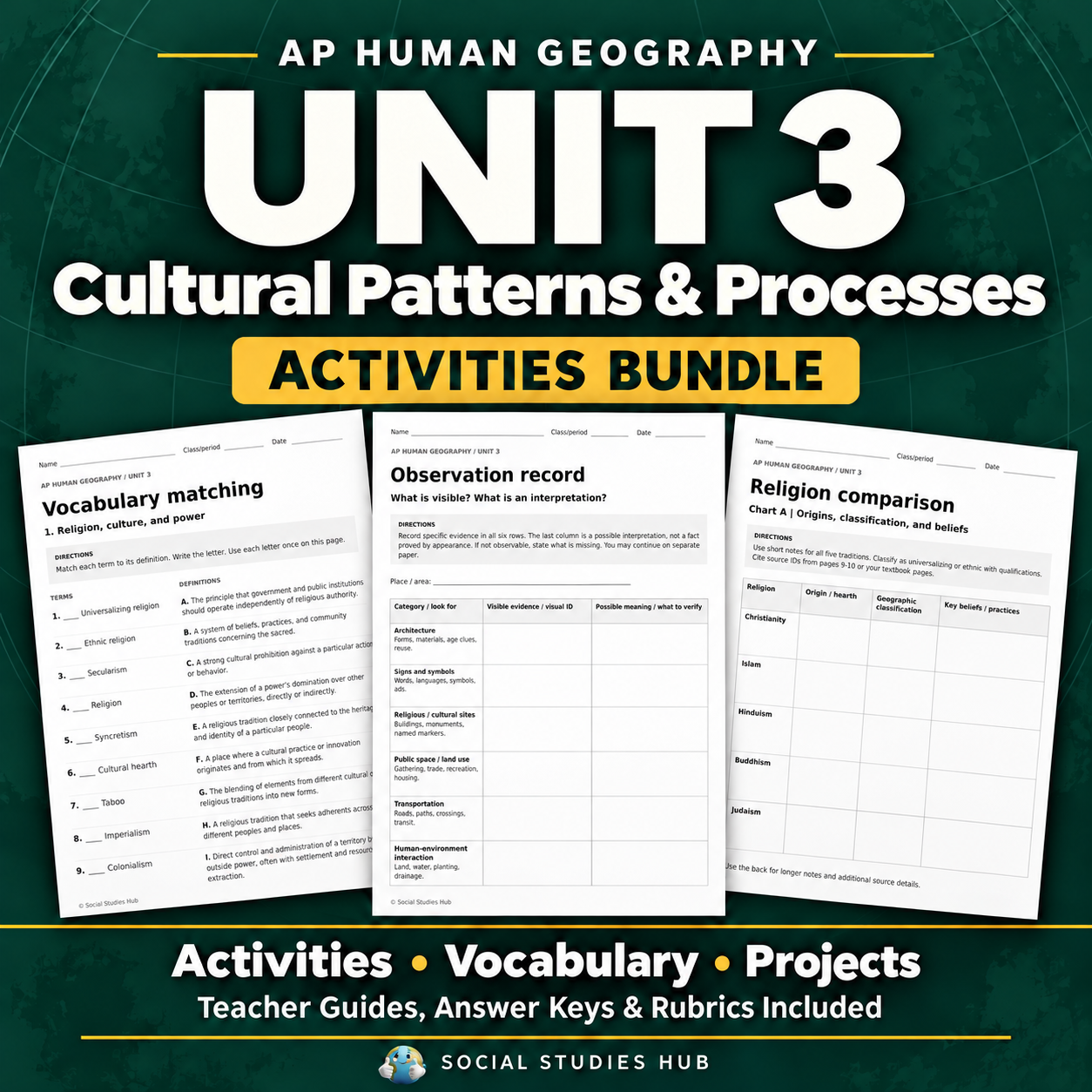
AP Human Geography Unit 3 Activities Bundle: Cultural Patterns & Processes
Help students move from naming cultural traits to explaining what they see. Compare cultural landscapes, investigate language and identity, trace the geography behind team names, or research religious traditions with evidence.
This collection gives you printable activity choices in one consistent format. Use a vocabulary sheet or puzzle for selected review, then choose an observation task, listening investigation or research project when your class is ready to apply the concepts. Teacher directions, answer keys, response guides and rubrics are included where appropriate.
WHAT YOU RECEIVE
Ten separate activity PDFs plus a three-page start-here guide in one ZIP. There are 126 pages total, including 86 student pages. The count includes 30 different bingo boards, planners, optional sheets, reflection pages, teacher directions and keys. It does not mean 86 separate assignments.
EIGHT RESOURCES
• Vocabulary Matching: 42 selected terms across six worksheets, with a complete key and teaching clarifications.
• Cultural Landscape Observation: an observation record, visual-source log, directions for 3-5 labeled visual items and a 300-400-word analysis, plus a rubric and a clearly fictional response model. Local, virtual and teacher-image routes are described; no image collection is supplied.
• Folk and Popular Culture Collage: eight examples, two planners, a 200-300-word explanation and a rubric. Students explain practices in context and may identify supported overlap. Physical and digital options are described.
• Culture Crossword: 28 entries, a clue sheet, an optional word bank, a solved grid and a numbered answer guide.
• Culture Bingo: 30 different boards and 39 terms, with caller definitions and directions. Multiple winners are possible.
• Accents of Identity: three speaker investigations using the same reading passage, evidence records, geographic connections, a reflection and a 100-point rubric. External audio is accessed separately. Teacher-led playback and separate concept-task guidance are described.
• Religion Project: 12 topic choices with scope guidance, research and source planners, timeline/map requirements, a comparative reflection, a 3-5-minute presentation plan and a 100-point rubric. A still-image/script option can replace the short media excerpt. Students describe practices academically rather than perform worship.
• Exploring Culture through TED Talks: eight linked options, an optional evidence planner, three reflection sheets, teacher response guidance, four optional extensions and a 100-point rubric. Students choose three approved talks and write 200-300 words about each. English transcript use receives equal credit.
TWO REVISED CLASSROOM EXTRAS
• Religion Comparison Chart: five traditions, seven comparison fields and five geographic questions, with possible answers and linked sources. Distribution examples are explicitly dated to 2020 estimates published in 2025.
• Name That Team: ten teams, three relocation cases, research records, reflection questions, checked historical examples and a rubric.
The original Religion Chart and Name That Team are available in the Social Studies Hub free resource library. These revised versions are included for convenience and added teaching support; the underlying activities are not exclusive to this paid collection. Free library: https://socialstudieshub.com/free-resource-library/
BEFORE ASSIGNING THE MEDIA TASKS
Audio recordings, TED videos/transcripts, photographs, maps and found media are not included or licensed by this purchase. Use the linked sources or teacher-provided materials and test access on your school network. Accents of Identity uses the Speech Accent Archive. Its guide describes a separate concept alternative if listening is inaccessible; a teacher must supply suitable profiles for that option.
The TED task has seven default options. Rives, The Museum of Four in the Morning, is an additional teacher-approved choice because it includes profanity and adult-entertainment references. Preview any selection before assigning it. Students never have to choose Rives. The guide supports English transcripts as an alternative to viewing.
FORMAT AND PLANNING
Printable PDFs in a ZIP file; U.S. Letter, 8.5 x 11 inches. Open with a standard PDF reader. Start with Actual Size / 100%; use Fit if your printer clips the edges. Student pages are grayscale. The start-here guide lists print ranges and which rubrics to share. Bingo needs counters or a pencil. Research tasks need credible sources, and visual projects need drawings or appropriately credited images. Teacher-provided readings/images and paper options are described where relevant. Editable slides, source files and image packets are not supplied.
CHECK BEFORE BUYING
If you previously purchased the Social Studies Hub Unit 3 activities collection or a full Unit 3 bundle on TPT, many underlying activities overlap. This is a revised edition, not an entirely new set. Religion Chart and Name That Team also have earlier free versions as disclosed above.
This is an activities bundle. Slides, guided notes, a study guide and an exam are not included. The collection is selected practice rather than exhaustive coverage of every Unit 3 objective, a complete curriculum or a set of official AP exam questions.
USE AND SUPPORT
For use in one classroom. Do not sell, redistribute or post the complete files publicly. Questions: mike@socialstudieshub.com.
AP is a trademark of College Board, which does not sponsor or endorse this resource.