
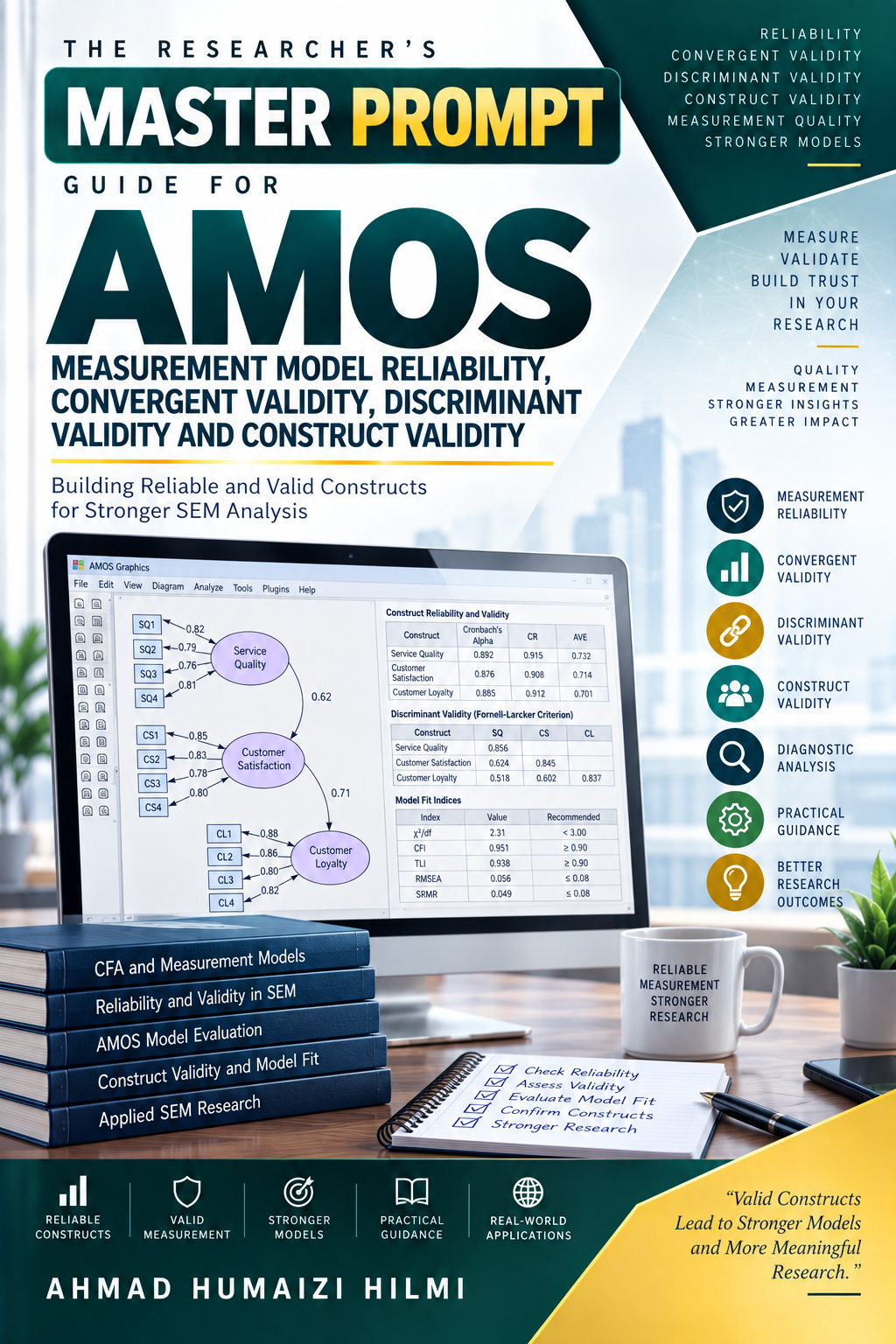
AMOS-VAL-005 — Measurement Model Reliability, Convergent Validity, Discriminant Validity and Construct Validity
Description
This Master Prompt focuses on determining whether latent constructs used in an AMOS model demonstrate adequate measurement reliability and validity before structural hypotheses are tested. It guides researchers in evaluating indicator reliability, internal consistency, Cronbach’s alpha, composite reliability, standardized CFA loadings, average variance extracted, convergent validity, discriminant validity and overall construct validity while integrating these statistics with the theoretical meaning and measurement structure of each construct.
A major emphasis is placed on treating reliability and validity as cumulative measurement-quality evidence, not as isolated numerical thresholds. The uploaded literature demonstrates this logic clearly. One study evaluates CFA factor loadings, composite reliability and AVE and then assesses discriminant validity through both the Fornell–Larcker criterion and HTMT. In the same study, CR values above 0.70 and AVE values above 0.50 are used together with standardized loadings as convergent-validity evidence, while construct distinctiveness is examined using both Fornell–Larcker and HTMT. Another uploaded application explicitly treats construct validity as encompassing face, convergent and discriminant validity.
The theme therefore requires researchers to examine whether observed indicators consistently represent their intended latent constructs, whether sufficient indicator variance is captured by those constructs, whether theoretically separate constructs remain empirically distinguishable and whether the overall measurement model is sufficiently credible to support subsequent SEM analysis. The uploaded studies also demonstrate the importance of completing measurement reliability and validity evaluation before proceeding to structural hypothesis testing.