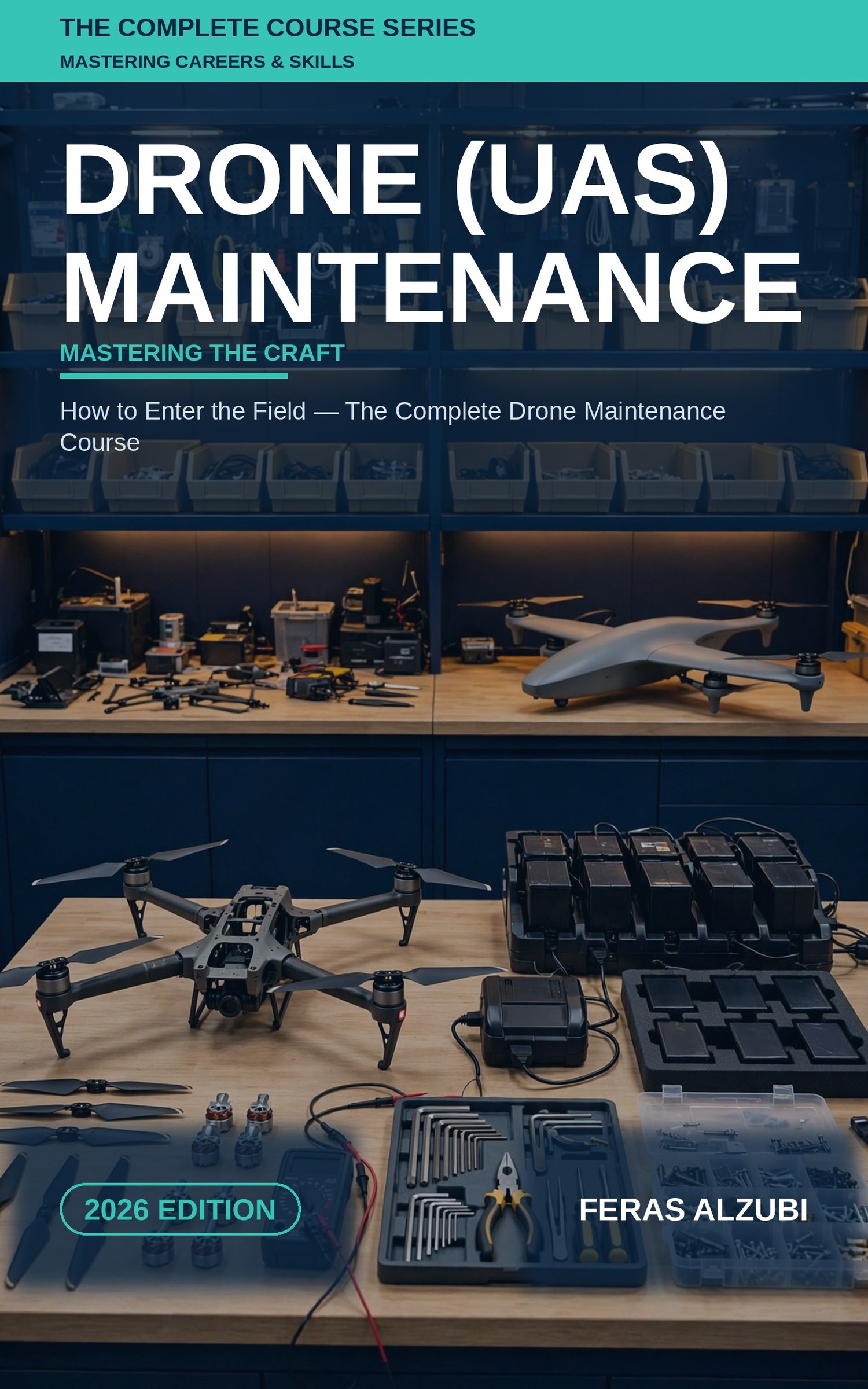
Drone (UAS) Maintenance: Mastering the Craft
Drone (UAS) Maintenance: Mastering the Craft — How to Enter the Field
850 fully explained practice items · a 50-item readiness diagnostic scored by strand · 50 guided maintenance case files · 120 strand repair items · 50 labeled figures (30 photorealistic plates verified part by part against reference dossiers) · a 352-entry glossary · study plans, cheat sheets, and coverage crosswalks.
What this book teaches. The complete course for drone (UAS) maintenance — the craft of inspecting, maintaining, repairing, and recording unmanned aircraft so a fleet can fly safely across hundreds of flights: what an unmanned aircraft is and how it flies, the electricity and digital systems that make it work, its airframes and structures, its propulsion and flight batteries, its flight controllers, navigation sensors, control links, and firmware, the inspection program that keeps a fleet airworthy, the records that are the fleet's memory, the diagnostic method that isolates faults from evidence, and the ground-or-fly judgment that is the craft's summit. It teaches the whole field — from zero, with no assumed background — as one system of three objects: the aircraft, the fleet, and the record. 42 chapters — 128,586 words of chapter prose — in nine parts: I The Field and Its Doors; II Foundations: How the Aircraft Works; III Airframes and Structures; IV Propulsion and Power; V Flight Control, Avionics, and Software; VI Inspection and the Program; VII Diagnosis and Repair Practice; VIII Fleet Practice, Safety, and Compliance Literacy; and IX Judgment, Ethics, and the Road. One specimen operator carries the teaching end-to-end — Hill Country Aerial Services, a fictional operator with its fleet, its inspection program, its batteries, and its events — and its inspections, battery retirements, fault isolations, and return decisions are worked as real artifacts.
There is NO FAA licence and NO FAA maintenance examination for UAS maintenance practice — this book says so plainly, and it prepares the reader for no examination of any body. Technicians are hired by employers — operators, fleet owners, service providers, manufacturers' service networks — on knowledge, workshop craft, and record discipline. The pilot framework the technician works inside is named exactly: the Remote Pilot Certificate with a small UAS rating, issued by the FAA under 14 CFR Part 107, is a pilot certificate — it certifies the person flying the aircraft; it is not a maintenance licence, and the pilot-exam preparation for that certificate belongs to a different book in this series. A baseline for this craft exists, and the designation landscape is signposted in Chapter Forty-Two in its cleared form only: ASTM International publishes ASTM F3600-22, Standard Guide for Unmanned Aircraft System (UAS) Maintenance Technician Qualification — a guide, under ASTM Committee F46, for assessing the competencies of individuals who wish to become certified as a UAS Technician through a certification program. The Unmanned Safety Institute (USI) states that it is an ASTM Approved Training Provider for UAS and that its curriculum is aligned to ASTM F3600; USI offers its own UAS Maintenance Technician Designation, which includes USI's Safety Level 1 and Safety Level 2 Certifications. That designation is voluntary; it is not an FAA licence or FAA maintenance credential, ASTM does not issue it, and this book prepares the reader for no designation. FAA Part 108 is, at this book's edition date (verified 2026-11-09), a proposed rule only — a notice of proposed rulemaking titled "Normalizing Unmanned Aircraft Systems Beyond Visual Line of Sight Operations" (90 FR 38212, August 7, 2025) that has NOT been adopted as a final rule; no final rule has been published and Part 108 is not in effect. Chapter Forty-One teaches it as a watching brief, in the conditional mood, labeled proposal content at every point.
Who it is for. The reader entering UAS maintenance work from zero; the working technician who wants the whole craft — airframes, propulsion, batteries, avionics, inspection program, records, and diagnosis — taught as one connected system; and the fleet operator's maintenance hand who needs the method, the program discipline, and the ground-or-fly judgment, stated honestly, with no licence or examination promised where none exists.
What's inside (every count verified against the actual book):
- 42 chapters in nine parts — 128,586 words of chapter prose
- 850 practice items, every one fully explained — why the key is right and why each wrong option is wrong
- A 50-item readiness diagnostic before the opening chapter, scored by strand (Foundations / Airframe, Propulsion & Power / Avionics, Software & Logs / Program, Inspection & Records / Fleet, Safety & Judgment) with a readiness tracker, so you start where you actually stand
- 630 chapter exercises — fifteen close every chapter
- 50 guided maintenance case files in two batteries: situation, evidence, a reasoning chain, and a conclusion — the craft taught as reasoning, never as recipe
- 120 strand repair items in eight strand sets that close the gaps the diagnostic finds
- 50 labeled figures at their teaching points: 30 photorealistic plates of the technician's physical world — the maintenance bay whole, the technician bench ensemble, the multirotor inspection aircraft, the battery-and-charger bench, the propulsion set and propeller families, the battery lifecycle and safety stations, the flight-controller stack, the record station, and the fleet row — each verified feature by feature against a reference dossier, with no people, no hands, no readable document or screen text, and no brand nameplate in any plate; and 20 diagrams whose subjects are diagrams by nature: the maintenance system map, the three frames map, the electrical quantities diagram, the battery lifecycle diagram, the interval timeline, the fault-isolation flow, and the ground-or-fly decision diagram
- A 352-entry glossary, study plans, cheat sheets, and coverage crosswalks
Honesty and limits. This book teaches the knowledge, method, and reasoning of UAS maintenance for education. It confers no authority: no licence, no sign-off power, and no return-to-service authority is created by reading it, and it teaches no flight — test and verification activity is taught as ground and bench method. It is not a substitute for a manufacturer's maintenance instructions for any real aircraft, for a designation body's own published requirements, for the current text of any statute or regulation, or for an operator's own program; procedures are taught as generic method, and the aircraft manufacturer's current instructions and the responsible operator's own program govern any real aircraft. On pay, the book's standing position prints in place of any figure: the U.S. Bureau of Labor Statistics publishes no occupation for UAS (drone) maintenance technicians in the Occupational Outlook Handbook, and this book prints no pay figure for this field — the nearest published occupations are certificated manned-aircraft occupations whose pay is not the pay of UAS technicians and is not a promise of any reader's pay. No score in this book converts to any other test's score or predicts any credential result. Nothing here guarantees a job, an interview, a promotion, a credential, a licence, or income — it guarantees a complete, accurate map of the field and the knowledge the doors reward.
Read the first chapter free — the sample on this page is Chapter 1 of this book, exactly as it appears in the full edition.
From the Mastering Careers & Skills library — complete A-to-Z professional teaching books for careers, trades, and certifications.
An independent study guide. Not affiliated with, endorsed by, or approved by the Federal Aviation Administration (FAA), ASTM International, or the Unmanned Safety Institute (USI).
Refunds: Please read the free sample chapter before you buy. This is a digital ebook, delivered instantly by download. If the file is defective, or you cannot open or download it and we cannot fix the problem, you will receive a full refund — email us within 14 days of purchase. Because the book is delivered instantly as a downloadable file, all other sales are final.
How to read this book (EPUB format): After checkout, download the EPUB file, then open it in any free ebook reader app. On iPhone or iPad: Apple Books — it is already on your device. On Android phones and tablets: Google Play Books (free: https://play.google.com/store/apps/details?id=com.google.android.apps.books) — upload the file in the app — or ReadEra (free). On a Windows or Mac computer: Thorium Reader (free: https://thorium.edrlab.org) or Adobe Digital Editions (free). On Kindle: use Amazon's free Send to Kindle (https://www.amazon.com/sendtokindle) to add the file to your Kindle library.