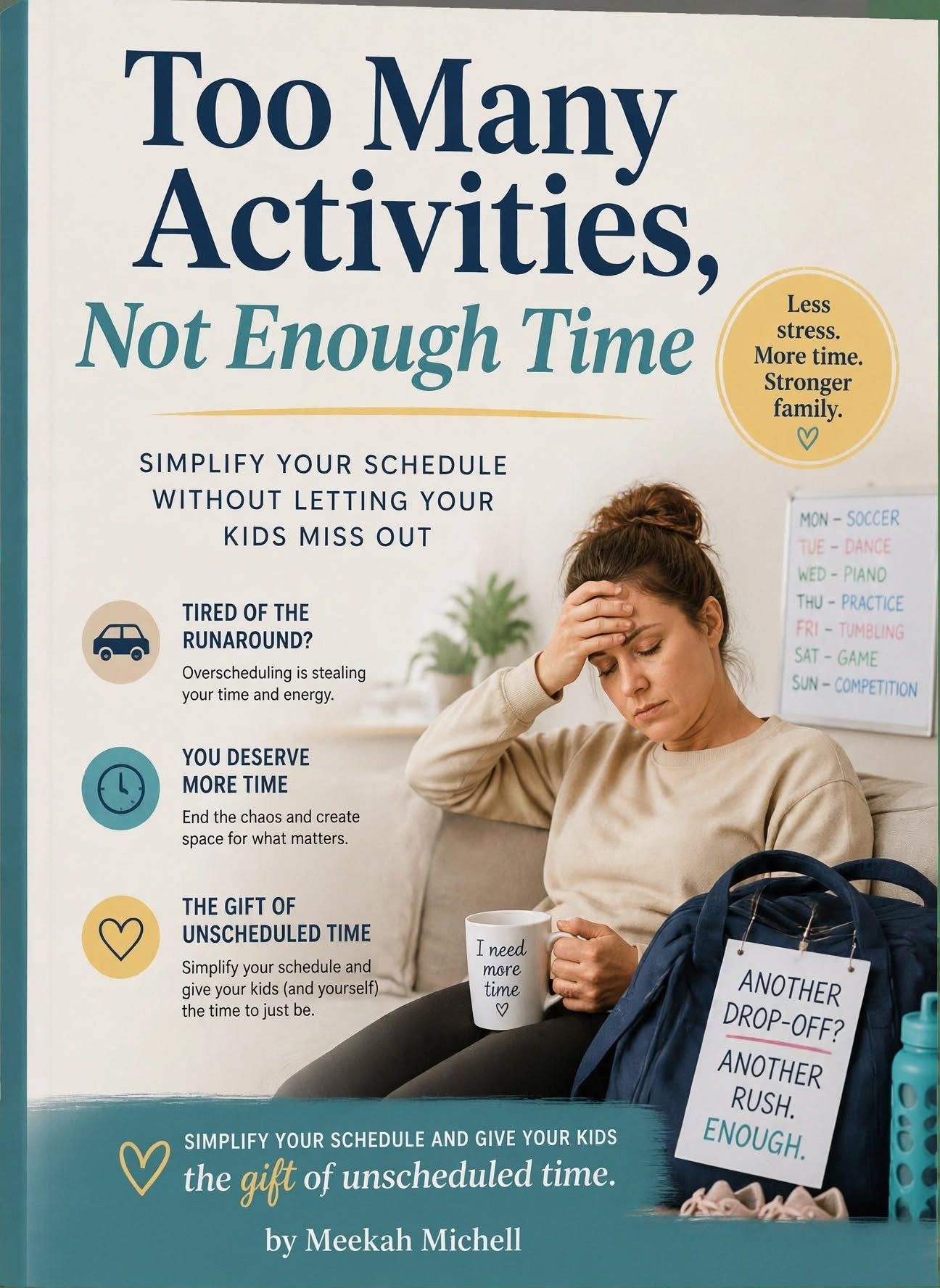
Too Many Activities, Not Enough Time
You Know the Backseat of Your Car Better Than Your Own Living Room. That's Not Parenting. That's a Shuttle Service.
WHAT THIS IS
This is not about quitting everything. It is not about pulling your kids out of every club and locking them in the garden. It is about something harder and more honest: looking at your family schedule and admitting that you are running a system no one designed, no one is enjoying, and no one can sustain. Every individual activity makes sense. Swimming is a life skill. Music builds discipline. Sport keeps them healthy. You are not making bad choices. You are making too many good ones at the same time.
Inside, you'll find:
• **The Accumulation Problem** — Nobody wakes up and decides to overschedule their family. It happens in small moments. A friend mentions a class. A flyer comes home in the book bag. Your child says they want to try karate. Your mum says, "I never had these opportunities." One activity costs an evening. Two cost two evenings. Three across two children cost your whole week. Each one looks small. Together, they are your life.
• **The FOMO Parenting Trap** — "What if she would have loved gymnastics?" "What if he falls behind because everyone else is doing extra maths?" Fear of Missing Out drives more overscheduling than genuine interest ever did. You sign them up not because they are begging, but because you are scared. And underneath every "What if they miss out?" is a deeper question: "Am I doing enough?" No amount of activities will answer it.
• **The Activity Audit** — Before you change anything, see what you are actually doing. Not what you think. What is really on the calendar, including travel time, kit preparation, waiting, emotional recovery. Most families discover their real schedule is thirty to fifty percent bigger than they thought. The audit gives you the truth. Then you get to choose.
• **What Kids Actually Need** — The research is clear. Children do not need a packed schedule to thrive. They need safety, connection, play, and rest. Unstructured time teaches them to entertain themselves, resolve conflicts, follow their own curiosity. Boredom is not a problem to solve. It is a skill to develop.
• **The Cost of Constant Motion** — Financial: fees, kit, fuel, parking, snacks, fundraisers. Physical: exhaustion, rushed meals, no time to cook. Emotional: short tempers, guilt, resentment. Relational: no time for family meals or talking. Developmental: no room for free play or creativity. The breaking point — the morning you cry in the car park, the evening your child says "I don't want to go" — is not failure. It is information.
• **Scheduling White Space** — The intentional absence of plans. At least two evenings per week with nothing scheduled. One full weekend day per month as a no-plans day. Never book back-to-back activities without a gap. When someone asks to fill the gap, say "We already have plans" — the plan is rest.
• **The Art of Subtracting** — Adding feels productive. Subtracting feels like loss. But subtraction is where the relief lives. The one-in-one-out rule: before adding anything, subtract something first. Pausing is not quitting forever — most activities will still be there when you are ready.
• **Saying No Without Guilt** — Scripts for the school gate, the grandparent, the partner, and your own brain. "We are doing less this term and seeing how it feels." No justification required.
• **Coordinating Multiple Kids** — Cluster activities by location and day. One parent, one drop-off run. Protect overlap time where siblings are actually home together — that is where the sibling relationship is built, not in separate cars going to separate clubs.
• **The Gift of Boredom** — Children who complain of boredom within two weeks of simplifying are not suffering. They are in withdrawal from constant stimulation. Within a month, they start making things up. That is creativity being born.
• **Family Time Is an Activity** — Pizza and a film is an activity. A walk after tea is an activity. Sitting on the sofa being available is an activity. Put it on the calendar. Give it a name. Protect it like you would protect swimming.
• **Building Your Sustainable Rhythm** — The six rhythm rules including: no new commitments in the first two weeks of any term, every activity gets a one-term probation, if it causes more than two bad evenings per week it goes. Plus the seasonal check-in: What did we enjoy? What did we dread? What do we want more of?
Your kids don't need every activity. They need you, rested.
WHO THIS IS FOR
This is for the woman who:
• Knows the backseat of her car better than her own living room because she spends more time driving to clubs than being at home
• Has a colour-coded calendar and no free evenings until half term — and cannot remember volunteering for any of it
• Has snapped at her child in the car because she is rushing, then felt sick about it, then done the same thing the next day because the schedule does not care about guilt
• Looked at another family at the school gate and thought "What am I not doing?" — without seeing the exhaustion behind their front door
• Pays hundreds of pounds a month in fees, kit, fuel, and snacks but has never once added it up because she is afraid of the number
• Cannot remember the last time she ate dinner with her family at a table instead of in the car between pick-ups
• Has a partner she exchanges logistics with but not actual conversation, because every evening is a relay race
• Has heard her child say "I don't want to go" and said "We are already here" because the term is paid for and the guilt of quitting is louder than the child
• Feels the specific, quiet shame of knowing her family is running a system nobody enjoys — but cannot see a way out without someone calling her lazy
• Signs her child up for things out of fear — fear of them falling behind, fear of being the only parent not doing enough, fear that rest means she does not care
• Wants a life where an evening with nothing on the calendar feels like relief, not anxiety
If you have ever cried in a school car park because you cannot find the right kit and you are already late and this is not what you thought family would feel like — this is for you. The breaking point is not failure. It is your family telling you the load is too heavy.
WHY YOU SHOULD BUY THIS
You think the problem is that you need better time management, or a bigger car, or a more understanding partner. The problem is that you are running a logistics company with no breaks, no pay, and no end in sight — and you have been told to be grateful because at least your kids are busy. Nobody did the maths before you signed up. You saw a flyer and thought "It's only one hour a week" and you were technically right. But one hour a week is never just one hour. It is the getting ready, the getting there, the waiting, the getting back, the washing, the finding of the lost sock, and the argument about whether they are going next week. That is the real cost. And it is eating your family alive. Simplifying your schedule is not giving your children less. It is giving them something that no club can replace: a parent who is present, a home that has room to breathe, and a childhood that includes both effort and emptiness. The life you are making room for is not smaller. It is deeper. It is the difference between a scrapbook of achievements and a life that actually felt good while it was happening.
✅ You stop running a shuttle service and start living in your own house again
✅ You stop signing your child up out of fear and start choosing what they actually love
✅ You break the FOMO cycle — the voice that says "what if they miss out" loses its grip when you see what they gain instead
✅ You give your children something no activity can provide: a parent who sits on the sofa and is available, not already checking the clock
✅ You discover that boredom is not the enemy — it is where creativity is born
✅ You build a rhythm that survives the real world — bad weeks, birthday parties, and the constant pull of more
Your children will not remember every club. They will remember the evening you said, "We are not going anywhere tonight. We are just here."
WHAT'S INCLUDED
• 15 chapters plus introduction and conclusion — covering the full journey from understanding why you overschedule to building a rhythm that lasts
• Why We Sign Them Up for Everything — the accumulation problem and the maths nobody does before signing up
• The FOMO Parenting Trap — fear of missing out, the comparison treadmill, and the worth problem underneath
• What Kids Actually Need — the research on free play, unstructured time, and what your child would tell you if they could
• The Activity Audit — step-by-step protocol including the activity table with columns for your child's interest, your stress, time conflicts, and decision
• The Cost of Constant Motion — the full cost breakdown: financial, physical, emotional, relational, developmental, plus the breaking point
• Scheduling White Space — how to build it in, the five rules, what white space looks like vs. what guilt calls it
• The Art of Subtracting — why subtracting feels like loss but lives where the relief is, the one-in-one-out rule, and pausing vs. quitting
• Saying No Without Guilt — scripts for the school gate, grandparents, partners, and your own brain
• Coordinating Multiple Kids — clustering by location and day, one-parent runs, protecting sibling overlap time
• The Gift of Boredom — the withdrawal period, what emerges after, and why children who are never bored never learn to create
• When Other Parents Judge — the specific shame of doing less in a culture that rewards more, and how to hold the line
• Family Time Is an Activity — putting rest and connection on the calendar with a name and the same protection you give clubs
• Building Your Sustainable Rhythm — the six rhythm rules, the seasonal check-in, and your full maintenance schedule with time estimates
• When You Need More Support — recognising when overscheduling is coping, not parenting, and where to turn
• The Life You Are Making Room For — what simplified families actually discover, and the withdrawal period that comes first
• Frequently Asked Questions — falling behind, genuinely gifted children, partner disagreements, existing commitments, and crisis weeks
• Complete professional support resource list (UK helplines and organisations)
• Chapter-by-chapter reflection questions, journal prompts, and "3 Quick Things" action steps
Your kids don't need every activity. They need you, rested. Get the framework and take back one evening this week.
Get the activity audit and clear two nights on your calendar by next term.