
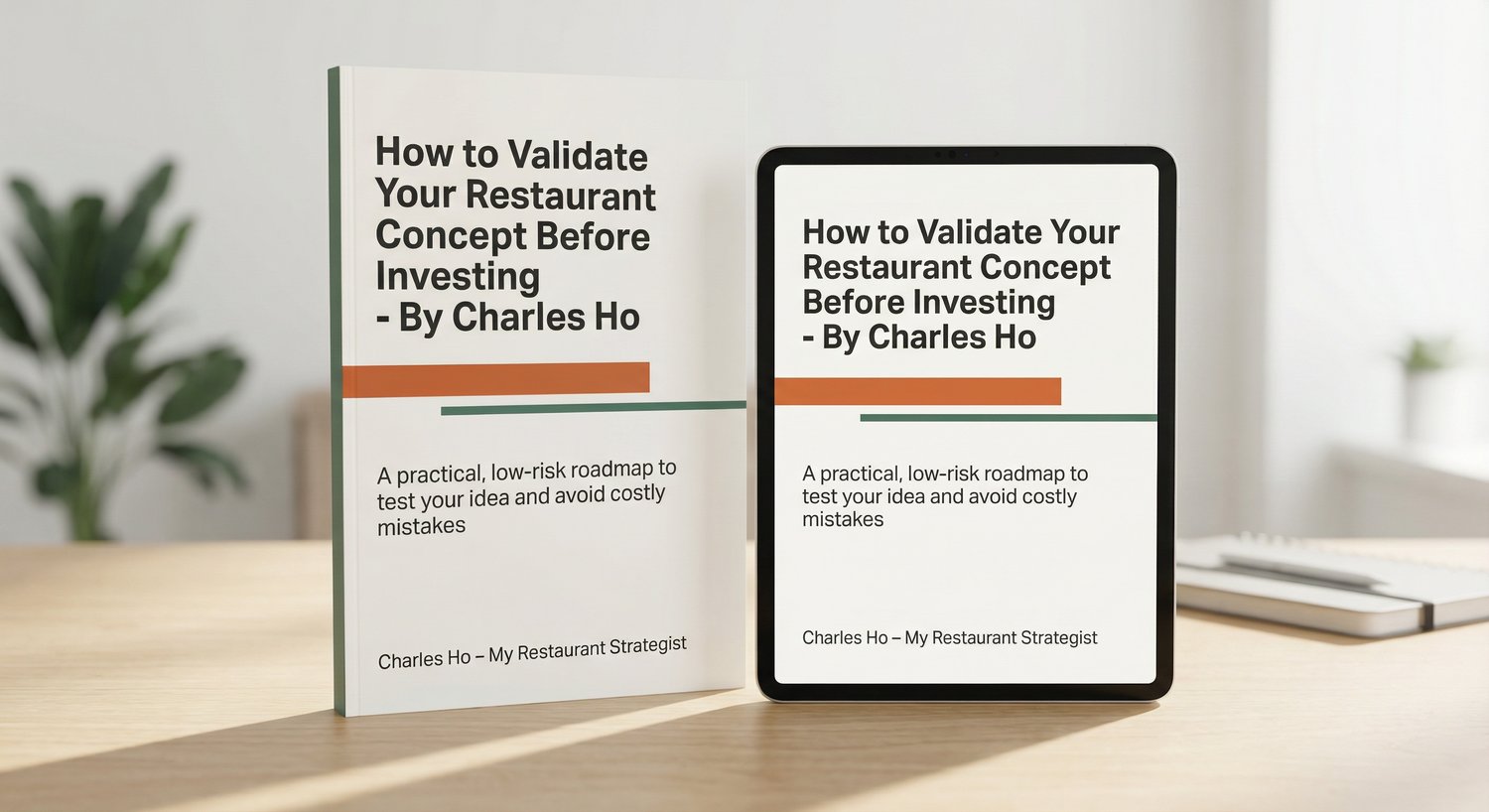


How to Validate Your Restaurant Concept Before Investing
How to Validate Your Restaurant Concept Before Investing – By Charles Ho
Stop Guessing. Start Proving Your Restaurant Concept Will Actually Work.
Most restaurant failures don’t happen because the food is bad.
They fail because the owner jumped in blind—no real validation, no hard data, just vibes and ego.
This guide shows you, step-by-step, how to prove your concept has real demand, solid economics, and operational reality before you sign a lease, borrow money, or burn through your savings.
If you’re serious about opening a restaurant (or not losing your shirt), this is the manual you should read before you spend a single major dollar.
This Guide Is For You If:
- You’re a first-time or aspiring restaurant owner who wants to do this once and do it right.
- You have a concept in mind—café, fast-casual, full-service, food truck, ghost kitchen—and you want to know:
“Will this actually work where I want to open?”
- You’re willing to be brutally honest with yourself, follow the numbers, and adjust based on what the market tells you.
- You want a clear roadmap from “interesting idea” to “validated, fundable, and launch-ready concept.”
This Is Not For You If:
- You’re just looking for someone to tell you your idea is amazing, no matter what the data says.
- You plan to open purely on passion and “hope it works out.”
- You’re unwilling to test, track, and adjust based on feedback and numbers.
What You’ll Learn Inside
1. The Real Reason Restaurants Fail – And How Validation Fixes It
- Why 60% fail in the first year and 80% within five years, and what those numbers actually mean.
- The difference between a nice idea and a validated concept with real demand.
- How to use validation as your insurance policy against six-figure mistakes.
2. Defining a Sharp, Bankable Restaurant Concept
You’ll clarify your concept so it’s more than: “I want to open a cute place that serves good food.”
You’ll nail down:
- Cuisine Type:
- Italian, Mexican, fusion, vegan, comfort food, etc.—and what that means competitively.
- Service Style:
- Fine dining, casual, fast-casual, counter service, food truck, ghost kitchen.
- Ambiance & Experience:
- Rustic vs. modern, cozy vs. upscale, family-friendly vs. adult-focused.
- Target Market:
- Who exactly you’re serving—and why they should care.
You’ll see how a well-defined concept:
- Attracts the right customers (and repels the wrong ones).
- Makes your restaurant memorable instead of generic.
- Simplifies your marketing and supports higher pricing and better margins.
3. Market Research That Actually Tells You the Truth
You’ll learn how to replace wishful thinking with real data using:
- Industry Trend Research
- How to mine reports from the National Restaurant Association and trade publications so you’re not swimming against macro trends.
- Local Market Data
- How to use Census data, local economic reports, and foot traffic patterns to see whether your area can support your concept.
- Consumer Behavior Insights
- What your future customers are already doing, eating, and spending money on—and how to align with that.
You’ll understand:
- Quantitative methods: surveys, foot traffic counts, sales data, social media analytics.
- Qualitative methods: interviews, focus groups, review mining, and observation.
And you’ll learn how to triangulate these so you’re not relying on one flattering data point while ignoring everything else.
4. Competitive & Location Analysis: Finding Your Gap
You’ll map out your real competitive landscape and avoid opening as “yet another place” in a saturated category.
Inside you’ll get:
- A framework for identifying direct and indirect competitors, including non-restaurant options (meal kits, grocery prepared foods, delivery platforms).
- A simple, structured way to:
- Analyze menus, pricing, service style, ambiance, and reviews.
- Spot what they do well, where they’re weak, and where the gaps are.
- A location checklist to evaluate:
- Foot traffic quality (not just quantity).
- Visibility & accessibility.
- Demographic fit with your target market.
- Competition density—when clustering helps and when it kills you.
Real-world examples show how demographic mismatch and bad location decisions sink concepts that otherwise should have worked.
5. Building and Testing Your MVP (Minimum Viable Product)
This is where the guide earns its keep.
You’ll learn how to test your concept without signing a 10-year lease or blowing $300K+ on a buildout, using formats like:
- Pop-up dinners
- Food truck runs
- Farmers’ market booths
- Shared/commercial kitchen service
- Ghost kitchen / delivery-only concepts
- Catering or corporate trials
You’ll learn to:
- Design a focused MVP menu (5–8 items) that represents your concept without overcomplicating operations.
- Set clear success metrics before you start (sales, food cost %, repeat rate, satisfaction scores, etc.).
- Prepare data collection tools (surveys, QR codes, POS reports, staff feedback logs).
Then you’ll get a full breakdown of:
- How to measure MVP performance (quantitative + qualitative).
- How to interpret the data honestly—when to persevere, iterate, or pivot.
The goal: Learn fast, cheap, and with much less risk.
6. Surveys & Customer Feedback That Don’t Lie to You
You’ll get a practical playbook for using surveys and feedback properly, including:
- The right 5–7 questions to ask (and what not to ask).
- How to measure:
- Willingness to pay
- Likelihood to return
- How you compare to “where else they would have gone”
- How to deploy surveys for maximum response (QR codes, post-meal email, social).
You’ll see a detailed case study where a “throwaway” vegetarian item became the winning differentiator—and how the data forced a smart pivot that made the business.
7. Financial Validation: Making Sure the Numbers Actually Work
This chapter walks you through the boring-but-critical math most first-timers ignore:
You’ll learn:
- The real startup costs you need to plan for (not the fantasy numbers).
- How to build realistic revenue projections using seats, average check, and turnover.
- What healthy COGS, labor %, and prime cost actually look like—and how to hit them.
- The essential KPIs (Key Performance Indicators) you must track even during MVP:
- Average check size
- Table turnover
- Customer retention
- Prime cost %
You also get an overview of a first-year financial projection model and how to use your MVP data to avoid delusional forecasting.
If your concept looks great emotionally but fails mathematically, this section will expose that—before you sign anything.
8. Branding, Marketing & Concept Message Validation
You’ll learn how to test whether your:
- Name
- Visual identity (logo, colors, look & feel)
- Tagline and core messaging
…actually land with your target customers.
You’ll see how to:
- A/B test names and visuals.
- Use social media and small ad spends to gauge real interest.
- Build early buzz, email lists, and pre-launch followers as part of the validation process, not as an afterthought.
9. Operational Feasibility, Legal & Regulatory Reality Check
You’ll walk through:
- Whether your menu and service model are operationally realistic at scale (not just for one cute pop-up).
- How to simplify for speed, consistency, and training.
- The health, zoning, licensing, alcohol, building code, and ADA issues that can quietly kill your project if you ignore them.
You’ll get practical advice for:
- Meeting with health and planning departments early.
- Testing in compliant commercial kitchens.
- Understanding licensing timelines and costs before you bet the farm.
10. Tools, Tech, Support Network & Success Stories
You’ll also learn how to:
- Build a support network of mentors, peers, and incubators so you’re not doing this alone.
- Use modern tech tools (POS, surveys, social listening, analytics) to gather 10x better data than operators had even a decade ago.
- Avoid common validation pitfalls: echo chamber feedback, confirmation bias, rushing to scale, ignoring unit economics, overcomplicating MVPs, and analysis paralysis.
Plus, you’ll see real-world success stories of concepts that validated first, invested second—and won.
What You’ll Walk Away With
By the end of this guide, you’ll have:
- A clearly defined, sharpened restaurant concept that isn’t generic.
- A market- and location-informed view of whether your idea makes sense where you want to open.
- A practical plan for a low-risk MVP test (pop-up, truck, ghost kitchen, etc.).
- A metrics-driven way to decide:
- Go ahead and invest
- Refine and retest
- Or walk away and save yourself a six-figure loss
- A concrete understanding of your financial reality—not just “I hope it works.”
- A step-by-step 90-day validation roadmap so you’re not guessing what to do next.
In plain terms: you’ll know whether your restaurant concept deserves your time, money, and energy—or not.
Who This Guide Is Perfect For
- Aspiring or first-time restaurant owners who refuse to be another failure statistic.
- Existing operators considering a new concept, additional unit, or pivot.
- Food truck, ghost kitchen, or pop-up founders who want to turn their test into a stable, profitable restaurant.
- Serious entrepreneurs who understand that validation ≠ negativity; it’s just disciplined thinking.
About the Author – Charles Ho, Restaurant Strategist
Charles Ho is a restaurant strategist and consultant who helps first-time and independent restaurant owners avoid the expensive mistakes most people only see in hindsight.
He has:
- Worked with 200+ food entrepreneurs from napkin idea to successful launch.
- Owned and exited multiple concepts himself, learning firsthand how brutal the industry can be if you skip validation.
- Taught restaurant entrepreneurship and advised food business incubators that see the same avoidable patterns over and over again.
This guide distills decades of patterns, failures, turnarounds, and wins into a single, practical playbook you can actually use.
Format, Access & How to Use This Guide
- Format: Digital eBook (PDF)
- Instant Access: Download immediately after purchase.
- Length: Comprehensive, but ruthlessly practical—no fluff.
- Includes:Sample survey questions
- MVP metrics tracking templates
- Competitive analysis and financial overview frameworks
- A 90-day validation action plan
You can work through it start-to-finish, or jump straight to the sections you need most (MVP, financials, surveys, etc.).
If You’re About to Put Real Money on the Line, Read This First.
If you’re even thinking about:
- Signing a lease
- Ordering equipment
- Hiring staff
- Borrowing money from the bank, investors, or family
…this guide will either:
- Give you the conviction to move forward, backed by evidence, or
- Save you from a very expensive mistake.
Both outcomes are wins.
Add “How to Validate Your Restaurant Concept Before Investing” to your cart now and give yourself what most first-time owners never have:
A proven, data-backed, reality-tested concept before you go all in.