
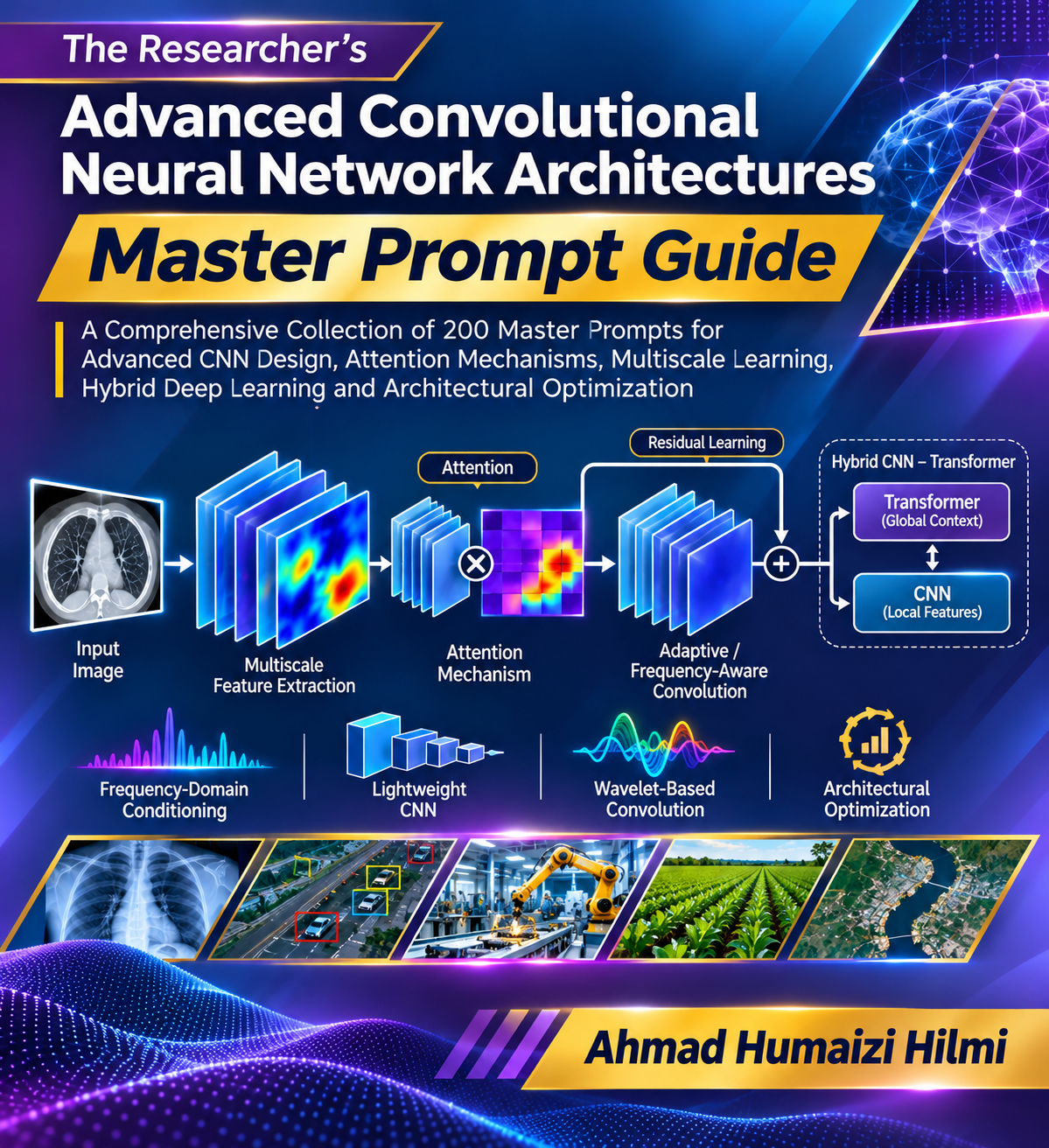
CNN-ARC-002 — Advanced Convolutional Neural Network Architectures, Attention Mechanisms, Multiscale Feature Learning, Frequency-Adaptive Convolution, Hybrid Deep Learning, and Architectural Optimization
Description
This Master Prompt theme investigates advanced CNN architecture development and enhancement through attention mechanisms, adaptive convolution, multiscale feature extraction, dual-branch networks, residual learning, squeeze-and-excitation modules, frequency-domain conditioning, wavelet-based convolution, and hybrid CNN–Transformer architectures. It explores the integration of spatial, temporal, spectral, and contextual information to improve feature discrimination, classification accuracy, computational efficiency, and robustness. The theme examines architectural innovations including frequency-adaptive lightweight networks, soft TopK convolution, hybrid Kolmogorov–Arnold CNN structures, canonical correlation-based convolution, and encoder-only Transformer–CNN combinations. Research directions include neural architecture optimization, adaptive feature fusion, hyperparameter tuning, Bayesian optimization, ablation studies, transfer learning, and comparative benchmarking. The objective is to develop high-performance CNN architectures capable of addressing complex data structures, heterogeneous input distributions, limited training samples, and demanding real-world prediction tasks.