
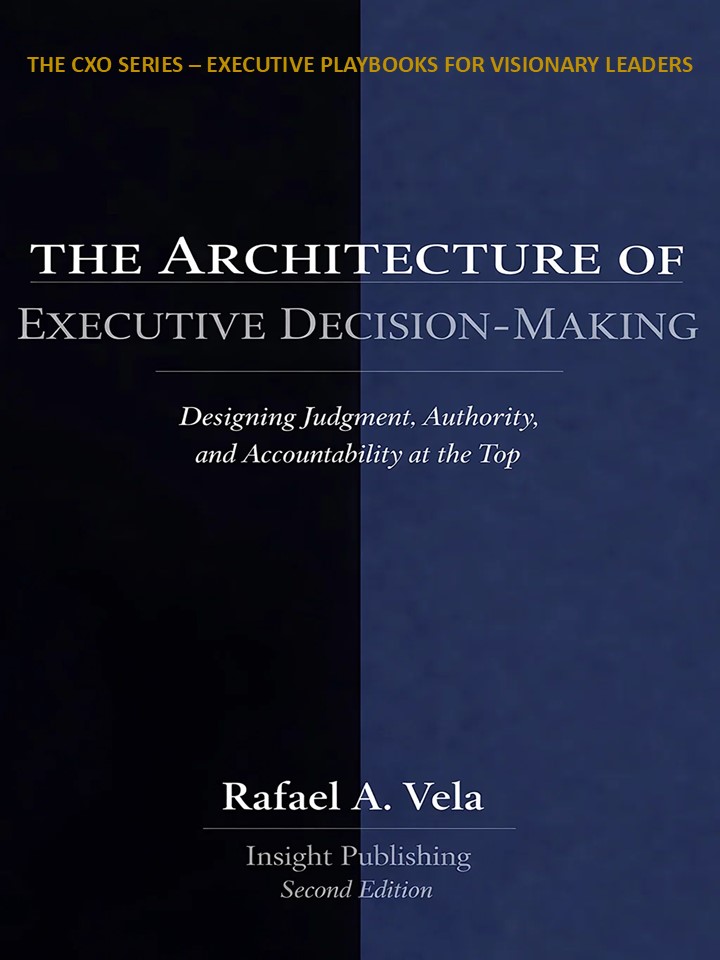
The Architecture of Executive Decision-Making - Designing Judgement, Authority, and Accountability at the Top
At the executive level, decisions fail less because of missing information and more because of flawed decision architecture.
This book examines how judgment, authority, and accountability are structured at the top of organizations, and how subtle design flaws distort decisions long before outcomes are visible. It focuses on how decisions are framed, who holds authority, how responsibility is assigned, and where accountability quietly dissolves.
Rather than treating decision-making as an individual skill, the book treats it as an organizational system. It explores how power, incentives, governance, and role design shape judgment, often in unintended ways.
Written for CEOs, COOs, CFOs, CIOs, board members, and senior executives operating in complex environments, this book speaks to leaders responsible not just for making decisions, but for designing the conditions under which decisions are made.
There are no personality profiles and no behavioral shortcuts. Only clear executive logic, system-level thinking, and a realistic view of how judgment actually functions at the top.
The Architecture of Executive Decision-Making is part of the CXO Series, a collection of executive literature focused on judgment, authority, risk, and executive governance.
Strong leaders do not rely on instinct alone. They design the architecture that shapes judgment.
TABLE OF CONTENTS
Part I — Why Decisions Fail at the Top
Chapter 1 — Decision-Making Is Not a Skill. It Is a System - 17
• Why executive judgment collapses without structure - 17
• The hidden cost of informal decision processes - 18
• Decisions as organizational design artifacts - 20
Chapter 2 — The Illusion of Experience and the Myth of Intuition - 23
• When experience misleads more than it guides - 24
• Pattern recognition versus structural understanding - 25
• Why seniority does not guarantee judgment quality – 26
• The Executive Reality: You Inherit a Decision System Before You Make a Decision - 28
Chapter 3 — When Speed Replaces Clarity - 31
• Urgency as a decision-distorting force - 31
• The difference between fast decisions and rushed decisions - 32
• Why velocity without framing creates rework and regret - 33
Part II — Designing Executive Judgment
Chapter 4 — Framing Before Choosing - 37
• Why most decisions fail before options are evaluated - 37
• Problem definition as the first act of leadership - 39
• Separating symptoms, constraints, and true decision variables - 40
Chapter 5 — Reversibility, Irreversibility, and Executive Risk - 43
• Understanding decision permanence - 44
• One-way doors versus two-way doors at the executive level - 45
• Why misclassifying reversibility creates hidden exposure – 47
• The Executive Responsibility: Designing Decisions Around Permanence - 48
Chapter 6 — Trade-Offs Are the Real Decisions - 51
• Why options are rarely the problem - 52
• How unspoken trade-offs sabotage execution - 53
• Making loss visible before choosing gain - 55
Part III — Authority, Ownership, and Accountability
Chapter 7 — Decision Rights Are Not Authority - 59
• The difference between influence, approval, and ownership - 59
• Why unclear decision rights create silent vetoes - 63
• Designing authority that survives organizational complexity - 66
Chapter 8 — Accountability Without Ownership Is Theater - 69
• Why accountability often fails in the C-suite - 69
• The dangers of shared responsibility - 73
• How to anchor accountability without micromanagement - 76
Chapter 9 — Escalation, Delegation, and the Executive Threshold - 83
• What must stay at the top and what must not - 84
• When escalation protects the enterprise, and when it weakens it - 85
• Designing clean handoffs without loss of intent – 86
• The Executive Threshold as Architecture, Not Habit - 88
Part IV — Decision Governance at Scale
Chapter 10 — Governing Without Slowing the Organization - 91
• Why governance fails when it mimics bureaucracy - 91
• Minimum effective structure for executive decisions - 92
• Separating decision governance from process control – 94
• Governing for Adaptation, Not Just Approval - 95
Chapter 11 — Decision Drift, Decay, and Silent Reversal - 97
• How decisions lose force over time - 97
• Why organizations undo decisions without saying so - 98
• Detecting drift before it becomes failure - 99
Chapter 12 — Building a Durable Decision Architecture - 103
• Embedding decision discipline into executive routines - 103
• Aligning decision architecture with culture and operating models - 105
• Why strong decision systems outlast strong leaders - 105
Conclusion — The Executive Legacy of Judgment - 109
• Appendix A: Executive Decision Architecture Diagnostic - 113
• Appendix B: Decision Classification Framework - 118
• Appendix C: Decision Governance Design Checklist – 124