
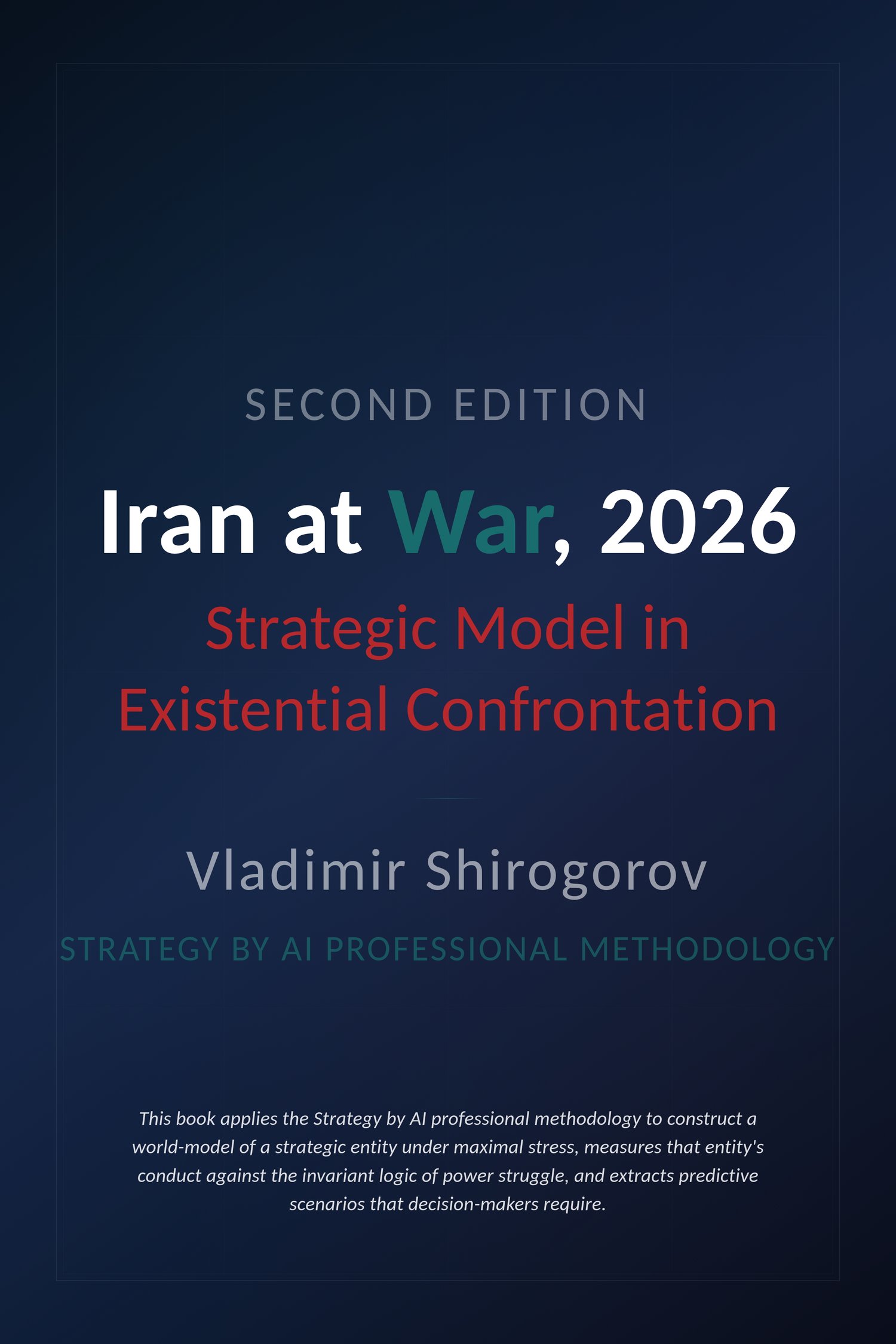
Iran at War, 2026: Strategic Model in Existential Confrontation. Second Edition
This book Iran at War, 2026: Strategic Model in Existential Confrontation is a strategic intelligence assessment of the Islamic Republic of Iran at existential war. It applies a structured analytical methodology — the Strategy by AI professional methodology — to construct a world-model of a strategic entity under maximal stress, measures that entity's conduct against the invariant logic of power struggle, and extracts predictive scenarios that decision-makers require.
The assessment was conducted by Strategy by AI. The methodology is universal: it applies to any strategic entity — a nation-state, an alliance, a business enterprise, a political party, an industry, a social movement — engaged in struggle over power and supremacy. The methodology works for external investigators analysing a subject from outside and for internal governance of strategy formulation and execution from within. The Iran case is its first full-spectrum demonstration, and the case where the methodology's predictive output has been tested against live events over an extended and dynamic operational period.
The first edition of this book was published on Day 45 of the war, in April 2026, when the conflict had transitioned from the initial clash phase into the protracted phase. The analysis rested on a 34-document intelligence portfolio and a capstone strategic intelligence report produced during the war's first month. The model identified the diplomatic settlement domain as the centre of gravity, predicted dual military-economic culmination, and constructed six development scenarios with weighted probabilities. On Day 45, these were analytical predictions. They had not yet been tested against events.
This second edition exists because the test occurred. Between Day 45 and Day 113, the war transitioned from the protracted phase into the settlement management phase. Iran’s concealed strategy hypothesis rose from analytical footnote to dominant alternative. Six consecutive reassessment packages and seven warning system reports tracked the model against live events, producing the most sustained accountability record of any structured strategic intelligence model operating against a live conflict.
The structure of the book serves to analytical discipline. Parts I and II present the Iran strategic World Model as constructed, while Part III tracks how the model performed under operational conditions — a narrative arc that moves from construction through prediction to accountability. The approximately one hundred and fifty visual diagrams serve as analytical instruments, not decorations. The argument builds cumulatively: the world-model must be understood before the strategy makes sense, and the strategy must be understood before the execution assessment reveals its significance. The scenarios in Part III are rooted in the model's own branching structure, which is why they follow rather than precede the model construction.
This book is not a policy recommendation. It does not advocate for or against any party to the conflict. It does not propose what Iran should do, what the United States should demand, or what Israel or the Gulf monarchies should accept. It produces the analytical output — the world-model, the strategy determination, the execution measurement, and the scenario architecture — and presents it to the reader for application within whatever professional, institutional, or governmental context the reader occupies.