Scottish Folklore Suite
Scottish Folklore Suite
I. Selkie - for tenor recorder and delay
II Kelpie - for descant recorder and treble recorder
III. Wee Nessie - for Paetzold contrabass recorder
*Selkie can be played without delay
- Selkie
Selkie are mythological creatures that can shapeshift between seal and human forms by removing or putting on their seal skin. They feature prominently in the oral traditions and mythology of various cultures, especially those of Celtic and Norse origin.
Selkie wife and human lover – Orkney and Shetland
A typical folk tale is that of a man who steals a female selkie’s skin, finds her naked on the seashore, and compels her to become his wife. But the wife will spend her time in captivity longing for the sea, her true home, and will often be seen gazing longingly at the ocean. She may bear several children by her human husband, but once she discovers her skin, she will immediately return to the sea and abandon the children she loves. Sometimes, one of her children discovers or knows the whereabouts of the skin. Sometimes, it is revealed she already had a first husband of her own kind. Although in some children’s story versions, the selkie revisits her family on land once a year, in the typical folktale, she is never seen again by them.
- Kelpie
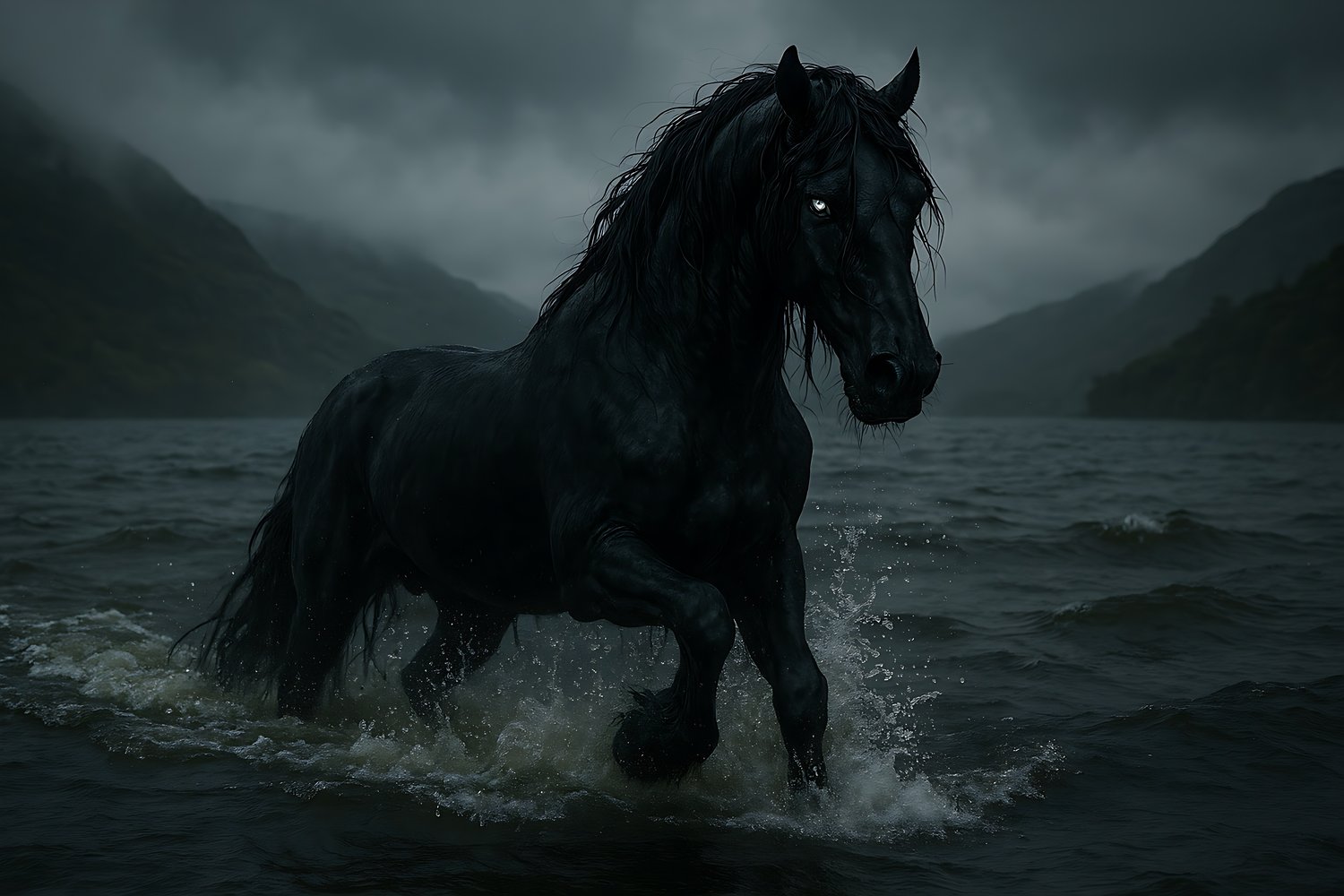
A kelpie, or water kelpie, is a shapeshifting spirit inhabiting lochs in Scottish folklore. It is usually described as a black horse-like creature, able to adopt human form. Some accounts state that the Kelpie retains its hooves when appearing as a human, leading to its association with the Christian idea of Satan, as alluded to by Robert Burns in his 1786 poem “Address to the Devil”.
Almost every sizeable body of water in Scotland has an associated kelpie story, but the most extensively reported is that of Loch Ness.
The Kelpie appears to their human victims as a horse, entices them to ride on their back, then carries them down to a watery grave. If caught using a magic bridle, however, the kelpie’s immense strength can be used to safely carry passengers or to haul vast loads.
- Wee Nessie
The Loch Ness Monster, affectionately known as Nessie, is a creature in Scottish folklore that is said to inhabit Loch Ness in the Scottish Highlands. It is often described as large, long-necked, and with one or more humps protruding from the water. Popular interest and belief in the creature has varied since it was brought to worldwide attention in 1933. Evidence of its existence is anecdotal with a number of disputed photographs and sonar readings.
Listening to this piece:
I. Selkie
II. Kelpie
III. Wee Nessie
Illustration by BedtimeOddities