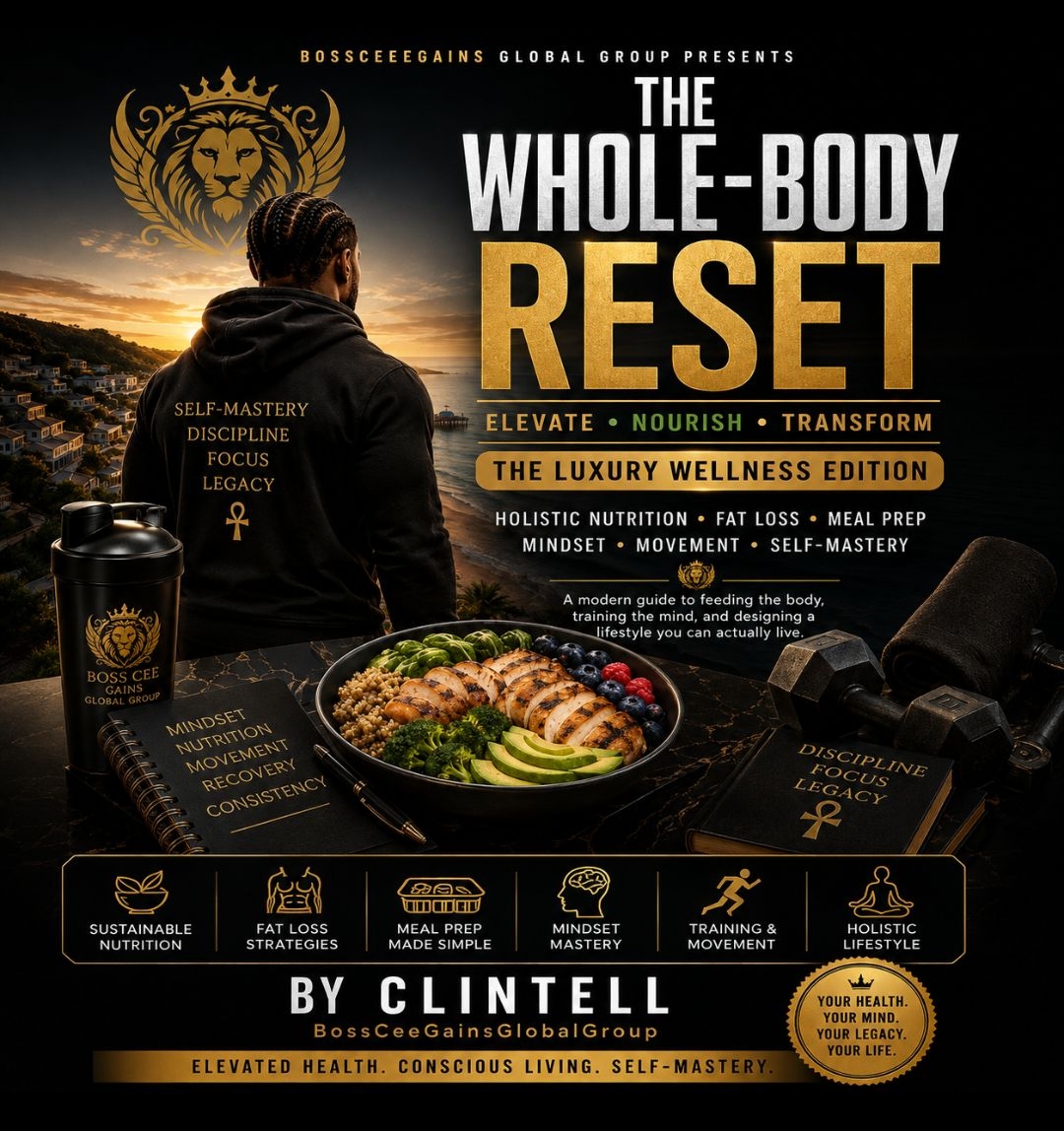
Boss Cee Gains Global Group Presents WHOLE-BODY RESET Elevate • Nourish • Transform
🔥 RESET YOUR BODY. REBUILD YOUR HABITS. MASTER YOUR LIFE. 🔥
Ready to stop chasing quick fixes and start building a healthier lifestyle you can actually sustain? The 30-Day Whole-Body Reset gives you a practical, motivating framework to help you become more aware of what you eat, structure your daily habits, improve your movement, strengthen your consistency, and take control of your choices. This isn't about perfection—it’s about progress, self-awareness, discipline, and learning how to trust yourself again. 💪🏾🔥 Whether you're working toward weight management, better energy, improved fitness, or simply becoming a stronger version of yourself, this book gives you a system you can keep building on. Your body is the vehicle. Your mind is the driver. Your habits are the road. Now build the whole system. 🚀
BOSS CEE GAINS GLOBAL GROUP PRESENTS
THE WHOLE-BODY RESET
ELEVATE • NOURISH • TRANSFORM
THE LUXURY WELLNESS EDITION
Holistic Nutrition • Fat Loss • Meal Prep • Mindset • Movement • Self-Mastery
A modern guide to feeding the body, training the mind, and designing a
lifestyle you can actually live.
BossCeeGainsGlobalGroup
ELEVATED HEALTH. CONSCIOUS LIVING. SELF-MASTERY. A Practical Guide to Holistic Nutrition, Sustainable Fat Loss, Meal Prep, Calorie Awareness, Recovery &
Self-Mastery.
Clntell | BossCeeGainsGlobalGroup
- 1. WELCOME — THIS IS NOT ANOTHER QUICK-FIX DIET
- 2. 1. THE SEVEN-PILLAR RESET
- 3. 2. CALORIES WITHOUT THE OBSESSION
- 4. 3. BUILD THE PLATE
- 5. 4. MEAL PREP FOR REAL LIFE
- 6. 5. THE DETOX CONVERSATION
- 7. 6. THE PSYCHOLOGY OF EATING
- 8. 7. KILL THE ALL-OR-NOTHING MINDSET
- 9. 8. TRAINING: BUILD A BODY YOU CAN USE
- 10. 9. THE OTHER 23 HOURS
- 11. 10. THE 30-DAY WHOLE-BODY RESET
- 12. 11. YOUR WEEKLY RESET CHECK-IN
- 13. 12. THE SELF-MASTERY PRINCIPLE
- 14. FINAL WORD — BUILD YOUR OWN STANDARD WELCOME — THIS IS NOT ANOTHER QUICK-FIX DIET
- Let me say this straight: you do not need another diet that makes you feel like you are fighting your own body.
You need a system you can actually live with.
This book is about learning how to make better decisions with food, movement, recovery, environment and
mindset. It is not about starving yourself, chasing a number on a scale, or pretending one food is going to
magically change your life.
My philosophy is simple: your body, mind and lifestyle work together. If one area is constantly fighting the
others, consistency gets hard.
The goal here is not perfection. The goal is control.
You are going to learn how to understand calories without becoming obsessed with them, create a
reasonable calorie deficit when fat loss is appropriate, build meals that keep you satisfied, prepare food
before hunger makes the decision for you, move your body with purpose, recover, and develop the mindset
to get back on track when life knocks you off it.
This is a practical reset—not a punishment.
And remember: you are not starting over every Monday. You are building a better decision-making system
one choice at a time.
1. THE SEVEN-PILLAR RESET
Your transformation has seven pillars:
1. MIND — awareness, habits, emotional eating
and self-talk.
2. NUTRITION — quality, portions,
protein, fiber and overall energy intake.
3.MOVEMENT — strength, walking, conditioning
and mobility.
4. HYDRATION — making water and
consistent hydration part of your routine.
5.RECOVERY — sleep, rest and managing the
demands placed on your body.
6. ENVIRONMENT — making the healthy choice easier to reach.
7.CONSISTENCY — learning how to keep going
when motivation disappears
Most people attack only one pillar: exercise.
Then they wonder why the results do not last.
Your workout matters. But what happens before the workout, after the workout, at dinner, at midnight,
during stressful days, and on the weekends matters too.
The Seven-Pillar Reset gives you a bigger picture without making the process complicated.
2. CALORIES WITHOUT THE OBSESSION
Calories are simply a measure of energy. Your body uses energy to keep you alive, move, think, digest
food and perform daily activities.
For many people trying to lose body fat, a calorie deficit—consistently consuming less energy than the
body uses—is part of the equation.
But there is a major difference between understanding a calorie deficit and starving yourself.
A useful approach is to begin with awareness. Learn the approximate calorie content of the foods you
commonly eat. Pay attention to portions. Watch liquid calories. Notice how restaurant portions compare
with the amount you actually need.
If you choose to track calories, use the information as feedback—not as a reason to punish yourself.
A simple starting framework:
• Estimate your normal intake.
• Identify where the easiest reductions can be made.
• Prioritize protein and high-fiber foods.
• Keep meals satisfying.
• Monitor your trend over several weeks rather than reacting to one day's scale reading.
• Adjust gradually if your results are not moving in the desired direction.
Your body weight can fluctuate from water, food volume, sodium, hormones and other factors. One
weigh-in is not the whole story.
The objective is sustainable progress, not winning a one-day contest against your appetite.
3. BUILD THE PLATE A practical plate is easier to follow than a complicated food rule.
Start with a protein source. Add vegetables and/or fruit. Add a carbohydrate source that fits your needs and
preferences. Include a reasonable amount of healthy fat.
Examples:
Breakfast:
Eggs + oatmeal + berries.
Lunch:
Chicken + rice + mixed vegetables + avocado.
Dinner:
Fish + potatoes + salad + olive oil-based dressing.
Snack:
Greek yogurt + fruit + nuts.
The exact foods can change. The structure is what matters.
Protein can help support muscle and satiety. Fiber-rich foods can help you feel fuller and support digestive
health. Carbohydrates can provide useful energy, especially around activity. Dietary fats are also important
for normal body functions.
You do not have to eat the same five foods every day. Build a system with enough variety that you can
actually enjoy it.
4. MEAL PREP FOR REAL LIFE
Meal prep is not about filling twelve identical containers and pretending you have no life.
The purpose of meal prep is to remove unnecessary decisions.
Use the 3-2-1 method:
3 proteins
2 carbohydrate choices
1 large batch of vegetables or mixed produce.
For example:
Proteins: chicken, lean ground turkey, eggs.
Carbs: rice, potatoes.
Produce: broccoli, peppers, onions and fruit.
Cook the basics. Store them separately. Build different meals throughout the week. Another strategy is the emergency meal.
Keep a few fast options available for the day when everything goes sideways: a protein source, fruit, a
high-fiber option and something easy to prepare.
Your plan needs a backup plan.
The question is not, “Can I eat perfectly?”
The better question is, “What will I do when life is not perfect?”
5. THE DETOX CONVERSATION
The word “detox” gets used everywhere, and that is exactly why we need to be careful with it.
Your body already has organs and biological systems that process and eliminate waste. A responsible
wellness program should not promise that a tea, juice, powder or special food will magically remove
unspecified “toxins.”
Instead, think about detox-supportive habits: drinking adequate fluids, eating fiber-rich whole foods, getting
regular movement, sleeping enough, reducing excessive alcohol intake, and limiting heavily processed
foods when doing so supports your overall diet.
A reset can also mean reducing the habits that make you feel worse.
Ask yourself:
What foods leave me feeling sluggish?
How often am I eating because I am stressed?
How much water am I actually drinking?
How much sleep am I getting?
How often am I moving?
What does my normal week really look like?
That is a more useful detox conversation than promising a miracle cleanse.
6. THE PSYCHOLOGY OF EATING
Food is not only fuel. For many people, food is connected to stress, celebration, boredom, comfort, family,
routine and memory.
That means telling someone “just have discipline” is often not enough.
Before you change a habit, learn to see it.
Try the PAUSE method: P — Pause before automatically eating.
A — Ask what you are actually feeling.
U — Understand the trigger.
S — Select the next action deliberately.
E — Evaluate afterward without beating yourself up.
Maybe you are hungry. Eat.
Maybe you are exhausted. Rest may be the real need.
Maybe you are stressed. Food may only be the quickest available comfort.
Maybe you are bored. Change the environment.
This is not about judging yourself. Awareness gives you options.
You do not have to become perfect before you become consistent.
7. KILL THE ALL-OR-NOTHING MINDSET
One of the biggest traps in nutrition is the thought that one imperfect meal ruined everything.
It did not.
If you eat a meal that was not part of your plan, the next decision is still available.
Do not turn one meal into a weekend.
Do not turn one weekend into a month.
Do not use guilt as your nutrition strategy.
Replace:
“I messed up, so I might as well keep going.”
With:
“That choice happened. My next choice is mine.”
This is self-mastery in practical form.
Your goal is not to control every circumstance. Your goal is to improve your response to circumstances.
8. TRAINING: BUILD A BODY YOU CAN USE
Exercise should not be punishment for eating.
Training is a tool for building capacity. A balanced program can include:
• Resistance training for strength and muscle.
• Walking and other regular movement.
• Cardiovascular conditioning appropriate to your fitness level.
• Mobility work where useful.
• Recovery between demanding sessions.
Start where you are.
A beginner does not need an advanced athlete's program. The best plan is one that can be performed
safely and consistently.
If you have a medical condition, injury, are pregnant, take medications that affect exercise or nutrition, or
are unsure whether a program is appropriate, work with a qualified healthcare professional before making
major changes.
9. THE OTHER 23 HOURS
A trainer might work with you for an hour.
What happens during the other twenty-three?
That is where your lifestyle lives.
Sleep.
Food.
Stress.
Hydration.
Work.
Family.
Walking.
Screen time.
Recovery.
Your environment.
Your training session is important, but it cannot erase a lifestyle that constantly works against your goals.
Build routines around the workout.
Pack food before work.
Keep water available.
Put your walking shoes where you can see them.
Create a realistic bedtime.
Keep your highest-trigger foods out of immediate reach if they repeatedly derail you. Make the environment help you.
10. THE 30-DAY WHOLE-BODY RESET
WEEK 1 — AWARENESS
Track your meals without trying to be perfect. Record water, sleep, movement and how you feel.
WEEK 2 — STRUCTURE
Build repeatable breakfasts and lunches. Prepare food before the busiest days.
WEEK 3 — PROGRESSION
Add or improve resistance training and regular walking or conditioning. Make one nutrition adjustment
based on your first two weeks.
WEEK 4 — MASTERY
Identify what actually worked. Keep the habits you can sustain. Remove the rules that created unnecessary
stress.
Daily minimums:
• Drink water consistently.
• Eat protein-rich foods across the day.
• Include produce and fiber-rich foods.
• Move your body.
• Get adequate rest.
• Pause before automatic eating.
• Make your next decision count.
Do not measure success only by the scale. Look at consistency, strength, energy, habits, waist
measurements if appropriate, and how well you are following the system.
11. YOUR WEEKLY RESET CHECK-IN
Once a week, answer these questions:
1. What did I do well?
2. Where did I lose
consistency?
3. What triggered it?
4. What food
choices made me feel my best?
5. Did I move
enough?
6. How was my sleep?
7. What is one thing I will change next week?
8. What is one thing I will keep exactly the same? This turns your lifestyle into feedback.
You are not failing a test. You are collecting information.
The person who learns from the week can improve the next week.
12. THE SELF-MASTERY PRINCIPLE
At the end of the day, health is not just about having information.
Most people already know they should drink more water, move more, eat more whole foods and sleep
better.
The difficult part is execution.
Self-mastery begins when you stop waiting for motivation to give you permission.
You make the decision first.
Then you build the environment, schedule and habits that make the decision easier.
You are not trying to become a different human overnight.
You are building evidence that you can trust yourself.
One meal.
One workout.
One walk.
One night of better sleep.
One better decision after a bad decision.
Stack enough of those together and your identity starts catching up with your actions.
That's the reset.
Not perfection.
Control.
DISCLAIMER: This ebook is for general educational and informational purposes only and is not medical, nutritional, psychological, or
individualized healthcare advice. It does not diagnose, treat, cure, or prevent disease. Nutrition and exercise needs vary by individual. Before
making substantial changes to diet, calorie intake, supplements, or exercise—especially if you have a medical condition, are pregnant or
breastfeeding, take medications, have a history of disordered eating, or have an injury—consult an appropriately qualified healthcare
professional. Any results described or implied are not guaranteed.
FINAL WORD — BUILD YOUR OWN STANDARD
You do not need to copy somebody else's body, lifestyle or definition of success. Learn.
Test.
Observe.
Adjust.
Use logic. Use awareness. Pay attention to your own patterns.
And when you find what works, make it repeatable.
That is what I want this book to give you: not another temporary challenge, but a framework you can keep
building on.
Your body is the vehicle.
Your mind is the driver.
Your habits are the road.
Build the whole system.
— Clintell