


Geometric Structure and Principle of the Helical Screw
Raising Water Without Lifting It
This minibook presents the principle of Archimedes’ helical screw and its fundamental geometric structure. It shows how a helical surface contained in a channel allows water to be raised in a progressive and controlled manner, transforming a simple rotary motion into a stable vertical transport.
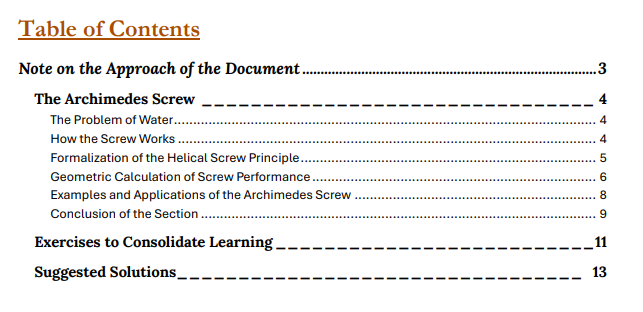
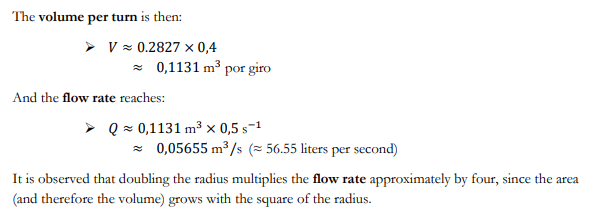
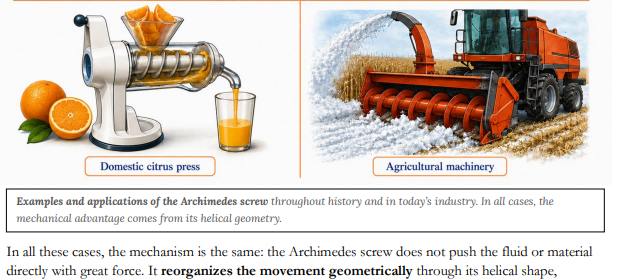
It explains the specific problem of water, the operation of the device, its geometric formalization (volume per turn and flow rate), historical and modern examples, and graded exercises in four levels.
Intended for
Students, autodidacts and curious minds who want to understand the deep geometric principles of classical mechanics through one of its most ingenious devices.
Not intended for
• Those seeking a complete biography of Archimedes or a detailed historical account.
• Readers who want an exhaustive overview of all his mathematical and scientific discoveries.
• Those expecting a practical engineering manual or step-by-step construction instructions.
• Readers who prefer popular anecdotes or superficial explanations without structural depth.
Main purpose
To show that raising a fluid does not require applying greater force, but rather an intelligent geometric organization of motion. With the helical screw, Archimedes demonstrated that a small, well-organized force can achieve what previously seemed impossible.
Part of the Proyecto 3.3.3: minibooks that take powerful ideas and resolve them through clear, useful structural understandings.
Version 1.0 — Functional and structurally complete.
Updated May 8, 2026.
Format: PDF
Length: 16 pages