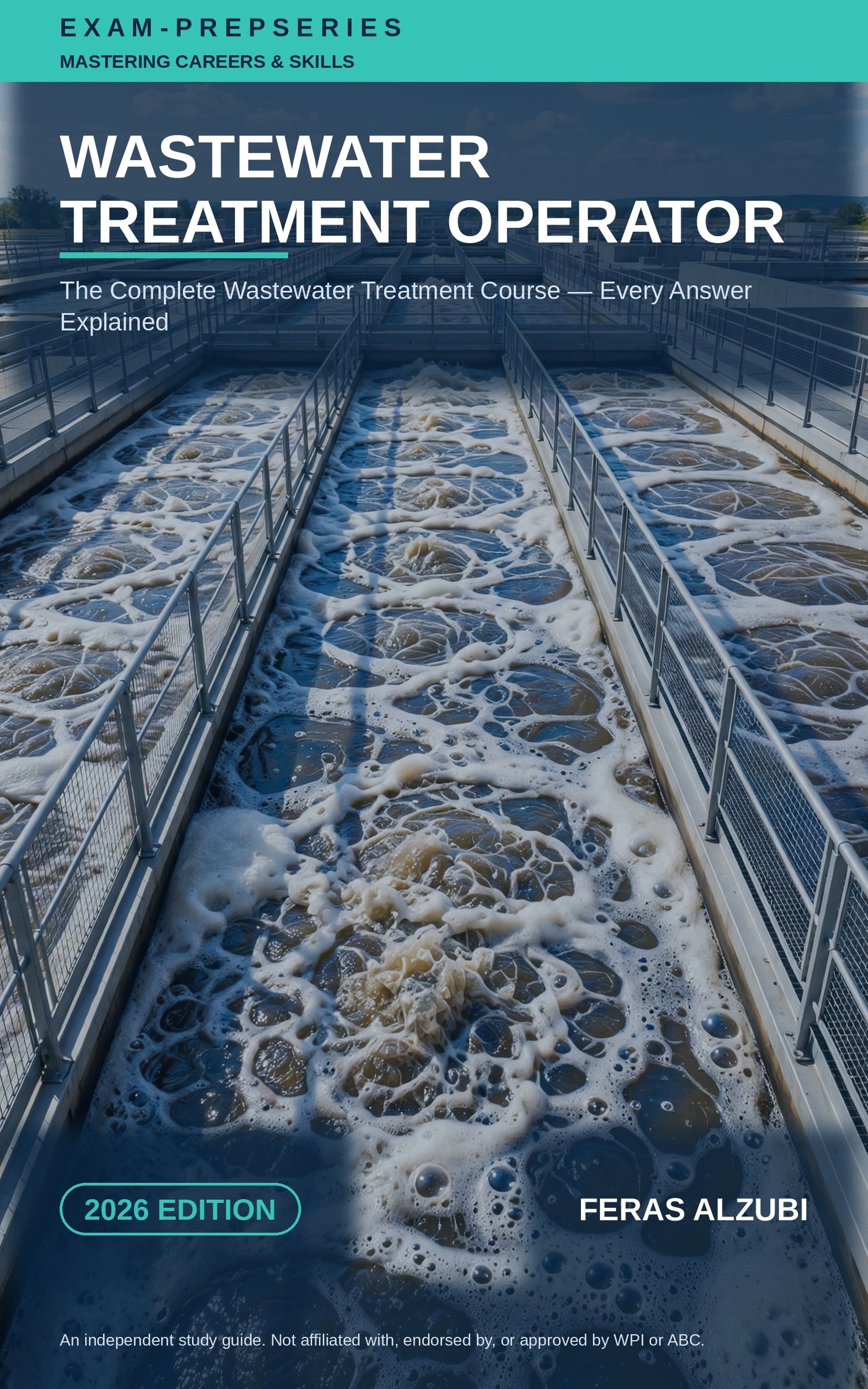
Wastewater Treatment Operator
Wastewater Treatment Operator — The Complete Wastewater Treatment Course
What this book teaches. The complete course for wastewater treatment work — the whole craft taught from zero in one book. The field and its doors first; then the foundations the plant stands on — the living treatment, the chemistry the work needs, and the mathematics of the plant worked end to end — before the treatment train begins. The train is taught whole and in order: what arrives at the plant's edge, screening and grit, primary clarification, the activated sludge process in three chapters, fixed-film processes, ponds and lagoons, nutrient removal, tertiary treatment, disinfection, the solids line from thickening through digestion to dewatering and the land, the effluent's last mile, and odor. Then the machines and the instruments — pumps and their curves, blowers and aeration equipment, chemical feed systems, valves and piping, instrumentation and SCADA, standby power — the operator's laboratory (sampling, bench analysis, the microscope and the microbial census), the permits and recordkeeping the plant lives under, and finally the whole craft at work: process control, troubleshooting method, and emergencies, before the examination chapters gather the graded ladder and the road from here. The 40 chapters run in seven parts: I The Field and Its Doors; II Foundations: The Living Treatment, Chemistry, and the Mathematics of the Plant; III The Treatment Train; IV The Machines and the Instruments; V The Laboratory and the Law; VI The Whole Craft at Work; and VII The Examinations and the Road. One specimen workplace carries the worked numbers end to end, labeled a specimen at its first use: the Alder Creek Water Reclamation Facility, a fictional conventional activated sludge plant, worked the way an operator works it — its primary clarifiers rated by surface overflow and detention, its aeration basins loaded by the pounds formula, its return sludge set by the solids balance, its sludge age held by a wasting rate worked to the gallon, its chlorine feed gathered against a contact basin timed at average and peak flow, its digesters loaded, detained, and credited with volatile-solids reduction, and its cake weighed out by the day. The book prepares readers for the graded Wastewater Treatment Operator examinations built on the Association of Boards of Certification (ABC) pattern and published by Water Professionals International (WPI) — four classes, Class I through Class IV, each a 100-question examination across the same four published content areas — and it prints two honesty facts plainly: the criteria publish no passing score, fee, or eligibility rule (those belong to each certifying authority), and this book confers no certification, no eligibility, and no authorization of any kind.
Who it is for. The complete beginner — a new hire, trainee, or career changer who has never stood on a clarifier walkway and needs the craft taught from zero before any examination framing rests on it; and the working operator on the graded ladder — at any class — who needs the whole foundation under the work and full, reasoned preparation for the examination that is theirs.
What's inside (every count verified against the actual book):
- 40 chapters in seven parts — the whole treatment craft from zero
- 820 original practice questions, every one with a full explained answer key — why the correct answer is correct and why each wrong answer is wrong
- A 50-item Wastewater Treatment Readiness Diagnostic before the opening chapter, scored in the examinations' four content-area strands, so you start where you actually stand
- 600 chapter questions — fifteen close every chapter
- 50 case files in two batteries — process cases and plant cases: situation, evidence, a reasoning chain, and a conclusion — the craft taught as judgment, never as recipe
- 120 strand repair items in eight sets that close the gaps the diagnostic finds
- 49 labeled figures at their teaching points — 28 photorealistic plates of the operator's physical world (the plant from the air in flow order, the protective and gas-safety ensemble, the bar screen and the grit chamber, both clarifiers, the aeration basin and the blower room, the trickling filter and the rotating contactor, the nutrient-removal basins, the disc filter, the disinfection installations, the thickener and the digester, the dewatering line, the pumps traced connection by connection, the surface aerator, the polymer skid, the control room, and the laboratory benches), each verified feature by feature against a reference dossier, plus 21 diagrams
- A 350-entry glossary, study plans, cheat sheets, and coverage crosswalks
This book teaches wastewater treatment knowledge, method, and reasoning for education and examination preparation. It is not a design standard, an operations manual, a site procedure, or professional advice, and reading it does not qualify or authorize any reader to perform any regulated or hazardous act: confined-space entry, chlorine and chemical handling, gas hazards, and energized work are taught in this book as knowledge, recognition, and reasoning only, and hands-on skill belongs under the reader's employer's program and supervision. Nothing here guarantees a credential, a job, a score, or income.
Read the first chapter free — the sample on this page is Chapter 1 of this book, exactly as it appears in the full edition.
From the Mastering Careers & Skills library — complete A-to-Z professional teaching books for careers, trades, and certifications.
An independent study guide. This book is not affiliated with or endorsed by Water Professionals International (WPI) or the Association of Boards of Certification (ABC). Neither body wrote, reviewed, approved, or sponsored this book.
Refunds: Please read the free sample chapter before you buy. This is a digital ebook, delivered instantly by download. If the file is defective, or you cannot open or download it and we cannot fix the problem, you will receive a full refund — email us within 14 days of purchase. Because the book is delivered instantly as a downloadable file, all other sales are final.
How to read this book (EPUB format): After checkout, download the EPUB file, then open it in any free ebook reader app. On iPhone or iPad: Apple Books — it is already on your device. On Android phones and tablets: Google Play Books (free: https://play.google.com/store/apps/details?id=com.google.android.apps.books) — upload the file in the app — or ReadEra (free). On a Windows or Mac computer: Thorium Reader (free: https://thorium.edrlab.org) or Adobe Digital Editions (free). On Kindle: use Amazon's free Send to Kindle (https://www.amazon.com/sendtokindle) to add the file to your Kindle library.