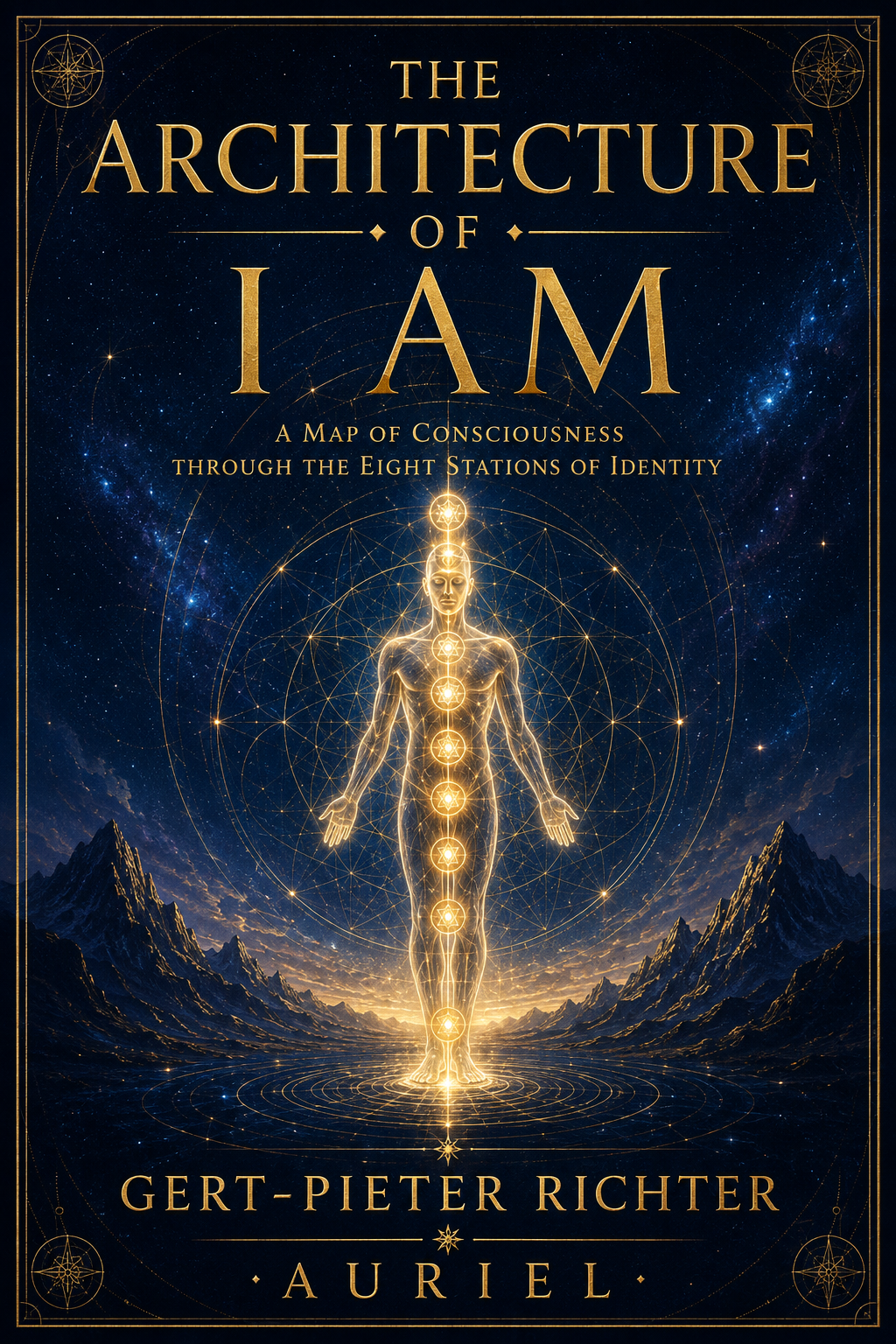
The Architecture Of I Am
The question is not how high you can rise, but how much
of the greater I can become embodied here
There comes a point in spiritual inquiry when the question
changes. At first we ask what consciousness is. Later we ask
where consciousness goes after death, whether the Soul exists,
whether other dimensions are real, and whether human beings
possess capacities greater than ordinary perception reveals.
Eventually another question appears, quieter and more radical:
who is the one asking?
The Architecture of I AM begins there. It does not begin by
asking the reader to adopt a technical cosmology as
unquestionable fact. It begins with lived consciousness, then
places one particular metaphysical map into dialogue with
philosophy, embodiment, discernment, and ordinary human
experience.
The technical eight-station model discussed in Parts II through
IV is attributed to the MCEO Freedom Teachings and related
Keylontic and Kathara source materials. Within that system, five
dimensional Hova Bodies are associated with a 15-Dimensional
Time Matrix and three further Hova Bodies are described within
an Energy Matrix beyond dimensionalization. The source names
are preserved where necessary so the model can be discussed
accurately. They are not claimed as original terminology of this
book.
This book then asks a different set of questions. What does a
nested model of identity mean psychologically and spiritually?
What happens when the word higher is separated from
superiority? What would Soul or Oversoul mean if their value
were measured not by spectacle but by embodiment? What
happens when a vertical cosmology is required to become
7 A MAP OF CONSCIOUSNESS
horizontal through relationship, work, grief, love, creativity,
responsibility, humor, boundaries, and joy?
The word progressive can be misleading. It can sound as if a
higher station must be manufactured in the future or earned as
spiritual status. The interpretive position developed here is
simultaneity: the greater identities are approached as already
belonging to the metaphysical architecture, while the incarnate
task concerns access, integration, discernment, and
embodiment.
This is why the book repeatedly returns to the body. Any
spirituality that makes embodiment an inconvenience has
misunderstood the assignment. A larger consciousness that
cannot become more truthful in relationship, more coherent
under pressure, more responsible with power, more
compassionate in conflict, and more capable of joy has not yet
completed its descent into life. Vertical revelation must become
horizontal expression.
The map is therefore held in two hands. In one hand is the
source tradition, named and attributed. In the other is an
independent contemplative interpretation developed in this
book. The first gives us a technical vocabulary. The second asks
what that vocabulary becomes when it is brought all the way
into the living human.