

Choose Your Spine. Build Your xSphere.
What you get
A 10-page OCV Intelligence Brief that names something your industry has felt for years but never had words for.
Every semiconductor professional in the LAX–SFO corridor has skipped a same-day supplier visit because the logistics weren't worth it. Every design review that stayed on video call because nobody could justify the trip. Every overnight stay for a meeting that should have been an afternoon. This brief calls that friction by its name — and shows exactly what it costs when it compounds over decades.
The xSphere framework. OCV's original analytical vocabulary for understanding how high-speed transportation spines transform industrial ecosystems into compounding coordination machines. The X is a blank. Taiwan filled it with chips and built the world's most defensible semiconductor supply chain. The brief explains precisely how — and why the LAX–SFO corridor has everything needed to do the same.
Taiwan's ChipSphere as the reference model. Five nodes. One spine. Eighteen years of compounding. 82 million passengers in 2025. 99% on-time since 2007. A Taipei-to-Kaohsiung corridor that connects IC design, advanced fabs, equipment suppliers, and advanced packaging so tightly that engineers don't travel to visit suppliers — they just go. The brief maps every node, quantifies the ridership, and explains the weekend mode that Taiwan's competitors have never thought to copy.
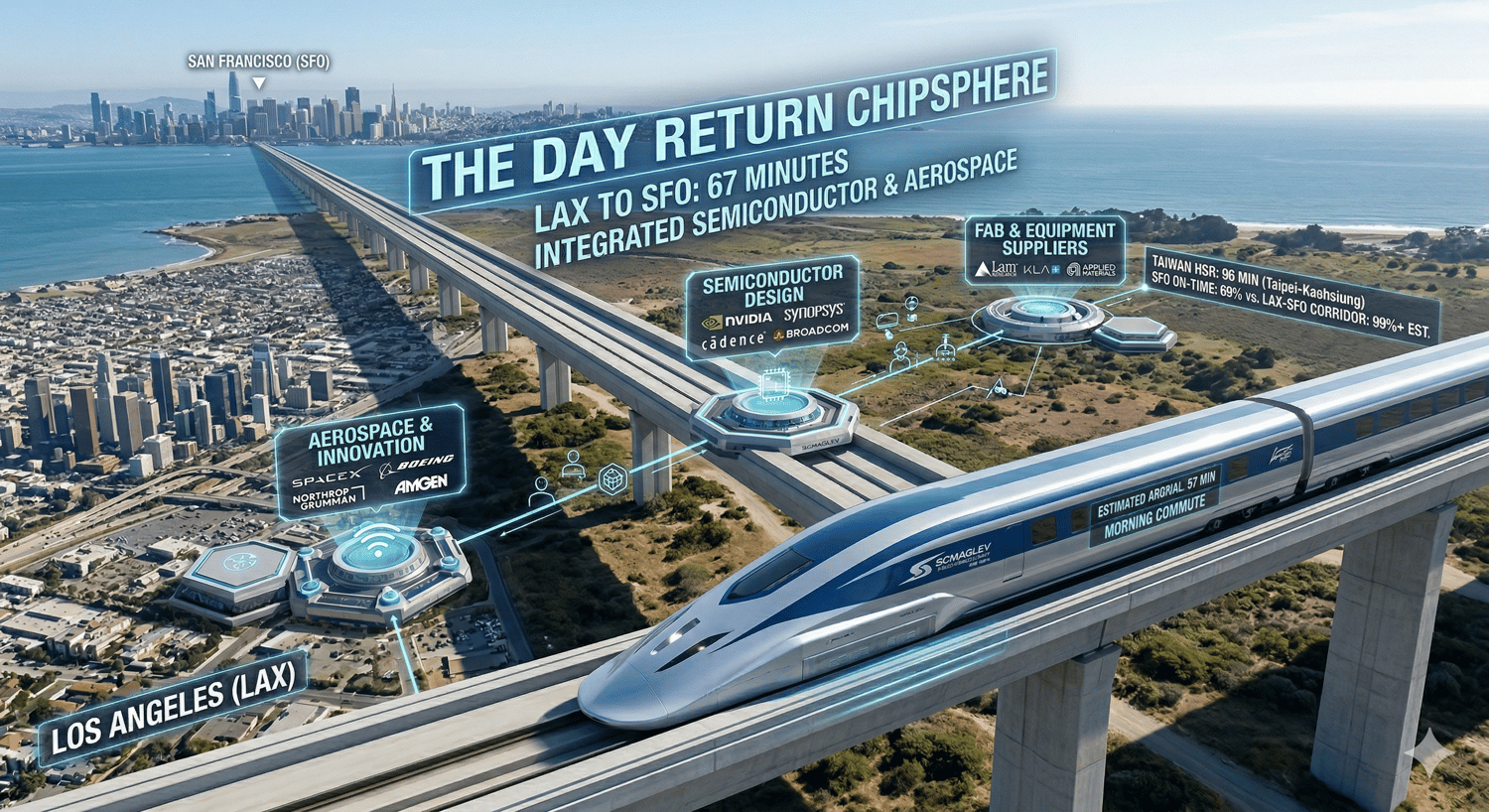
The late mover case. Taiwan built its spine on second-generation Shinkansen. The LAX–SFO corridor can arrive at the third — Japan's SCMaglev L0 Series, certified for commercial operation at 505 km/h, world speed record 603 km/h, already under construction for the Tokyo–Nagoya corridor. LAX to SFO in 67 minutes. Not day-return territory. Morning-commute territory. The brief shows why arriving late means arriving with a better technology and without paying the pioneer's learning cost.
The financing and partnership model. The shipbuilding industry just proved that allied industrial capability transfer onto US soil is politically viable and commercially rational. Japan has been trying to build SCMaglev in the United States since 2013. The BOT structure, the trade negotiation leverage, the tunneling solution to the land problem — all mapped in detail with precedents that already exist.
The carbon and ESG case. 102 kg CO₂e per passenger on the current air corridor. 2.5 kg on SCMaglev. 975,000 tonnes saved annually on modal shift. For companies with Scope 3 supply chain commitments, the numbers are in the brief.
The CHIPS Act gap. Fifty-two billion dollars funded fabs, equipment, and training. It did not fund the infrastructure precondition that makes ecosystems self-sustaining rather than dependent on continued subsidy. The brief explains the difference — with the Kumamoto economic multiplier methodology as the analytical framework — and makes the case that Arizona has a fab while Taiwan has a ChipSphere, and that gap is measured in decades, not process nodes.
The brief includes the full xSphere vs ChipSphere comparison table, all sourced data, and the Gemini-generated corridor visualization.
Who it is for: Director, VP, and C-suite professionals at US semiconductor equipment companies, fabless design houses, aerospace and defense primes, and institutional investors tracking CHIPS Act ecosystem development in the LAX–SFO corridor.