

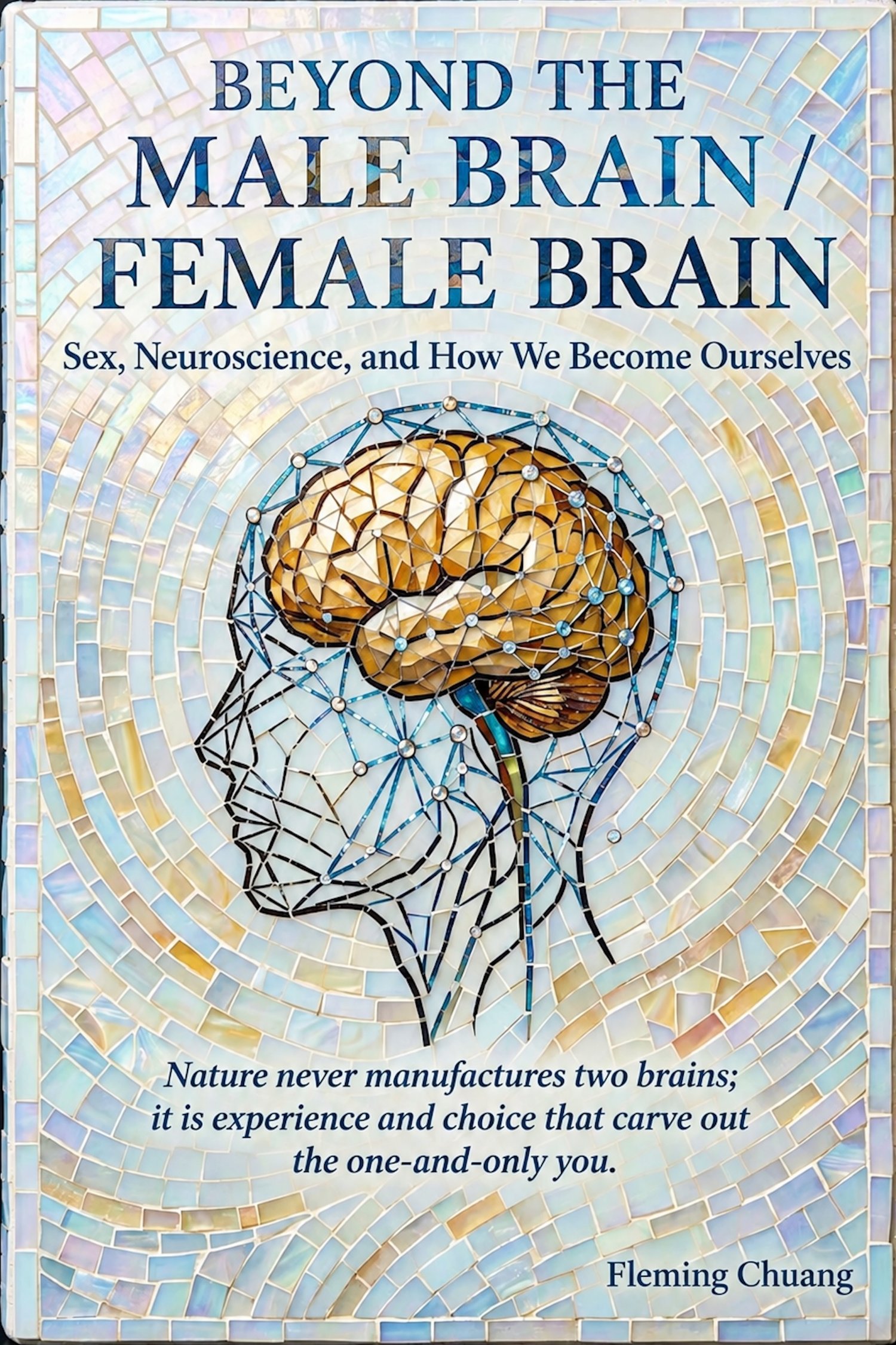
Beyond the Male Brain / Female Brain: Sex, Neuroscience, and How We Become Ourselves
What if the “male brain” and “female brain” are not two fixed biological types after all?
For decades, popular culture has taught us to explain human behavior through a simple binary: men are supposedly more logical, spatial, competitive, and system-oriented, while women are described as more emotional, verbal, empathetic, and relationship-oriented. These stereotypes are familiar—but what does contemporary neuroscience actually tell us?
Beyond the Male Brain / Female Brain takes a rigorous yet accessible journey through the science of sex differences, asking a more important question: how does a unique human brain emerge from the interaction of biology, hormones, experience, culture, and choice?
Beginning with brain anatomy and the controversial history of “male” and “female” brains, the book introduces the concept of the brain mosaic—the idea that an individual brain can contain features that statistically lean toward either sex, alongside countless characteristics that overlap between groups. Rather than two opposing brain types, human neurobiology reveals extraordinary diversity within each sex.
The journey then moves through the brain’s chemical environment. Testosterone, estrogen, and oxytocin are examined beyond their popular stereotypes, revealing how hormones influence neural sensitivity, motivation, attachment, stress, and social behavior without functioning as simple biological switches.
The book also explores spatial cognition, language, abstract thinking, emotion, empathy, stress, romantic attachment, and conflict. It examines evolutionary explanations alongside the powerful influence of childhood experience, social expectations, education, professional training, and cultural conditioning.
At the heart of the book is neuroplasticity: the brain is not a fixed machine determined at birth. Experience continually reshapes neural circuits. Skills we practice, environments we inhabit, relationships we form, and patterns we repeatedly reinforce can all leave measurable traces in the brain.
This leads to one of the book’s most important conclusions: within-group differences are often far greater than the differences suggested by simple male-versus-female labels.
The final sections move beyond gender toward a future of personalized neuroscience, where the individual brain—not a demographic stereotype—becomes the proper unit of understanding. Sex differences remain important for medical and scientific research, but they should not become psychological cages that determine what any particular person can think, feel, learn, or become.
Beyond the Male Brain / Female Brain is a book about neuroscience, but it is also a book about human possibility.
Biology may provide a starting point. Experience draws the path. Neuroplasticity keeps the path open.
You are not simply a “male brain” or a “female brain.”
You are a living neural mosaic—continually shaped by the history behind you and the choices still ahead.