







Ready to Escalate
Support to engineering plays for technical support teams
$19. All sales are final.
You know the loop. A ticket goes to engineering, comes back with "can't reproduce" or "which version?", goes over again, and the customer waits through every lap. Someone asks for an ETA nobody has. When the fix finally ships, support hears about it from the customer.
Ready to Escalate is a playbook for breaking that loop, written from the support engineer's chair. Its 24 plays follow a case from start to finish: what to have before you escalate, how to investigate the cases that don't fit a template, how to write an escalation engineering can act on the first time, how to keep customers honestly informed while the fix is underway, and how to close the loop when it ships so the same case doesn't cost you a week next time.
Most examples follow one made-up case, a nightly export that fails on some nights and not others. You see the escalation as it was first sent, the three bounces it caused, and the packet that replaced it; then the same case runs through every play to the engineer's root cause note, the plain-language version sent to the customer, and a verification window that crosses a daylight saving change. Every play has the move, a decision rule, a worked example, the habit that causes bounces, the traps, a fallback, a check before you send, and an agent prompt for the slow parts.
Leads get the weekly ping-pong review, a hold-or-send threshold for incomplete escalations, a severity worksheet with labelled starting defaults, and a measure sheet for bounce and reopen rates on your own tracker.
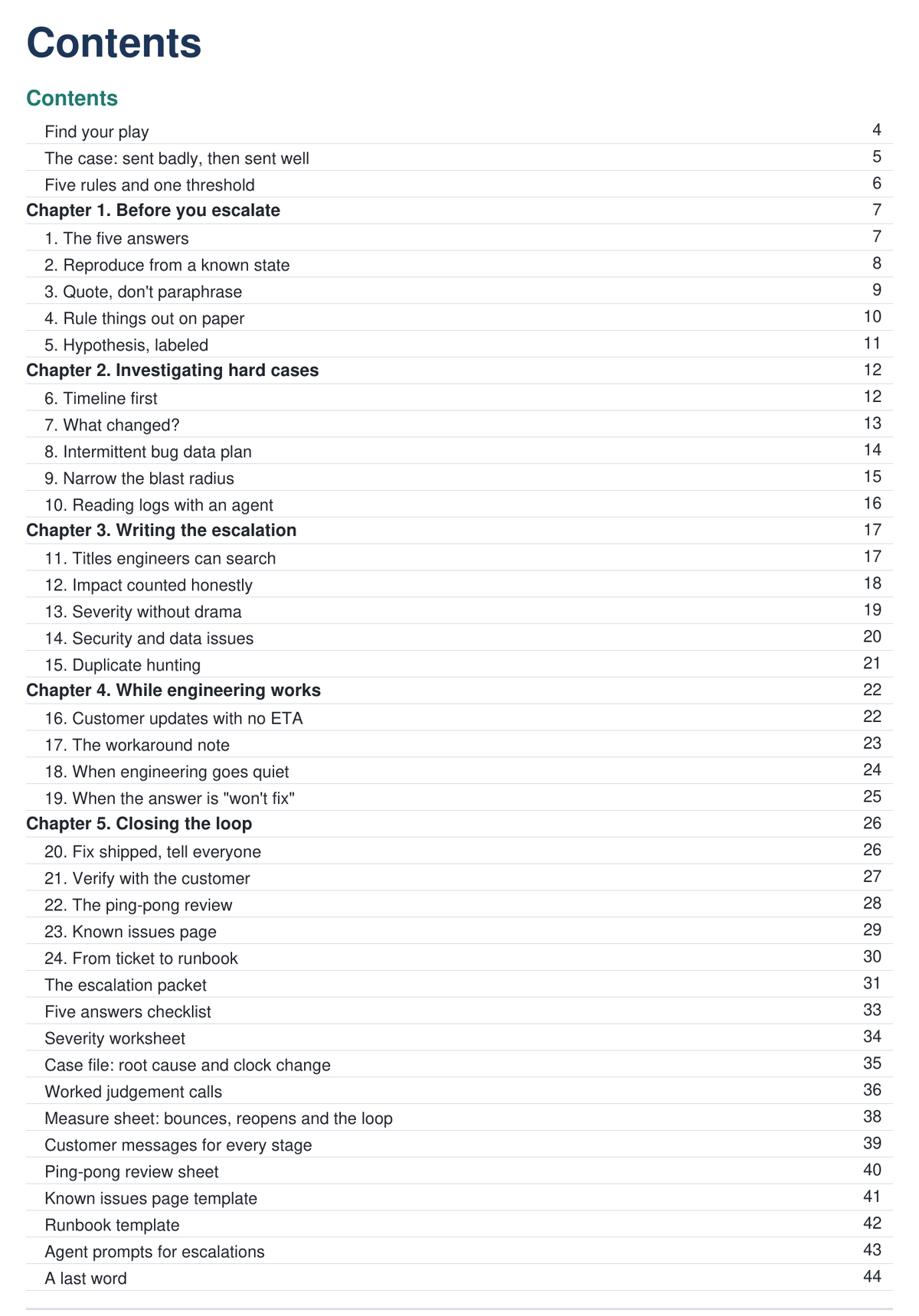
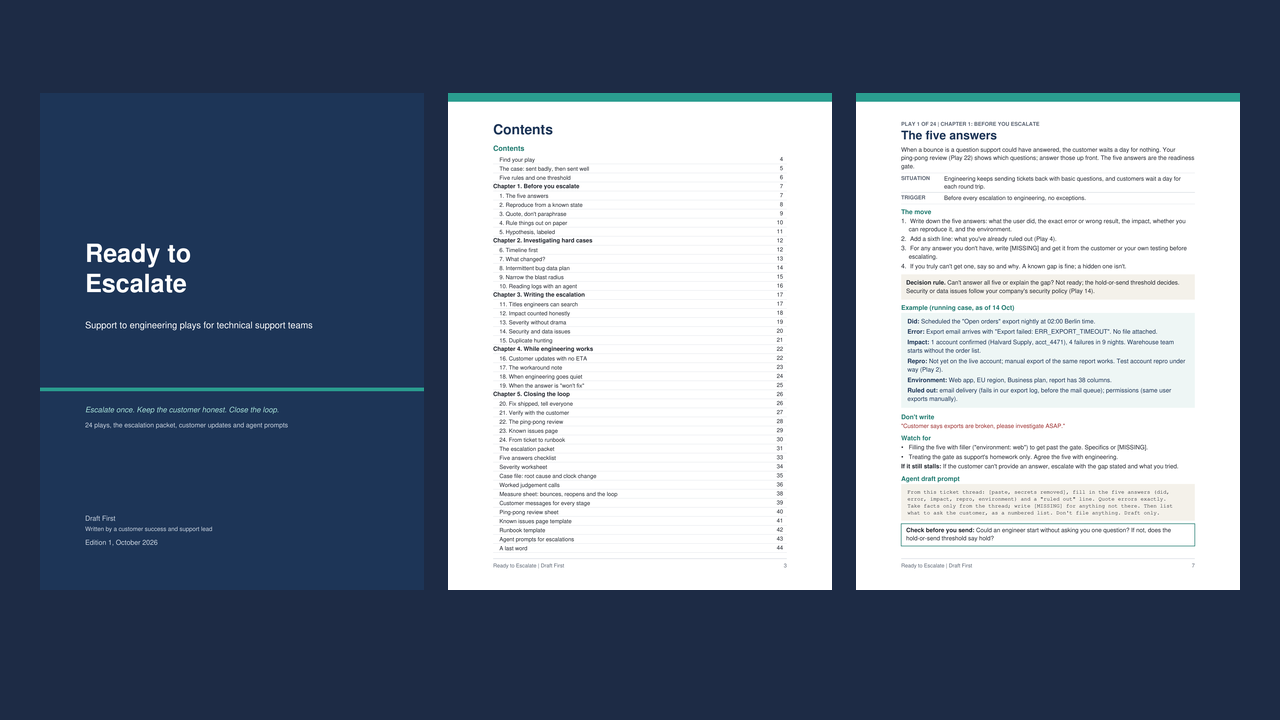
Contents, page 3
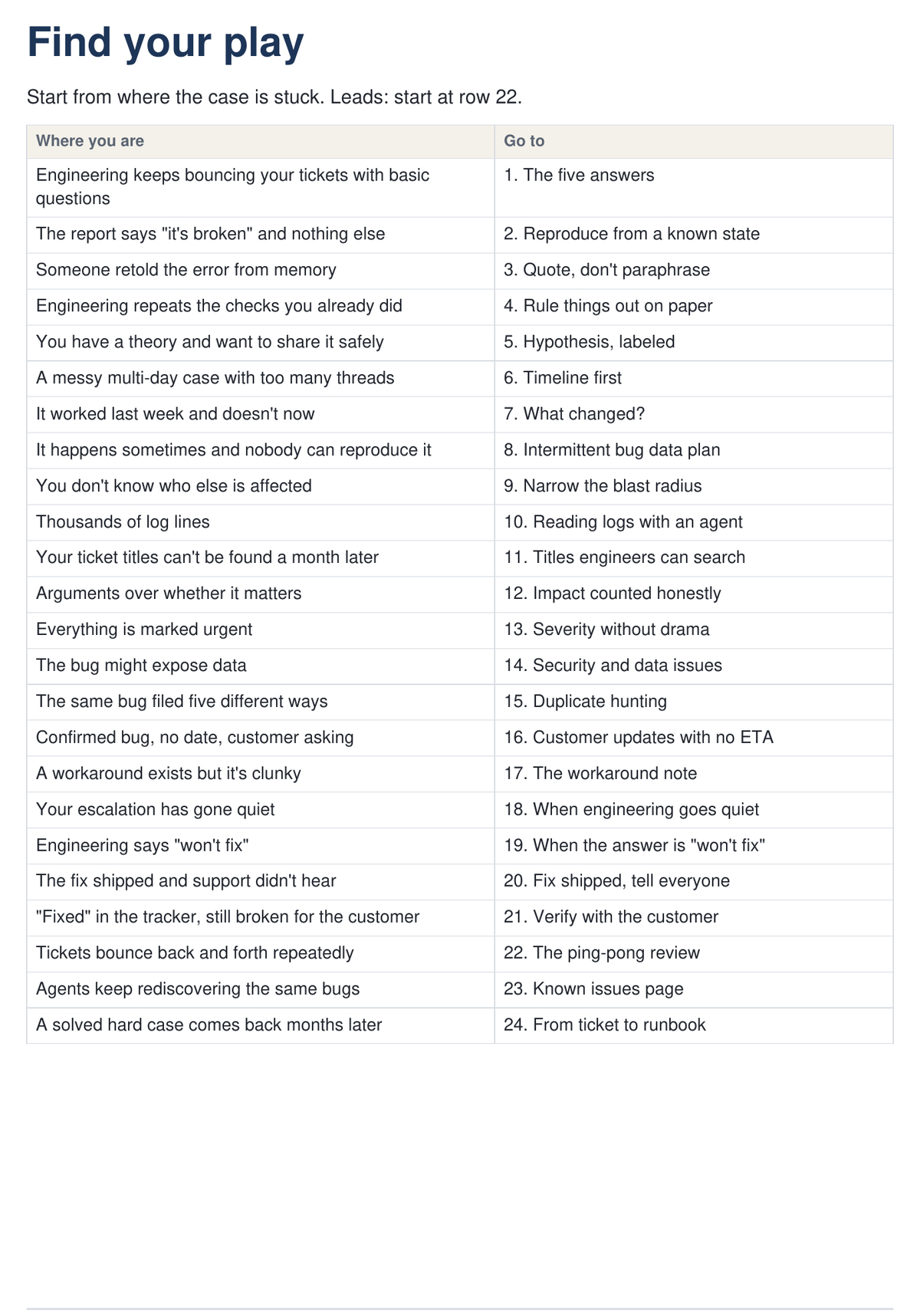
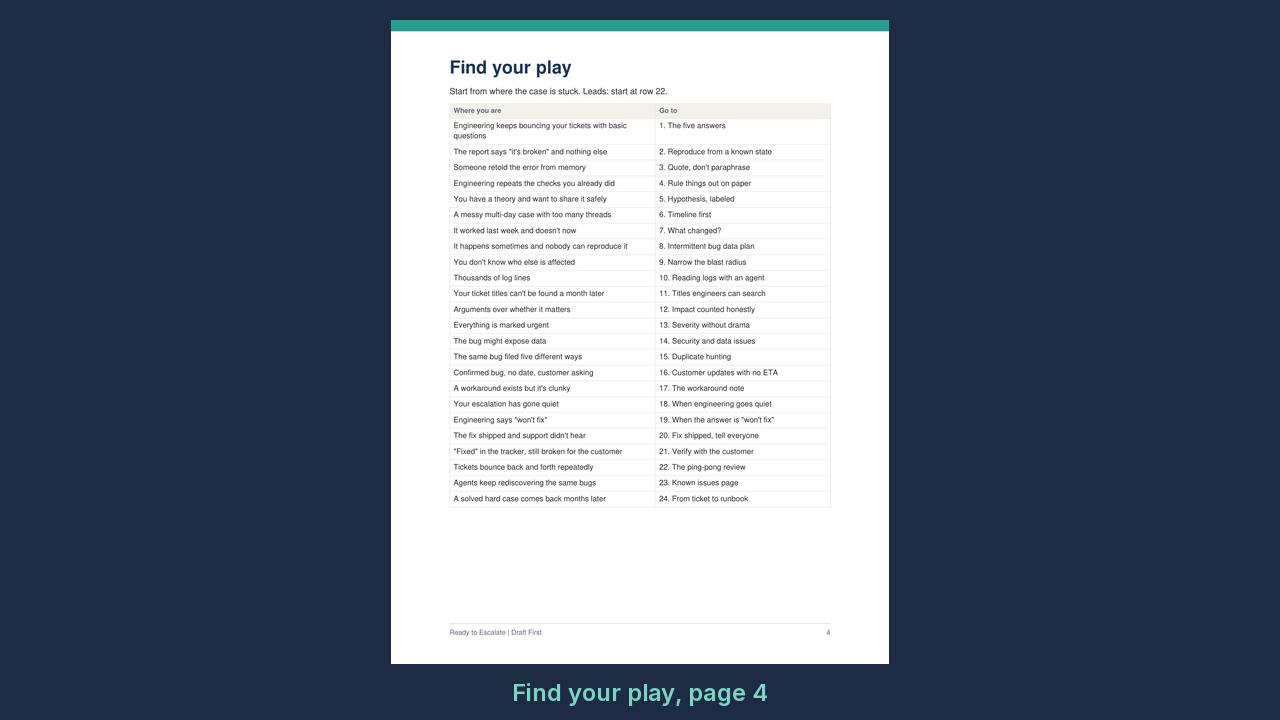
Find your play, page 4
What's inside
- 24 plays in five chapters: before you escalate, investigating hard cases, writing the escalation, while engineering works, and closing the loop
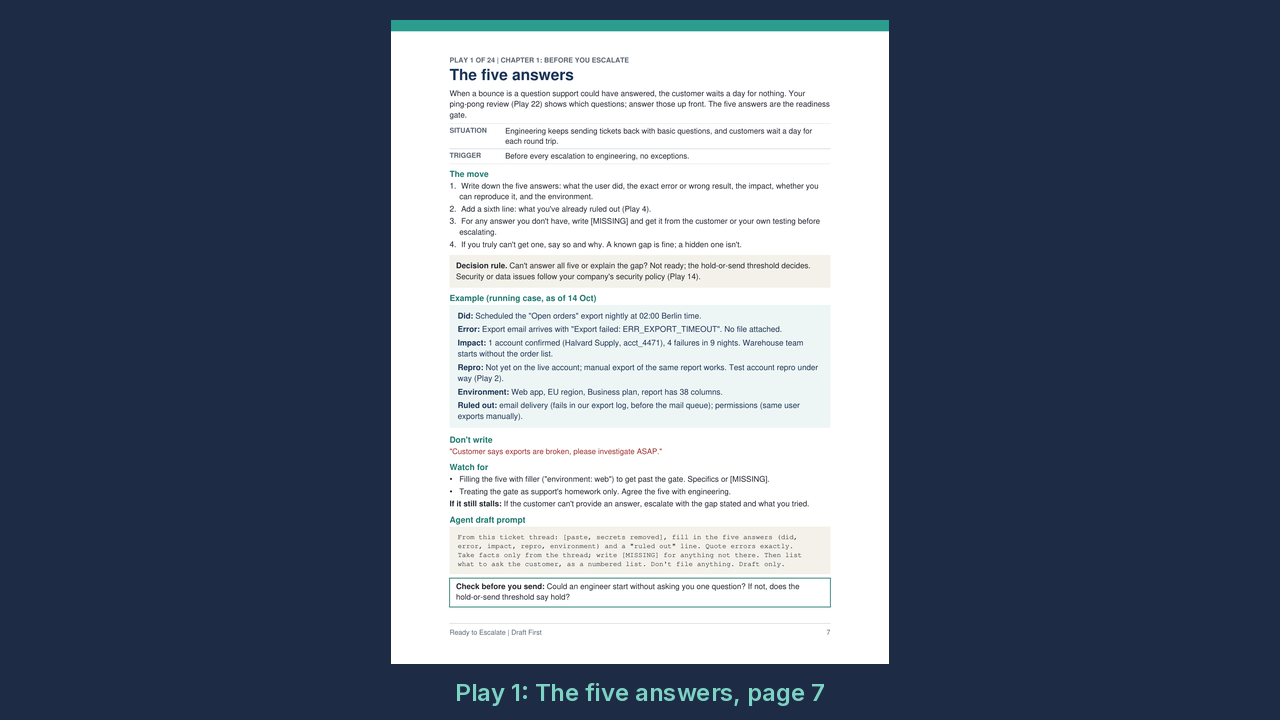
- Every play: situation and trigger, the move, a decision rule, a worked example, "don't write", what to watch for, what to do if it still stalls, a check before you send, and an agent draft prompt
- A "Start here" reading order on the welcome page, one for support engineers and one for team leads
- A running example case that follows one bug through every stage, starting with the vague first escalation and the three bounces it caused
- The case file: the engineer's root cause note, the customer version, and verification across a clock change
- The hold-or-send threshold for escalations with a missing answer
- Four worked judgement calls, and a table of what usual templates ask for and what this book adds
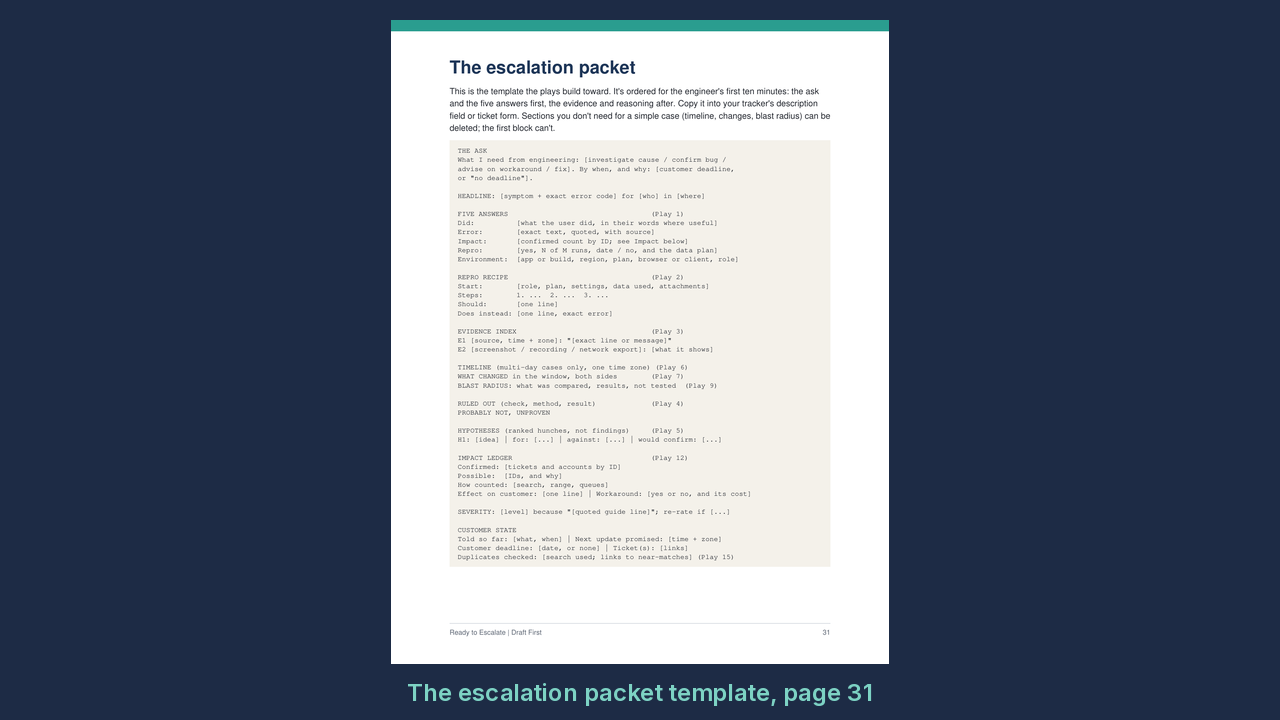
- The escalation packet template, ordered for an engineer's first ten minutes, with a filled-in example
- Five answers checklist, with the question to ask the customer for each missing answer
- Severity worksheet with labelled starting defaults and the reasoning, to agree with engineering
- Measure sheet: bounce rate, reopen rate, fix-to-told gap and more, from your own tracker
- Customer messages: request for missing details, intermittent bug capture steps, no-ETA update, workaround, won't fix, fix shipped
- Ping-pong review sheet, known issues page template and runbook template
- Four longer agent prompts: draft the escalation packet with a readiness verdict, pull exact errors from logs, find duplicates, and draft fix-shipped messages for every linked ticket
- A 44-page PDF, plus a plain-text file of every prompt in the book
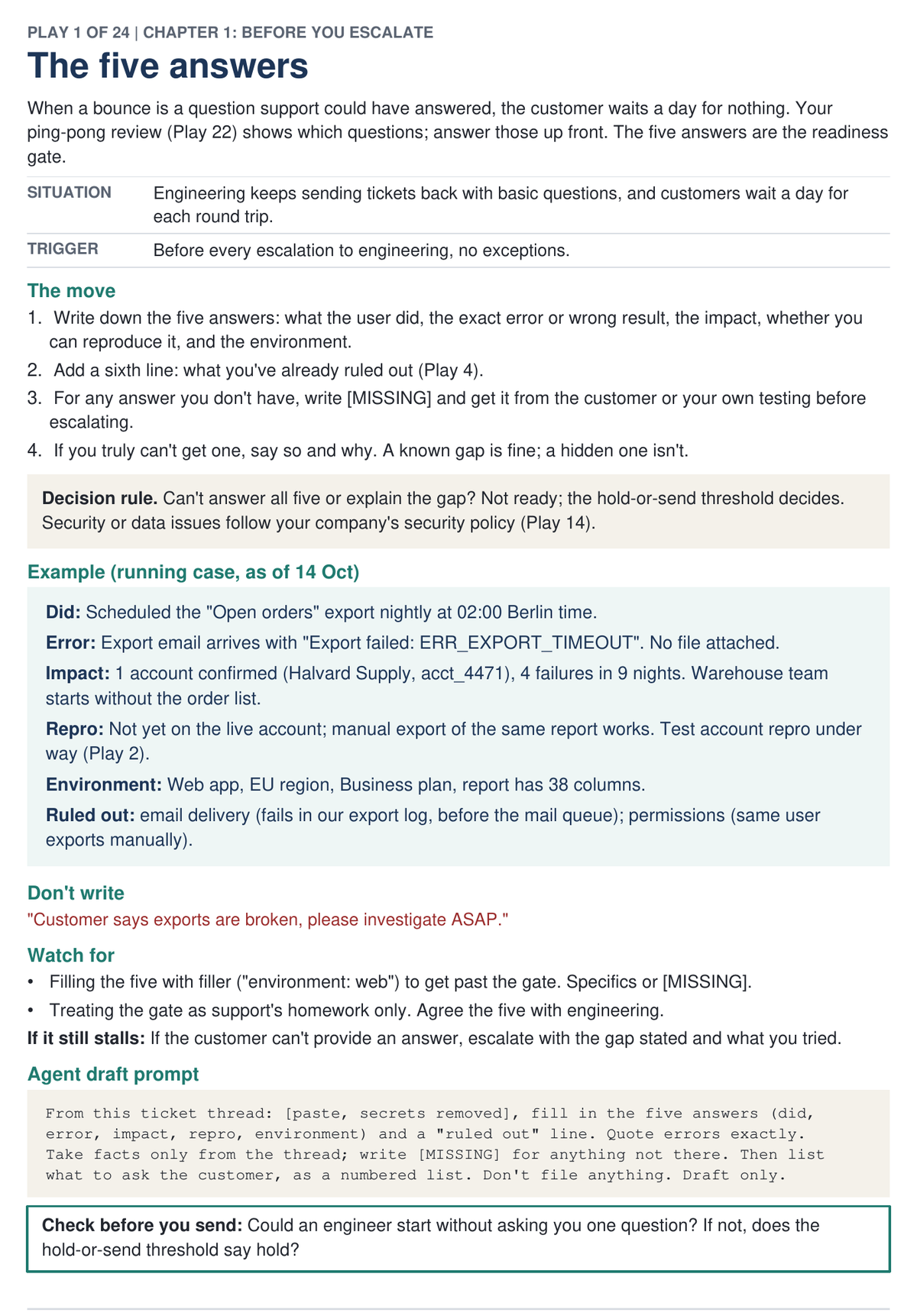
Play 1: The five answers, page 7
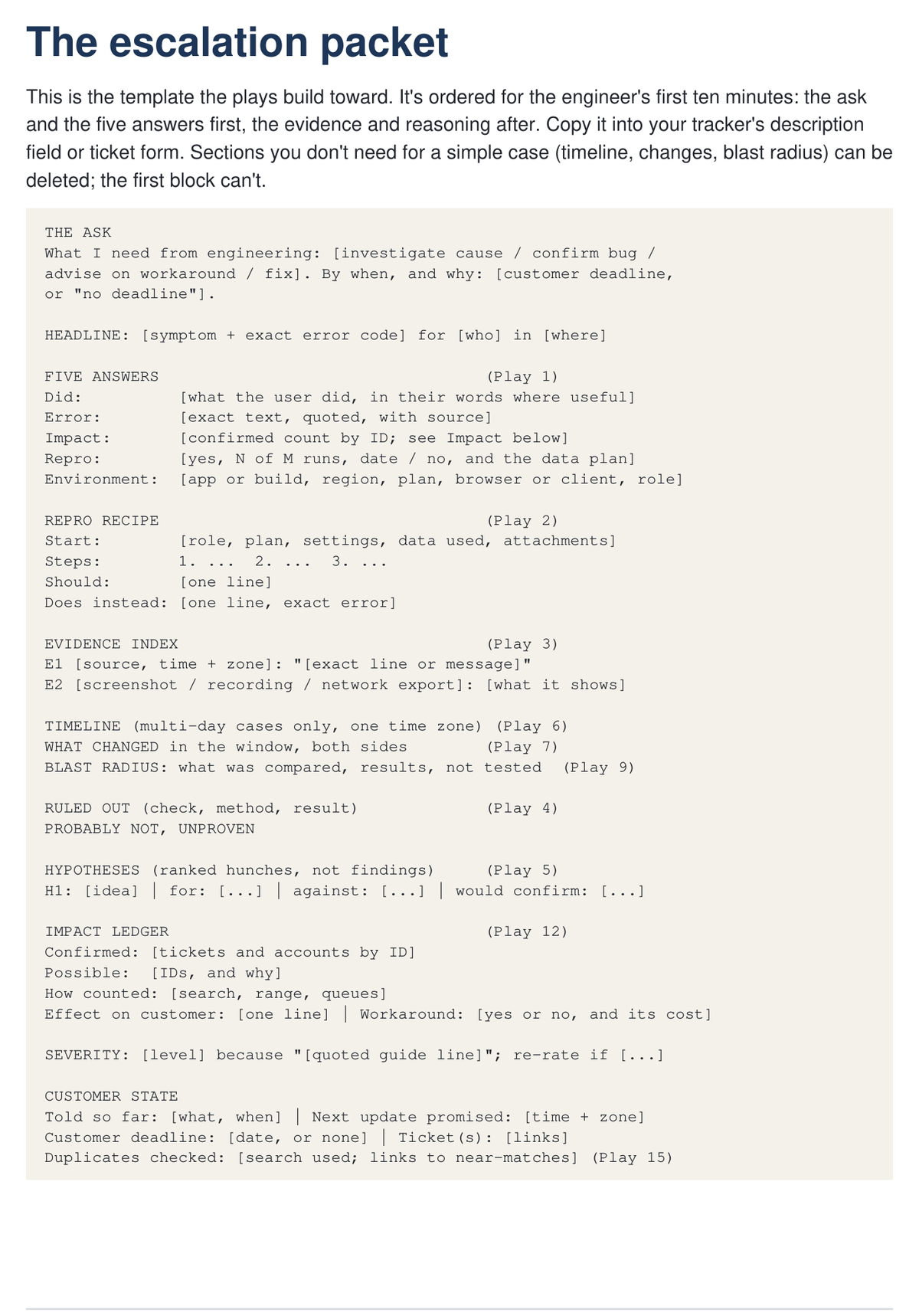
The escalation packet template, page 31
Who it's for
- Technical support engineers and tier 2 or tier 3 support at software companies
- Support leads who want fewer bounced escalations and a shared standard with engineering
- Support engineers who are tired of being the human relay between customers and the bug tracker
Who it's not for
- Teams without an engineering escalation path at all
- Anyone wanting a single bug report template: this is a method for the whole lifecycle of an escalation
Good to know
- Written by Draft First, a customer success and support lead.
- The examples use a made-up product and made-up customers; no real log data appears.
- Agent prompts produce drafts. Strip secrets first and use an AI tool your company approves.
- Security and data issues follow your company's policy; the book says so where it matters.
- Free sample: three complete plays.
- Questions: hello@draftfirstcs.com
- All sales are final, so please read the free sample first.