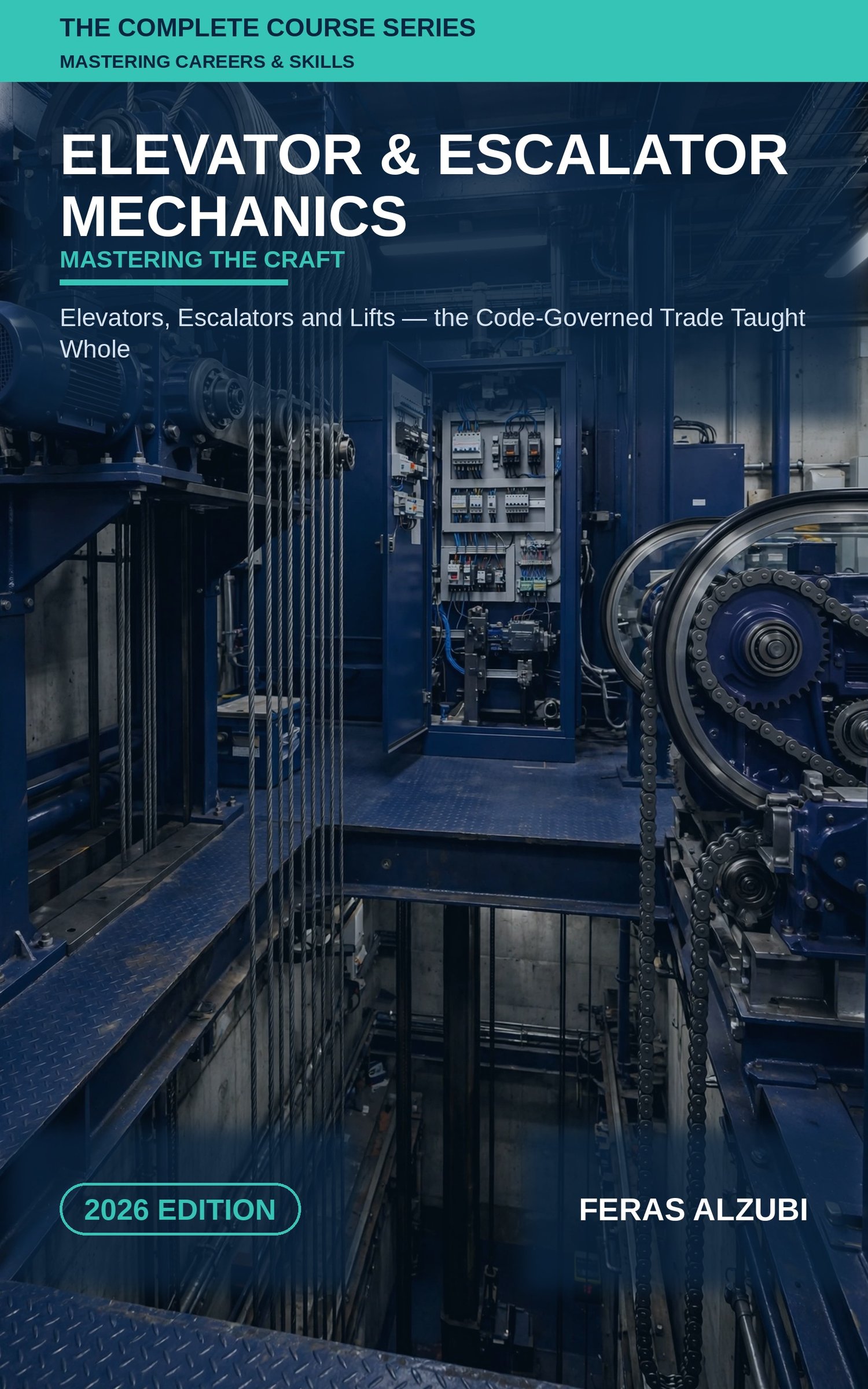
Elevator & Escalator Mechanics: Mastering the Craft
Elevator & Escalator Mechanics: Mastering the Craft
What this book teaches. The full trade of the elevator and escalator mechanic — the occupation classified as SOC 47-4021 — taught A to Z in one volume, from first principles to the finished maintenance visit. The foundations come first: the trade and its people; the code landscape built on ASME A17.1/CSA B44, A17.3, and A17.2 as adopted by the authority having jurisdiction; the safety discipline that stands in front of every task in a hoistway, on a car top, or in a pit; and the electricity, motors, and controls that are the language of every modern installation. Then the equipment in turn. Traction elevators whole: the machine, ropes, and sheaves; the governor, safeties, and buffers that form the overspeed and falling-car protection chain; doors and entrances, the highest-risk interface in the system; and controllers and drives from relay logic to variable-voltage variable-frequency control. Then hydraulic elevators, escalators, moving walks, dumbwaiters, and freight elevators, accessibility and residential lifts, and machine room-less and modern systems. The book closes with the working mechanic's craft: maintenance under a written maintenance control program, the testing regime of periodic, acceptance, and category tests, the inspector's world and the QEI credential, troubleshooting method, emergency operations from entrapment response to fire service, modernization, and the career itself — apprenticeship, state licensing, and the NAEC certifications. Every system is taught so you can explain it, test it, and trust your conclusion.
Who it is for. Apprentices and helpers who want the whole trade in one place, with names, systems, and code reasoning for what their hands are learning; working mechanics who want to formalize their knowledge, fill the gaps habit leaves behind, and strengthen the code and testing knowledge that inspections examine; mechanics moving between equipment families — hydraulic to traction, construction to maintenance, or adding escalators and accessibility lifts; and the building professionals who work beside this trade — facility engineers, property managers, and consultants — who need to understand what their elevator contractor does and what the code requires. No general book replaces the code as adopted in your jurisdiction or the documentation for the specific equipment in front of you — the book teaches the systems, the code's structure and reasoning, and the method.
What's inside (every count verified against the actual book):
Complete course — 20 chapters in five parts, foundations to the career
340 practice questions — every answer explained, right and wrong
40-question diagnostic — scored by domain, with a routing worksheet
240 chapter questions — a 12-question check closes every chapter
60-question final review — sampling the whole trade, with routed re-study
40 labeled figures — system diagrams and protection-chain maps, two in every chapter
22 tables — code data, sequences and reference data for the field
150-term glossary · 8 cheat sheets · 3 study plans — the two-week sprint, the six-week standard, and the twelve-week deep study
The code taught as a system — A17.1/CSA B44 structure, the AHJ, and how requirements hang together as safety systems
Every one of the 340 questions is original, written for this book, and every explained answer tells you why the right answer is right and why each wrong answer is wrong. The book's code and standards facts rest on verified sources, listed in a Sources & Verification Note at the back of the book: ASME A17.1/CSA B44, A17.3, A17.2, and A18.1 as adopted by the authority having jurisdiction, the SOC 47-4021 occupation definition, state licensing, and the NAEC CET/CAT and QEI credentials. Safety is structural throughout — no procedure in the book outranks the safety discipline, and no item teaches a defeated safety circuit, a bypassed interlock, or unlicensed work as correct.
Read the first chapter free — the sample on this page is Chapter 1 of this book, exactly as it appears in the full edition.
From the Mastering Careers & Skills library — complete A-to-Z professional teaching books for careers, trades, and certifications.
This book is an independent teaching work. ASME, CSA, NAEC, NAESA International, and NEIEP are named as the public standards bodies and credentialing organizations they are; this book is not published by, endorsed by, or affiliated with any of them. It teaches the trade and its code — elevator mechanics are licensed in most states, and the license, like the CET, CAT, and QEI credentials, is issued by its own body under its own requirements; this book does not itself confer a license or a certification.
Refunds: Please read the free sample chapter before you buy. This is a digital ebook, delivered instantly by download. If the file is defective, or you cannot open or download it and we cannot fix the problem, you will receive a full refund — email us within 14 days of purchase. Because the book is delivered instantly as a downloadable file, all other sales are final.
How to read this book (EPUB format): After checkout, download the EPUB file, then open it in any free ebook reader app. On iPhone or iPad: Apple Books — it is already on your device. On Android phones and tablets: Google Play Books (free: https://play.google.com/store/apps/details?id=com.google.android.apps.books) — upload the file in the app — or ReadEra (free). On a Windows or Mac computer: Thorium Reader (free: https://thorium.edrlab.org) or Adobe Digital Editions (free). On Kindle: use Amazon's free Send to Kindle (https://www.amazon.com/sendtokindle) to add the file to your Kindle library.