
AI Output Fact-Check & Source Verification Tracker
AI writes with total confidence — and sometimes total fiction. A hallucination comes with no warning label: invented statistics, misattributed quotes, non-existent studies and outdated market data arrive in exactly the same polished tone as accurate information.
In NP Digital's 2026 survey of 565 US marketers who use AI, 47.1% met AI inaccuracies several times a week, and 36.5% said hallucinated or incorrect AI content had already gone live. More than 70% of those marketers spend one to five hours a week fact-checking AI output. In Ahrefs' 2026 survey of 301 marketers, 66% trust AI content only after a human reviews it — and 2.7% trust it with no review at all. One uncaught error in a client deliverable can damage a reputation that took months to build.
This tracker is your second reader, in spreadsheet form. One row per claim, the source the AI gave you, the primary source you checked yourself, and a verdict that says keep, fix, or cut.
WHAT YOU GET
A formula-driven Excel workbook with 5 sheets:
1. Start Here — the method, the rule in one paragraph, the worked example, and why November 2026 is the moment: the two 2026 surveys, Google's rater guidelines, and the practical verification guides that appeared in September and October 2026.
2. Claim Log — one row per verifiable claim in an AI draft. Fill in the type and the risk, paste the source the AI gave you, then check the primary source yourself and record the result. "Risk points" and "Verdict" are formula-driven: Matches keeps the claim, Close — fix means rewrite it, Contradicts or Not found means cut it, Not checked means do not publish it.
3. Risk Guide — which claim types carry high risk and what to check for each. Specific numbers, recent events, biographical details of less-famous people, legal specifics and product features or prices are high risk and need a primary source. General explanations and process descriptions are low risk and need only a sanity check.
4. Trusted Sources — the documents and pages you already treat as true: your pricing page, product data, signed contracts and published reports. Log each one, when you last checked it, and whether it is still current.
5. Dashboard — headline counts: claims logged, verified and kept, to fix, to cut, unverified, the percentage verified, total minutes spent checking, high-risk claims, and high-risk claims not yet checked. One next action tells you what to fix first, plus claims by type.
WORKED EXAMPLE INCLUDED
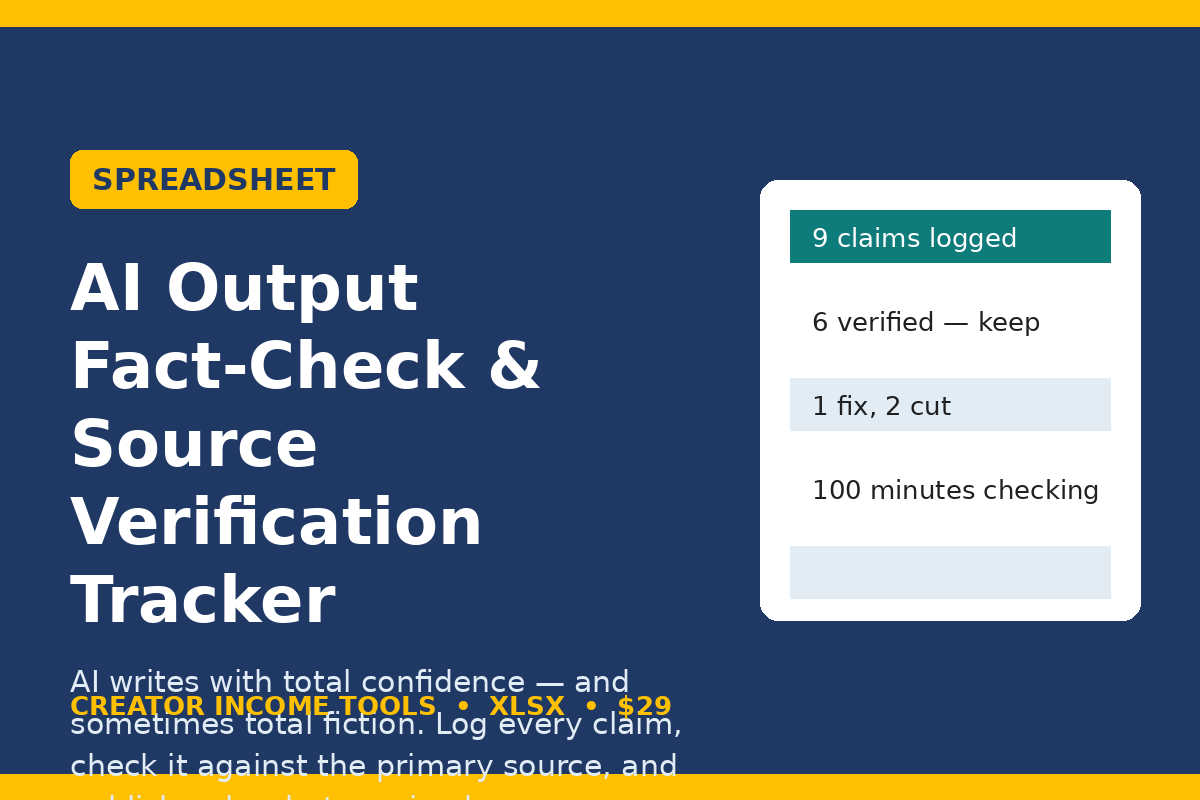
9 claims from one AI-drafted blog post, "How small creators can grow in 2026". 6 verified and kept, 1 to fix, 2 to cut, 0 unverified — 66.7% verified, 100 minutes spent checking. The claim to fix is the EU AI Act fine: the draft said €35 million, but transparency breaches under Article 50 carry fines up to €15 million or 3% of worldwide annual turnover — the €35 million figure applies to prohibited practices. The two claims to cut: "TikTok auto-labels all AI content" (creators must label realistic AI content themselves) and "the average newsletter open rate in 2026 is 52%" (no primary source supports it; published averages are about 37–41%). Delete the example rows and start with your own AI drafts.
THE RULE, IN ONE PARAGRAPH
Ask the AI for its sources as full links, not titles. Then open the link yourself and find the exact sentence the claim is supposed to prove — a link that works proves nothing by itself, because AI can link a real source and still make up the fact. Run four checks on every high-risk claim: does the source say this at all; did the draft keep the source's words or swap one; what does the number actually measure, whose is it, and where; and when was it measured and published. Apply the two-source rule before you use any statistic in a client deliverable: confirm the same claim in at least two independent, credible sources — if you can only find it in the AI output and nowhere else, do not use it as a hard number. If it matches, keep it. If it is close, fix it. If it contradicts the source or cannot be found, cut it. Never verify an AI statistic by asking another AI, and never verify a legal claim by reading a blog post that summarises the law.
WHAT IT IS NOT
This tracker records fact-checks and verdicts. It is general information, not legal advice: verify legal and regulatory claims against the regulator's own site or the legislation text, and ask a qualified lawyer if a claim affects a client's legal position. Survey figures in the worked example are from vendor surveys (NP Digital, Ahrefs, beehiiv, Mailmend) and are only as good as those surveys; re-check any figure against the original report before you publish it, and re-check your Trusted Sources list every 90 days.
Publish only what survived the check.