
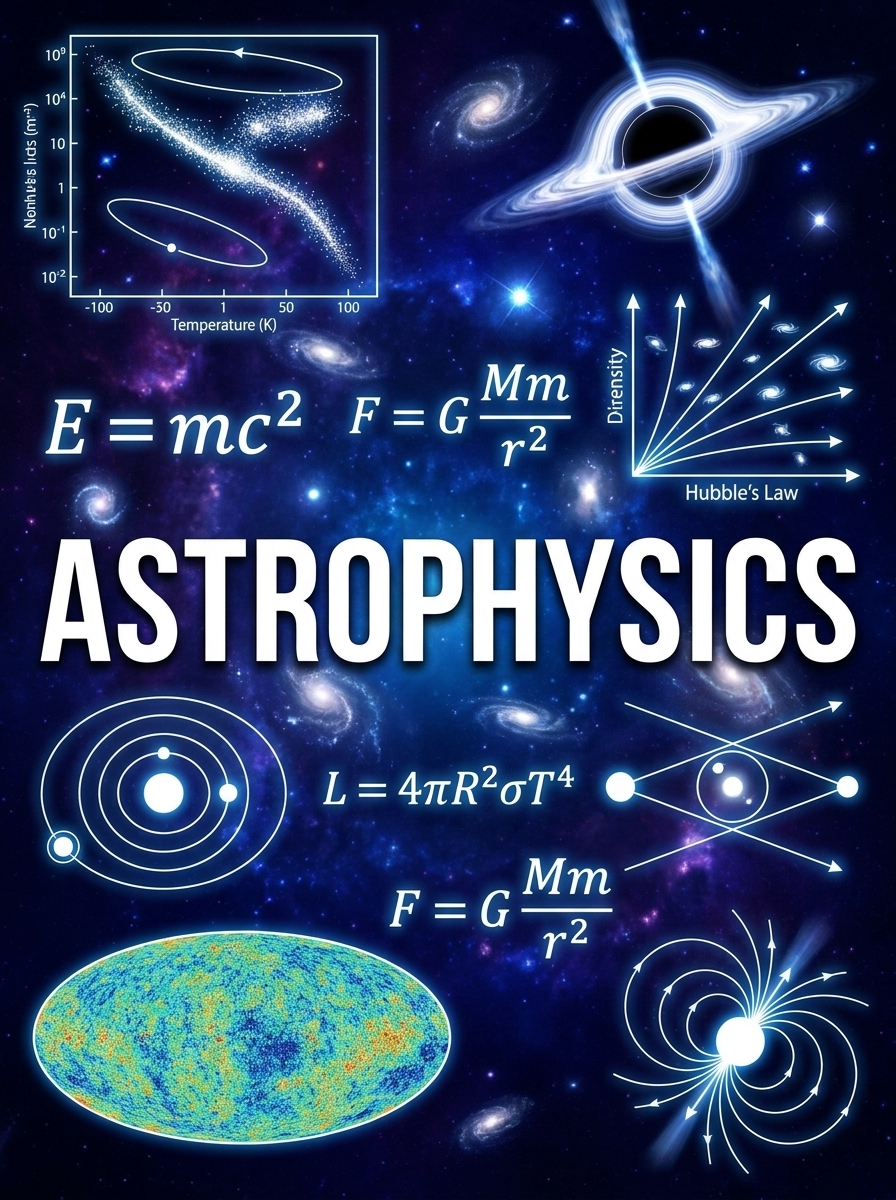
🌌 Astrophysics Without the Misery
🌌 Astrophysics Without the Misery
The observable universe is about 93 billion light-years across. Astronomers state that number with real confidence, down to the decimal — but no human being has ever traveled past the Moon. Nobody has stretched a tape measure across a galaxy or radioed back a distance from anywhere. So how do they actually know?
This book answers that question properly. Starting from the simple fact that nothing in deep space can be reached or pinged, you'll build up through every tool astronomers actually use to measure the universe — and how those tools check each other.
🔍 WHAT'S INSIDE:
📡 Why light is the only messenger — and why looking into space means looking back in time
📏 Parallax: the one technique that works like an actual geometric ruler (and why it stops working past a certain distance)
💡 Standard candles and the inverse square law — how known brightness becomes calculated distance
🌈 Redshift and blueshift, explained properly — including why redshift does NOT mean something is physically racing away through space
📊 Spectroscopy: how astronomers read a galaxy's "barcode" to measure its motion
📐 Hubble's Law — the real math, plus how flipping one formula gives you the age of the universe itself
⚠️ A "3 Common Mistakes" chapter covering the misunderstandings almost everyone falls into
🧮 A Formulas & Quick Reference appendix — inverse square law, redshift, Hubble's Law, and the actual magnitude scale professional astronomers use, all with worked examples
✏️ 9 fully worked examples with every step shown
✅ 10 practice problems with complete answers at the back
🎯 WHO THIS IS FOR:
Anyone who's ever wondered how we know how far away a galaxy is. Anyone taking an astronomy or physics course who wants the logic behind the numbers, not just the numbers. Anyone who wants to understand what "looking back in time" actually means, and why it's not just a poetic phrase.
📘 No prior knowledge of physics required. 32 pages.