
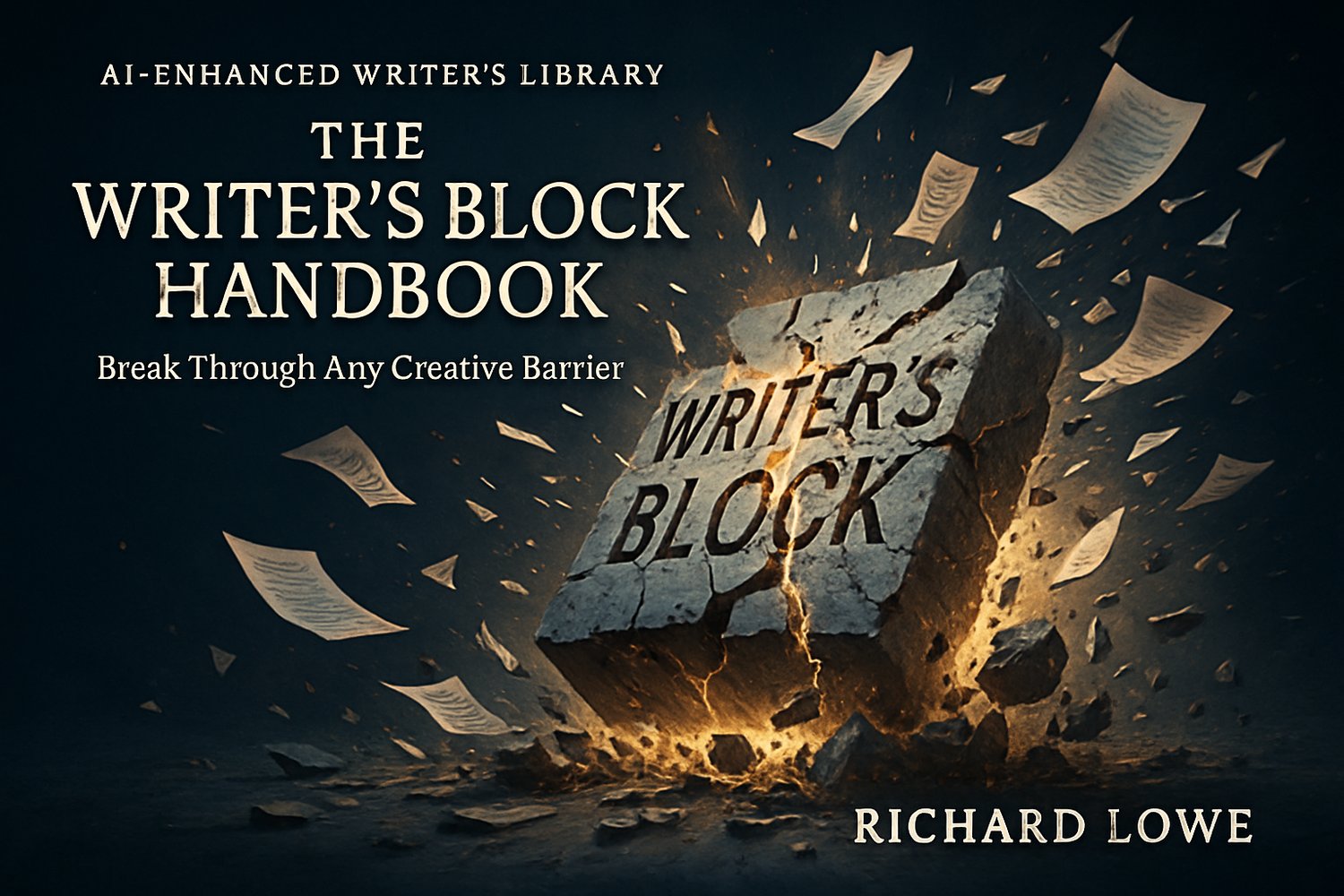
AI-Enhanced Writer's Block Handbook
Stop Calling It "Writer's Block" Like It's One Problem When It's Actually Four
"Just write." "Push through it." "Real writers don't get blocked."
Thanks. Very helpful. Like telling someone with a broken leg to walk it off.
Yale researchers proved decades ago that writer's block is a documented psychological condition with measurable patterns. Blocked writers who understand their specific type recover faster than those who just white-knuckle through it.
Here's why generic advice fails: calling all creative paralysis "writer's block" is like calling every car problem "engine trouble" and wondering why the same repair technique doesn't fix flat tires, empty gas tanks, and broken windshields. The perfectionist frozen by fear needs different medicine than the writer whose imagination has gone dark.
The Four Types of Writer's Block
Based on Yale research by Singer and Barrios. The diagnostic quiz in the handbook identifies your dominant type.
The anxious writer feels fear of failure, grinding dread, and constant self-editing. The root cause is perfectionism and the inner critic. Every sentence carries the weight of potential failure. The joy that once came from writing has been replaced by grinding dread. You can daydream about your story, but the moment you try to capture those images in words, the inner critic takes over. You write a sentence, reread it, change a word, reread it, delete the whole thing, start again. An hour passes. Twelve words on the page.
The angry writer feels rage at comparison, irritability, and fear of judgment. The root cause is external criticism and envy avoidance. Block comes from external judgment, not internal perfectionism. You don't want your work compared to others. The thought of readers finding your book lacking fills you with rage you can barely articulate. Or the opposite: you don't want to succeed too visibly because success invites envy.
The apathetic writer feels creative deadness. They can't visualize, and nothing interests them. The root cause is imagination shutdown and burnout. Your imagination feels shut down. You can't visualize scenes, can't generate ideas, can't feel the story the way you used to. The rules of good writing feel like a prison. Everything feels like it's been done before. The problem isn't fear or anger. It's flatness.
The disappointed writer has motivation that depends on validation, constantly checking stats. The root cause is external validation dependence. You check reviews and sales numbers constantly. You only want to write if it's going to lead somewhere. Poor sales or lack of attention kills your motivation. You've abandoned projects because they weren't getting traction.
The Neuroscience of Stuck
Understanding why blocks form helps you reverse them.
The default mode network is the part of your brain that generates creative ideas. Stress responses shut it down. Your "blocked" state is often a suppressed DMN. The prefrontal cortex is where your inner critic lives. When it's hyperactive, it vetoes ideas before they reach conscious awareness. You experience this as "nothing comes." The dopamine system affects your ability to start. Low dopamine makes starting feel impossible. This isn't laziness. It's neurochemistry working against you. Social pain circuits process criticism using the same circuits your brain uses for physical pain. One harsh review can trigger genuine neurological hurt.
The handbook covers how to reverse each of these mechanisms with targeted interventions.
What's Inside
The handbook covers the four types of writer's block based on Yale research, with a diagnostic quiz to identify your specific pattern. The neuroscience of stuck explains what happens in the prefrontal cortex, default mode network, and dopamine system when blocks form and how to reverse it. Physical factors most writers ignore addresses Computer Vision Syndrome, sleep, diet, movement, and the body-mind connection that sabotages creativity. The criticism shield explains why one negative comment can kill 3,000 words an hour and how to build psychological armor.
Managing your inner critic covers where the voice comes from, its favorite tactics, and techniques for turning down its volume. The 45-minute rule explains why shorter sessions work better for blocked writers and exactly how to structure them. Separating writing from editing addresses the death spiral that keeps you stuck on the same paragraph and how to break it.
Plus chapters on voice dictation workflows, emergency unblock protocols including garbage draft, private file, and wrong genre techniques, type-specific AI solutions, building block resistance, ADHD-specific strategies, and the complete AI prompt library.
Built for Writers Who Use AI
AI becomes powerful when you're blocked. Not for writing your book, but for breaking through the paralysis.
When you're stuck on what happens next, AI can generate ten possibilities in seconds. You won't use most of them. But one might spark something. When your inner critic won't shut up, AI can help you argue back. When you can't visualize your scene, AI can describe it multiple ways until something clicks.
The handbook includes type-specific AI prompts designed for each block pattern. The anxious writer needs permission to be imperfect. The angry writer needs outlets for frustration. The apathetic writer needs stimulation and novelty. The disappointed writer needs to reconnect with intrinsic motivation.
Different types require different prompts. Generic "help me write" requests waste your time. Targeted prompts matched to your specific block get you unstuck.
From an Author With 113 Published Books
My ghostwriting clients have secured over $30 million in venture capital with manuscripts that got finished despite creative paralysis. Not through willpower, but through understanding how blocked writers actually recover. I'm also AuDHD. Diagnosed at 50, after decades of boom-bust creative cycles: hyperfocus sessions that produced entire books in days followed by periods where nothing came at all. I've experienced every type of block in this handbook. That's how I know the fixes work.
The breakthrough came when I discovered the Singer and Barrios research from Yale. They studied blocked writers for months, running nearly sixty psychological tests. What they found: every blocked writer was unhappy, but they weren't all unhappy in the same way. The unhappiness clustered into four distinct profiles, each with different emotional signatures, different triggers, and different paths to recovery.
153-page writer's block handbook covering four block types, neuroscience-based interventions, emergency protocols, psychological armor, ADHD strategies, and type-specific AI prompts.
The words you've been trying to write are waiting for you to unblock the path.