
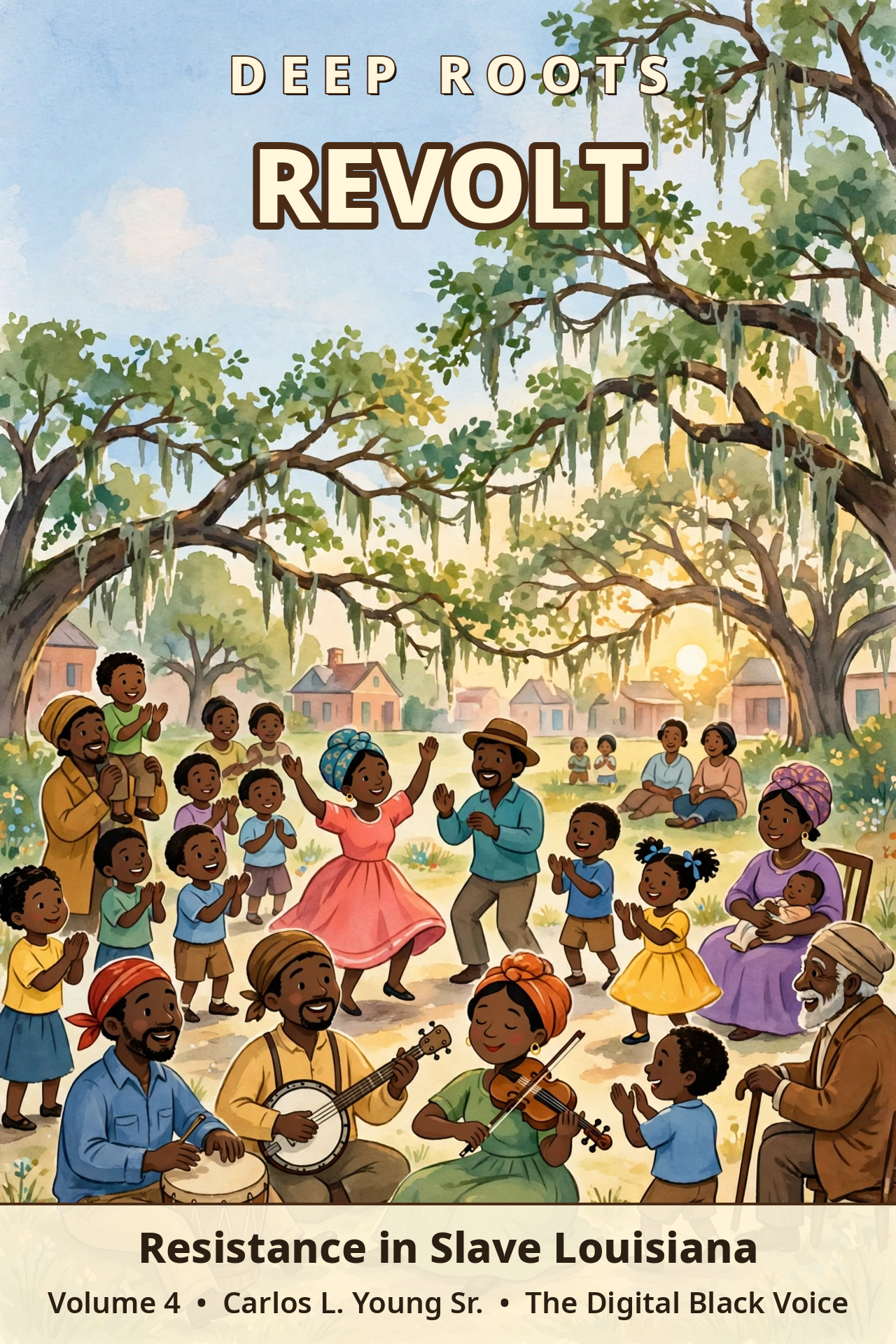
Deep Roots Vol. 4 — Revolt: Resistance in Slave Louisiana (Interactive Edition)
A warning stands at the front of this book, and it is the book's method: the record of these revolts was written by the men who crushed them. Everything here is read against that grain — sourced, attributed, and corrected where the popular versions inflated it.
Pointe Coupee, 1795: the conspiracy in the cypress swamp, and the trial record's own arithmetic — 57 convicted plus 3 more, 23 hanged. The German Coast Uprising, 1811: the largest revolt of enslaved people in American history, told with its numbers held to the eyewitness record — the participants are given as the range the evidence supports, 150 to 500, everywhere the book prints them. You will not find the flat "500" of the popular accounts here, nor the famous line about "sixty miles of pikes" — this book checked, and does not repeat them. Charles Deslondes, the revolt's leader: an enslaved driver, killed January 11, 1811, without trial — and no likeness of him exists, so this book shows you none. Congo Square, where an 1817 ordinance and Benjamin Latrobe's notebook (February 21, 1819) document the one ground where the culture survived out loud. Solomon Northup, kidnapped, enslaved in Louisiana, freed at Marksville on January 4, 1853 — and Patsey, whose life after 1853 the record does not document, and whose story this book therefore does not finish for her.
Inside the Interactive Edition:
- The complete book — all 6 chapters, full text
- Recorded narration by Marcus — about 69 minutes, every chapter read aloud
- A chronological timeline that jumps straight to the chapter behind each date
- A 10-question educator quiz drawn strictly from the text
- Every chapter closes with its sources and a method note — inflated claims are named and refused, ranges are printed as ranges
- The storybook-style cover, drawn for young readers and the families who read with them
- For educators: a TEKS correlation sheet for this volume is available with the Deep Roots Educator materials — it states plainly that no TEKS standard names any slave revolt, and maps the volume to the resistance expectation in African American Studies
The chapters: Pointe Coupee, 1795: The Conspiracy in the Cypress Swamp · The March on New Orleans: The German Coast Uprising, 1811 · Charles Deslondes: The Name the Textbooks Skipped · Congo Square: The One Ground Where the Culture Survived Out Loud · The Man Who Came Back with the Receipts: Solomon Northup · The Punishment Trail: Terror, Written Down
Two states. One story. All receipts.