
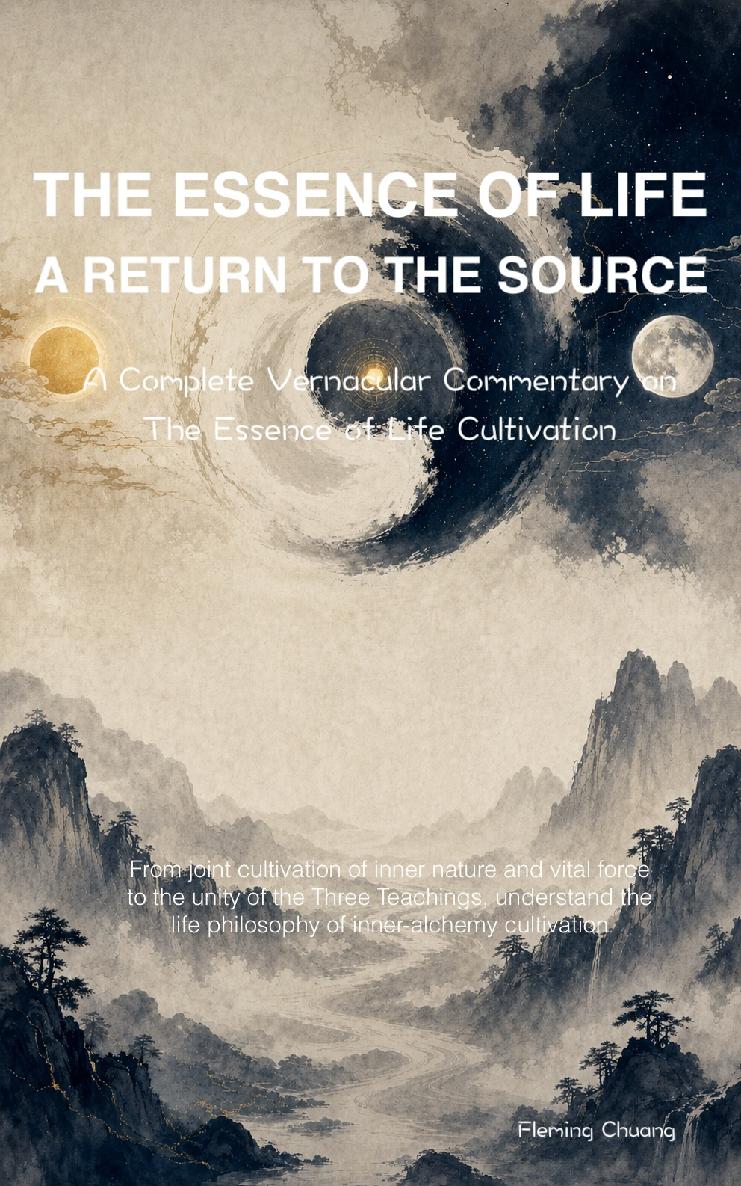
The Essence of Life: A Return to the Source
Can an ancient cultivation text speak to the pressures of modern life? The Essence of Life: A Return to the Source offers a contemporary vernacular commentary on Xingming Guizhi, one of the important texts associated with Daoist inner-alchemy thought.
At the heart of the book is the principle of joint cultivation of inner nature and vital force: the understanding that a complete life requires the simultaneous refinement of consciousness, character, body, essence, and qi. Rather than treating spiritual practice as separate from ordinary existence, this commentary connects classical teachings with questions that remain urgent today—How can we steady the mind? How can we balance effort and rest? How can we transform emotional energy, recover our inner direction, and live with greater clarity?
Organized through the four collections of Yuan, Heng, Li, and Zhen, the book traces a progressive path of cultivation. The Yuan Collection introduces the Dao, qi, the heart, the Hun and Po, the Five Elements, the Dragon and Tiger, Kan and Li, life and death, and the distinction between the true and the false. The Heng Collection turns toward foundation-building: settling the spirit, gathering the innate, protecting the original source, and returning attention to the root. The Li Collection explores the gathering and refining of the elixir, the harmony of Qian and Kun, the timing and intensity of inner fire, and the long nurturing of the sacred embryo. The Zhen Collection follows the classical vision toward the emergence of the spiritual infant, the quieting of mind, the refinement of spirit, and union with the Dao.
Throughout, the commentary brings Daoist, Buddhist, and Confucian perspectives into conversation. Its reflections also translate ancient images into modern practices of focused attention, emotional regulation, sustainable work rhythms, restorative rest, self-observation, and the development of meaning beyond material achievement.
For newcomers, this book provides a guided entrance into a difficult and richly symbolic tradition. For experienced readers, it offers a structured companion for revisiting the language of inner alchemy and the enduring question at its center: how might we return to the source of a life that is whole?