
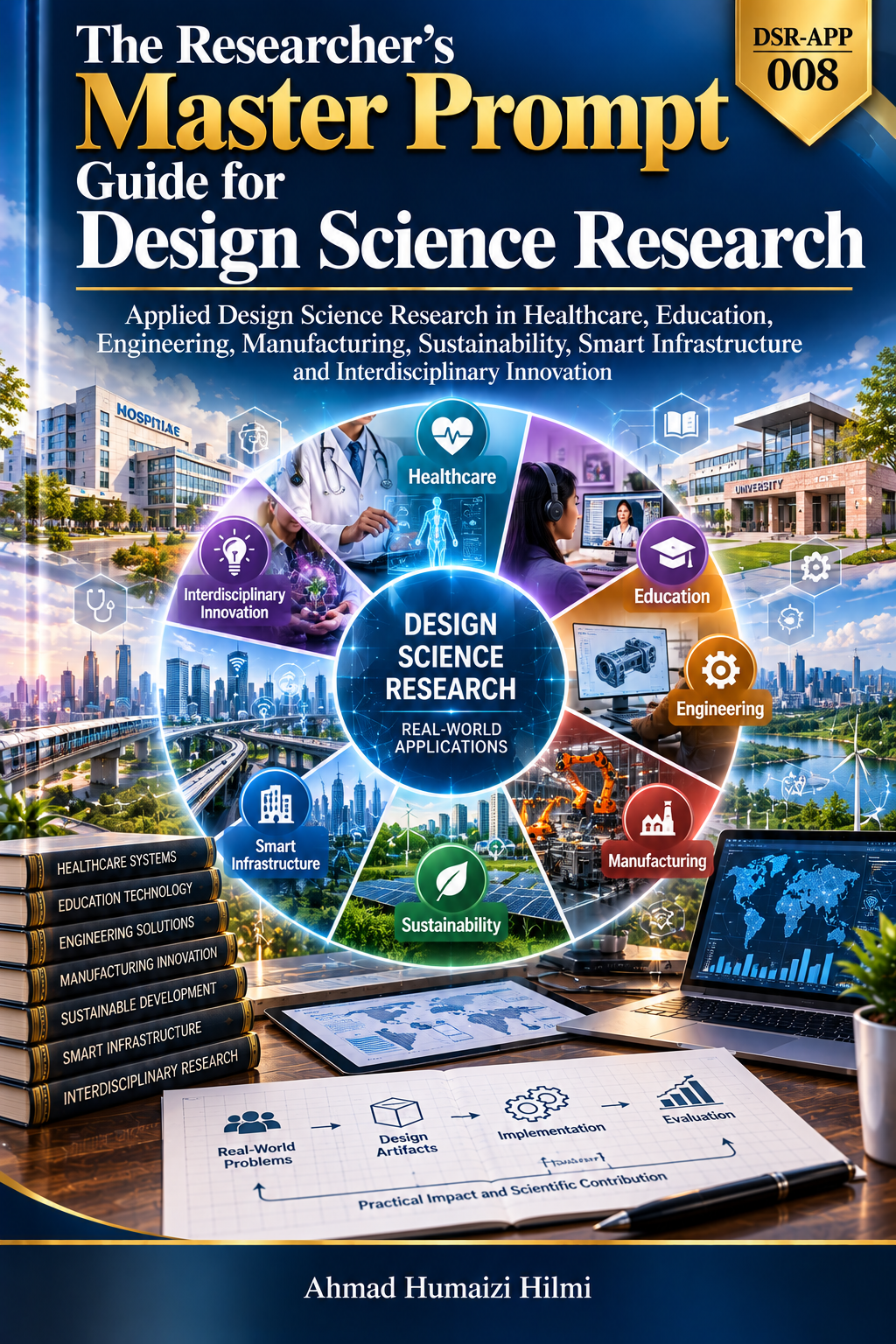
8. DSR-APP-008 — Applied Design Science Research in Healthcare, Education, Engineering, Manufacturing, Sustainability, Smart Infrastructure and Interdisciplinary Innovation
Description
This Master Prompt provides a multidisciplinary framework for applying Design Science Research methodologies to complex practical problems across healthcare, education, engineering, manufacturing, construction, environmental management, sustainable development, public services and emerging technological applications. It examines how domain-specific theoretical knowledge, stakeholder requirements, operational constraints and technological capabilities can be integrated to develop purposeful artifacts addressing real-world challenges. Particular emphasis is placed on the adaptation of Design Science Research principles to different disciplinary contexts, including clinical decision-support systems, mobile health applications, rehabilitation technologies, educational learning platforms, engineering optimization tools, manufacturing process improvement frameworks, smart infrastructure systems, digital twins, environmental monitoring platforms and sustainability-oriented decision models. The framework integrates domain-specific theories, engineering design principles, human-centered design, systems thinking, operations research, process optimization, sustainability assessment, technological innovation and interdisciplinary research methodologies. Researchers are guided in identifying application-specific research problems, establishing contextual requirements, selecting suitable artifact types, developing design specifications, constructing prototypes and evaluating artifacts using discipline-appropriate performance indicators. The Master Prompt addresses patient-centered design, educational effectiveness, engineering performance, operational reliability, manufacturing productivity, environmental sustainability, resource efficiency, accessibility, safety, usability and stakeholder acceptance. It supports the development of interdisciplinary conceptual frameworks, engineering schematics, system architecture diagrams, process flowcharts, simulation models, sustainability assessment matrices, performance comparison graphs and domain-specific evaluation frameworks. Particular attention is given to contextual adaptation, stakeholder engagement, regulatory requirements, ethical considerations, implementation feasibility and the transferability of design principles across different application domains. The framework emphasizes that successful Design Science Research must establish both practical problem-solving value and scientifically defensible design knowledge, while recognizing that evaluation procedures and contribution claims may differ substantially among disciplines.