
4. REV-SCR-004 — Eligibility Criteria, Duplicate Management, Screening, Study Selection and Review Corpus Construction
Description
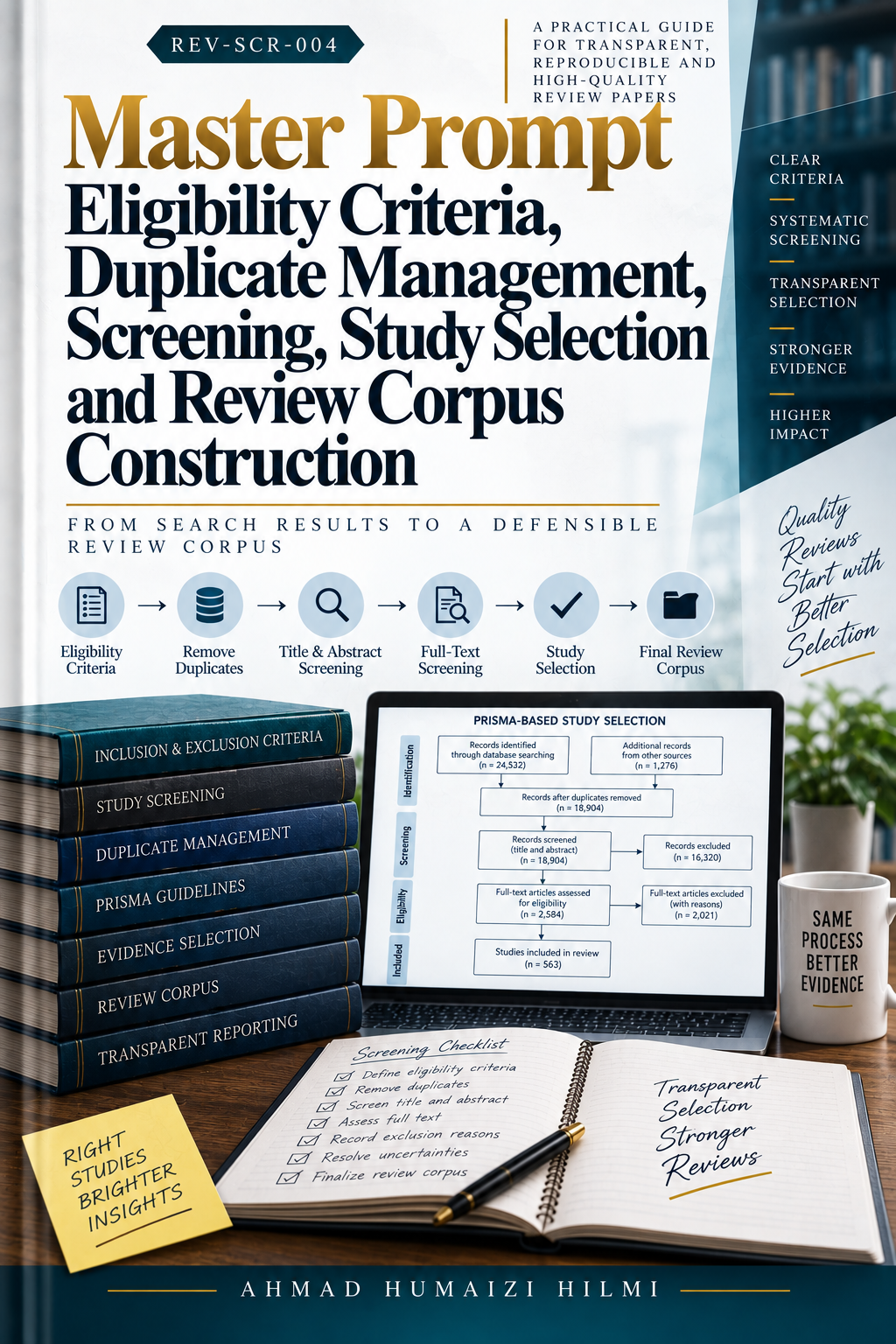
This Master Prompt focuses on transforming the complete set of records identified through database and supplementary searching into a transparent, reproducible, logically bounded, and defensible final review corpus. It guides researchers in translating the previously established review problem, scope, objectives, questions, and search boundaries into explicit eligibility rules; defining inclusion and exclusion criteria for publication type, study design, population, intervention or exposure, technology, phenomenon, outcome, context, geography, time period, language, evidence type, accessibility, and other review-specific characteristics; consolidating records retrieved from multiple sources; detecting and resolving duplicates; conducting title-and-abstract and full-text screening; documenting exclusion decisions; resolving ambiguous cases and reviewer disagreements; and establishing the final collection of studies that will proceed to extraction, appraisal, and synthesis. The uploaded literature demonstrates this progression clearly: one systematic review describes duplicate removal followed by title/abstract screening and full-text eligibility assessment, while its PRISMA-style flow diagram preserves the relationship between identification, screening, eligibility, and final inclusion.
A major emphasis is placed on prospective, question-driven eligibility rather than retrospective evidence selection. Inclusion and exclusion criteria should follow logically from the review question and predefined scope and should not be modified merely because retrieved studies support or contradict a preferred interpretation. Eligibility criteria must therefore be sufficiently specific to produce consistent decisions while remaining conceptually faithful to the review purpose. The uploaded papers illustrate different forms of legitimate eligibility architecture. The childhood-loss scoping-review protocol, for example, specifies empirical peer-reviewed and grey literature, English-language publication and a 2000–2025 period while imposing no restrictions by study design, geography, race, or ethnicity; by contrast, the systematic review of children's engagement required studies to compare the same books in paper and ebook forms. Such differences demonstrate that eligibility criteria should be derived from the intellectual function of the review rather than copied mechanically from another review methodology.