
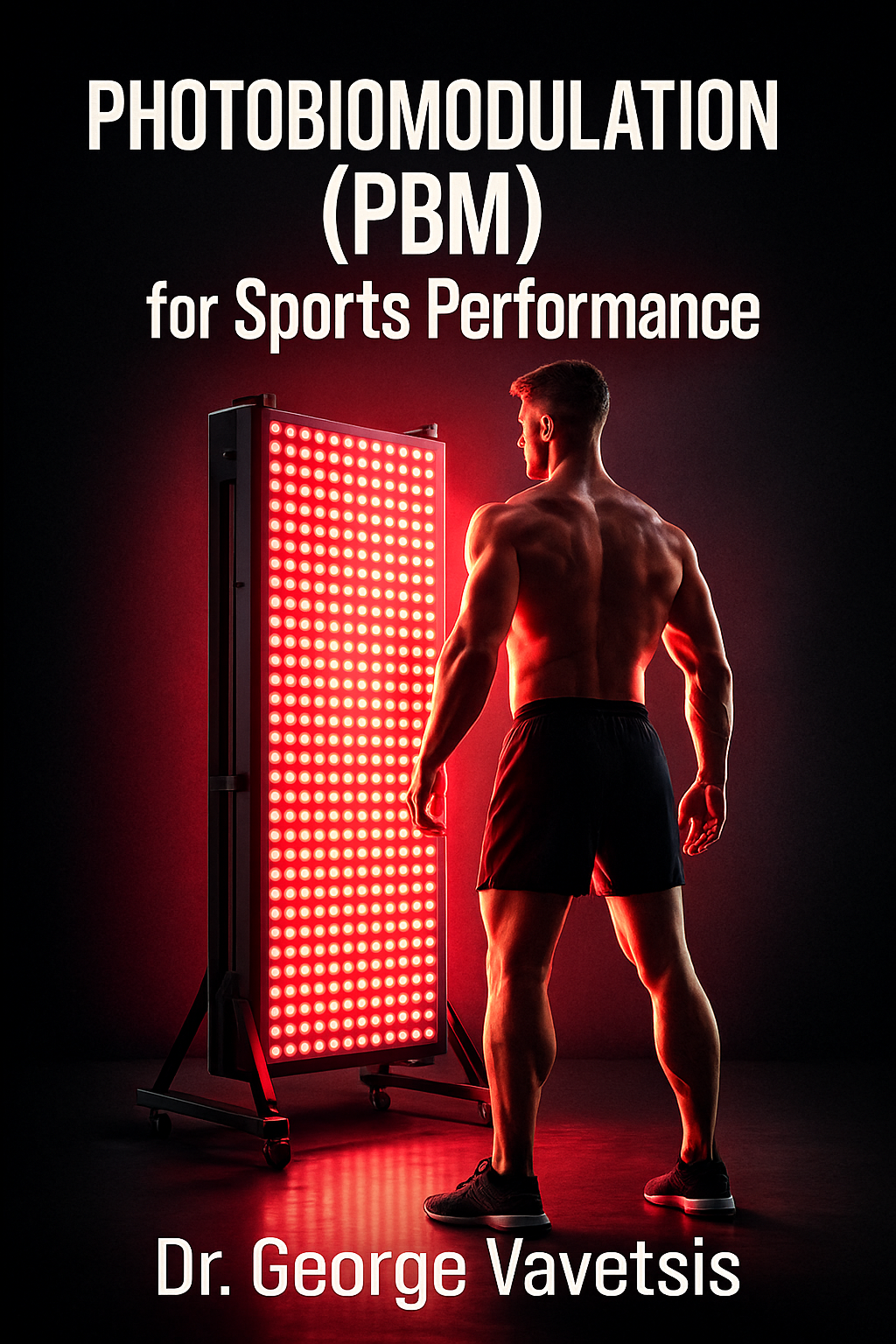
Photobiomodulation (PBM) for Sports Performance
Pages: 288
In the relentless pursuit of human performance, athletic preparation has evolved far beyond the boundaries of traditional strength and conditioning. Today, elite sport is a complex biological puzzle—one that demands a seamless integration of physiology, neuroscience, technology, and precision-driven recovery strategies. Amid rapid innovation across sports science, one modality has stepped into the spotlight as a unique bridge between cellular bioenergetics and applied performance: Photobiomodulation (PBM). This book has been written to illuminate that bridge.
Photobiomodulation, once primarily explored within clinical rehabilitation, has emerged as an influential tool capable of optimizing adaptation and unlocking higher-quality training outputs for athletes. By stimulating mitochondrial function, improving tissue perfusion, modulating calcium kinetics, stabilizing membrane potentials, influencing neural transmission, and accelerating recovery, PBM allows the human organism to operate closer to its true limits. It enhances not only how athletes train — but how they recover, how they sustain performance, and ultimately, how they compete.
The modern athlete operates on the razor’s edge between functional overload and dysfunctional fatigue. Training systems are planned with mathematical precision; nutrition and sleep are monitored relentlessly; psychological readiness and neurocognitive performance are constantly evaluated. In such a high-performance landscape, even marginal gains become decisive. PBM offers more than marginal improvement — it offers a biological advantage where it is often most difficult to achieve one: inside the muscle cell, inside the neuron, inside the machinery of human energy.
As a strength and conditioning coach or sports scientist, the central mission is enabling optimal progression without compromising longevity. Load tolerance must rise without excessive tissue cost. Recovery must accelerate without blunting adaptation. Athletes must express maximum power and speed while maintaining physiological resilience. PBM serves exactly this mission. Integrated properly within periodization and carefully dosed within training cycles, it becomes a silent force multiplier — improving cellular readiness before training, and restoring homeostasis after it.
Despite its demonstrated value, PBM remains misunderstood, under-utilized, and inconsistently applied in sport settings. Coaches often ask: Which wavelength? What power density? How many Joules? How frequently? Which muscle groups? Pre-training or post-training? How do we ensure adaptations are supported rather than suppressed? These are not merely theoretical questions — they are the difference between wasted time and competitive advantage. This book provides the clarity required for precise decision-making.
The structure of this work reflects the demands of applied elite performance. Each chapter connects the underlying biological mechanisms of PBM to specific programming strategies. Rather than isolating theory from practice, mechanisms are always tied to training scenarios: hypertrophy phases, high-velocity power sessions, congested match schedules, eccentric-dominant microcycles, altitude adaptations, and neuromuscular skill acquisition periods. PBM’s interaction with ATP turnover, ETC flux, nitric-oxide-related vasodilation, calcium signaling, myelin conductance, and redox control is explored not as abstract physiology — but as tactical leverage for coaches.
We now recognize that performance enhancement does not happen during training itself — but in the cellular remodeling that follows. A tired muscle does not adapt simply because it is tired; it adapts when its recovery environment is intelligently supported. A highly stimulated nervous system does not develop speed merely from exposure to speed; it requires neural energy resources and conduction efficiency to translate training into progression. PBM contributes directly to these environments.
Athletes today require precision recovery, not just passive rest. They need intelligent tools tailored to the physiological targets of each training block. PBM is that kind of tool: adaptable, data-driven, and synergistic with all modern monitoring systems. It has become possible to measure the exact improvements in bar velocity, SmO₂ kinetics, HR recovery, and set-to-set power maintenance when PBM is integrated into the microcycle. What once was theoretical is now measurable — and what is measurable becomes coachable.
The role of a coach or practitioner is no longer simply prescribing workloads, but orchestrating adaptation. Coaches are now system architects — with biology as the construction material. PBM provides a way to influence biology in real time, shifting the adaptive equation toward faster progression, lower soft-tissue stress, and more stable performance expression.
The purpose of this book is not to claim PBM as a universal solution, but to establish it as a smart component of a high-performance ecosystem — one that respects the principles of dosage, timing, periodization, and individual response. When employed with scientific rigor, PBM empowers athletes to train harder, recover faster, and sustain peak performance deeper into competition calendars.
For the elite athlete, success is often determined not by the difference between good and bad days — but by the difference between good and almost-as-good days. PBM minimizes the drop-off. It preserves quality. It expands the athlete’s resilience envelope. This capacity to maintain outputs when fatigue should dominate is where winning lives.
I invite you to explore this book not just as a manual for PBM usage, but as a blueprint for elevating the standard of performance preparation. The science is here. The methodology is here. Now, the competitive advantage is yours to apply.