
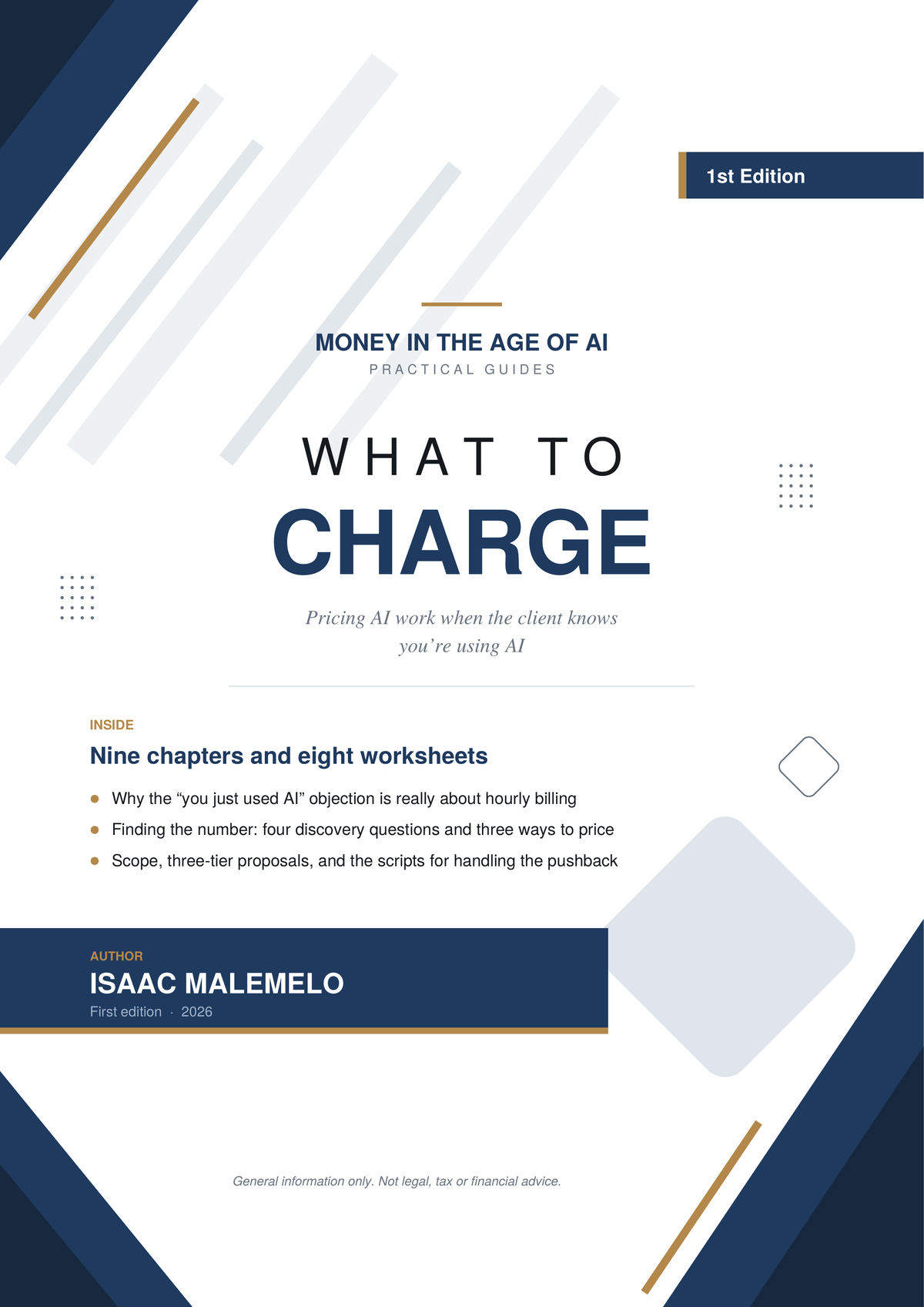
What to Charge: Pricing AI Work When the Client Knows You're Using AI
You charge £60 an hour. The job used to take ten hours, so you invoiced £600. You got good with AI and now it takes three. You invoice £180.
You became three times more effective and took a seventy per cent pay cut.
That isn't a market correction or a sign your skills are worth less. It's the mechanical consequence of selling hours, meeting a technology that compresses hours. Anyone billing time was always exposed to it. AI just made the exposure sudden and obvious.
And then comes the conversation:
"That was quick." "You just used ChatGPT for this, right?" "Can you do it cheaper now? It must be easier."
What to Charge is about the number, how to arrive at it, how to say it out loud, and what to do when someone tells you a machine did the work.
The central argument
The "you just used AI" objection is not really about AI. It's an objection to hourly billing wearing different clothes — and if you bill by the hour, the client is correct. You cannot win that argument, because you agreed to its terms when you quoted a rate. Change the basis and the objection stops making sense.
What's inside — nine chapters
- The Hourly Trap — why the comfortable option is now the losing one
- What Clients Actually Buy — five things you provide that no tool does, and why not one of them gets cheaper because the work got faster
- Finding the Number — four discovery questions, three ways to price, and the floor you never show anyone
- Scope Is the Protection — the six elements, the change clause, and why AI-assisted work needs tighter revision caps than you used to set
- Presenting the Number — three-tier proposals, using the client's own words, and saying the figure out loud
- "You Just Used AI For This" — what's actually being said, whether to disclose, and the confidentiality problem that matters more than any of it
- Agreements and Getting Paid — deposits, terms, kill fees, and the invoice that doesn't reopen a settled decision
- Raising Prices — new clients first, existing clients on notice, and why not to cut prices because your costs fell
- Knowing Which Clients to Refuse — the arithmetic nobody runs, and six warning signs visible before you start
Eight worksheets
What You Actually Sold · Your Floor · Value Discovery Script · The Scope One-Pager · Objection Scripts · Three-Tier Proposal Builder · Client Red Flag Checklist · Annual Rate Review. Built to be printed and written on — photocopy them freely.
Who it's for
Anyone doing client work — writing, design, development, marketing, consulting, editing, video, research — who is producing more, faster, better than ever, and watching their income go sideways.
It assumes you already have work coming in and are being paid badly for it. It is not about finding clients. (That's Book Two.)
What it will not do
It will not promise you a number. Anyone selling "charge $10,000 for this" doesn't know your market, your clients or your work. This gives you a method for finding your own number and defending it. It makes no income claims, and it is not legal, tax or financial advice.
Part of a series
Money in the Age of AI — Practical Guides. Book Two, The First Ten Clients, is about finding the work in the first place. Two halves of one problem — read them in either order.
Details
- Format: PDF, print-ready A4
- 49 pages · 9 chapters · 8 printable worksheets
- First edition, 2026 · dated deliberately
- Instant download