
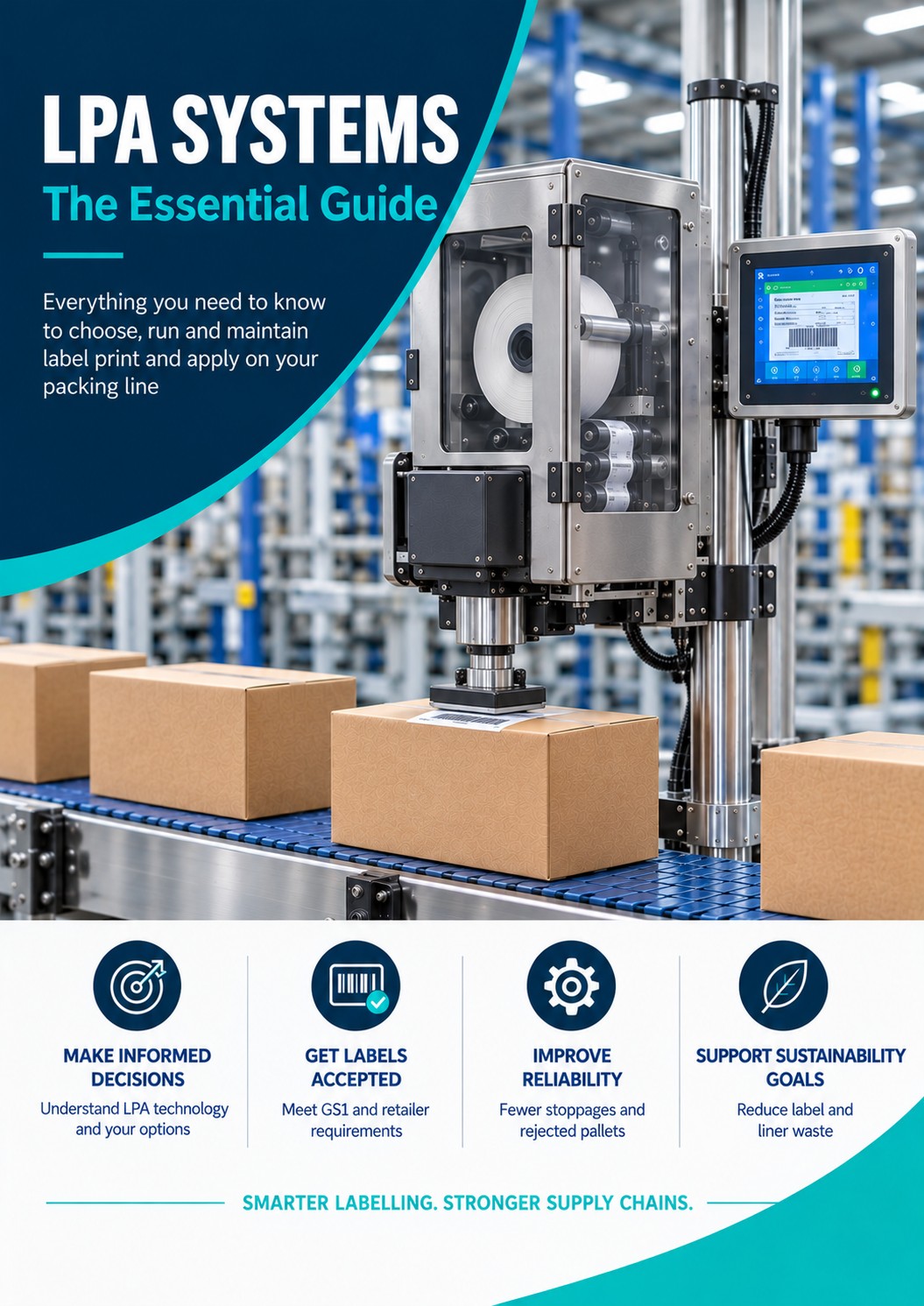
Label Print and Apply Systems The Essential Guide
Every pallet delivered to a retailer’s distribution centre is scanned before it is accepted. If the label won’t read, the pallet is set aside, keyed in by hand or refused, and the cost usually lands with the supplier. Most of those labels are printed and applied by a Label Print and Apply (LPA) system at the end of the packing line. Yet many engineers, packing managers and quality teams work alongside these machines for years without a clear picture of how they work, why they stop or what the label actually has to achieve.
This 48-page guide sets that out in plain terms. It is written by Andrew Robinson and Yilmaz Cigdem, who have more than 50 years’ combined experience in coding and marking, much of it on customers’ packing lines. Andrew was Project Manager for the pallet labeller project at Videojet Technologies and worked on most of the primary labeller project that followed.
What’s inside
- How case and pallet labelling moved from pre-printed stock to on-demand printing, and why the SSCC made pallet labelling a must
- The print engine, label stock, adhesives and ribbons, and how print-apply and apply-print modes affect timing and data integrity
- Tamp, tamp-blow, blow-on, wipe-on and corner-wrap application compared, plus pallet labelling
- System architecture, line integration, connectivity and guarding
- Print quality, placement accuracy, adhesion, common defects and barcode verification
- GS1 logistics labels: SSCC, GS1-128, Application Identifiers, layout, placement rules, retailer requirements, and what Sunrise 2027 does and doesn’t change for case and pallet labels
- Food and beverage in detail: shelf-ready packaging, chilled and frozen product, washdown areas, high-speed beverage lines and the real cost of a rejected pallet
- Pharmaceutical, e-commerce and 3PL, chemicals and automotive applications
- LPA against pre-printed labels, high-resolution inkjet, TIJ and valve-jet, on cost of acquisition and cost of ownership
- Preventive maintenance, printhead care, sensor set-up, troubleshooting and spares holding
- Where the market is heading: vision verification, sustainability, linerless labels, the EU Packaging and Packaging Waste Regulation and RFID
- A glossary of key terms
Who it’s for
Production, maintenance and packing engineers, operations managers, procurement and quality teams, and sales engineers who need a sound working knowledge of LPA. Useful if you are specifying a new end-of-line system, dealing with rejected pallets, comparing suppliers or simply want to understand the machine at the end of your line.
It is the companion to TTO Coders: The Essential Guide and part of the Markpath Technical Library.
Format: PDF download, 48 pages, A4.