
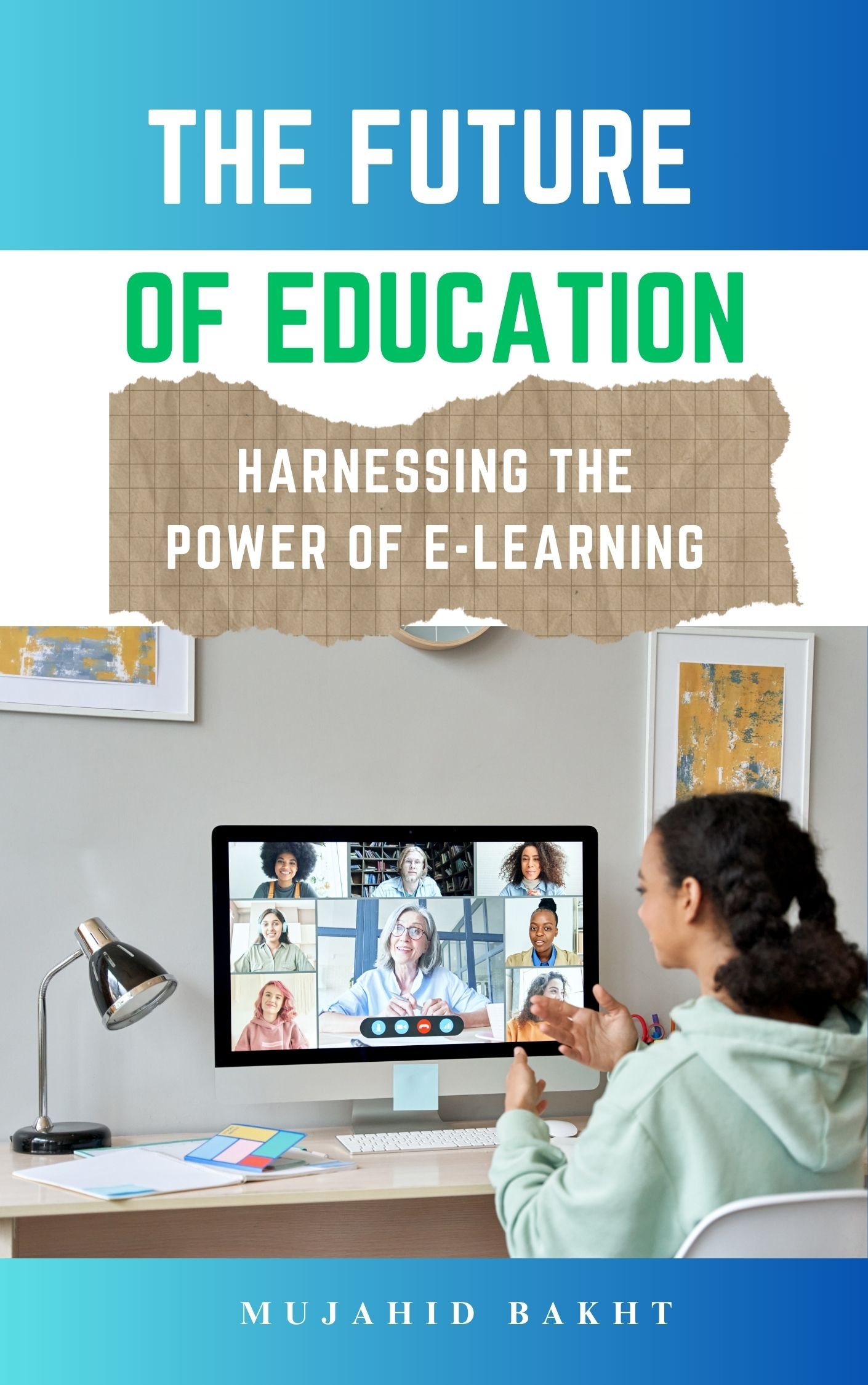
THE FUTURE OF EDUCATION HARNESSING THE POWER OF E-LEARNING “1ST EDITION”
THE FUTURE OF EDUCATION HARNESSING THE POWER OF E-LEARNING “1ST EDITION”
THE FUTURE OF EDUCATION HARNESSING THE POWER OF E-LEARNING. Education stands on the brink of a monumental revolution driven by emerging technologies that have the potential to transform and enhance learning experiences fundamentally. We now have within our reach the capability to provide truly personalized, adaptive instruction to students while liberating educators to focus on mentoring critical thinking and creativity. Compelling, immersive simulations, intelligent tutors, and experiential mobile learning are all coming online to make education more intuitive, effective, and accessible than ever conceived. However, effectively harnessing these exponentially accelerating innovations requires careful implementation guided by pedagogical best practices – simply dumping the latest gadgets into the classroom fails to move the needle without a cohesive strategy grounded in learning science research. Instructional design, teacher development, policy updates, and business model realignment all play a role in successfully leveraging education technology to uplift outcomes. This book aims to paint a holistic picture of the impending revolution in education while charting a course for the successful integration of promising innovations using evidence-based strategies. Key questions we tackle include:
How can technologies like artificial intelligence, augmented reality, and big data analytics be carefully targeted to enhance experiential learning and skill development without diminishing the vital human connections at the heart of education?
What instructional frameworks best leverage tech-enabled personalization while also providing consistency and transparency?
How can we democratize access to high-quality learning experiences that empower individuals from all backgrounds and locales to reach their potential?
How must we redefine traditional education roles, objectives, and policies to align with emerging best practices for learner-driven education?
What are the biggest pitfalls and risks we must mitigate in effectively adopting emerging innovations?
This book serves as a guide for institutional leaders and policymakers to chart the course for the future of education in pragmatic yet ambitious ways and as an insight-rich resource for instructors and content developers keen to harness technology to uplift their practices. Most importantly, it lays out a student-centric vision for the future of pedagogy that makes learning more engaging, effective, equitable, and empowering.
ARTIFICIAL INTELLIGENCE AND ADAPTIVE LEARNING: Natural language processing for conversational agents. Machine learning to predict learner needs. Neural Networks Enabling Adaptive Testing. Limitations and Ethical Considerations.
IMMERSIVE LEARNING ENVIRONMENTS: Augmented reality overlays enhance the real world. Virtual reality for context-specific training. Multi-sensory cues and interactions. Considerations for Accessibility.
DATA ANALYTICS AND LEARNING ANALYTICS: Learning record stores enable lifetime transcripts. Predictive analytics to improve outcomes. Methods for collecting student learning data. They are setting policies for data privacy and ethics.
COMPETENCY-BASED EDUCATION: Competencies are transparently mapped to assessments. Adaptive instructional approaches. Proficiency-based transcripts and credentials. Requires strong learner motivation.
DIGITAL BADGES AND CREDENTIALING: Enables showcase of the full range of capabilities. Promotes pathways to further education and employment—risks of diminishing intrinsic motivation.
MOTIVATES THROUGH ELEMENTS OF GAME DESIGN: A sense of community increases engagement. Develops teamwork and interpersonal abilities. Co-creation and peer feedback opportunities. Enabled through social media integration. Requires moderation and conflict resolution skills.
MOBILE LEARNING SIMULATIONS AND GAME-BASED LEARNING: Enables seamless Omni Channel experience. Contextualized content responsive to location. Considerations for Small-screen Design. It can increase digital distraction.
Principles of gamification enhance engagement and direct alignment to target capabilities. Balance skill acquisition with entertainment. Development requires extensive resources.
eBook:- ISBN: 978-1-961299-86-3
Paperback:- ISBN: 978-1-961299-85-6
Hardcover:- ISBN: 978-1-961299-84-9
GREETINGS FROM NEW YORK: Downloading your PDF paperback edition is fast and effortless! Once your order is complete, you will see an instant “Download Button” right on your screen, and a secure download link will also be delivered straight to your email inbox. Simply click to save the high-resolution PDF file directly to your phone, tablet, or computer, so you can start reading immediately or print a physical copy at your convenience “NO” waiting, “NO” hassle. ENJOY YOUR READING