

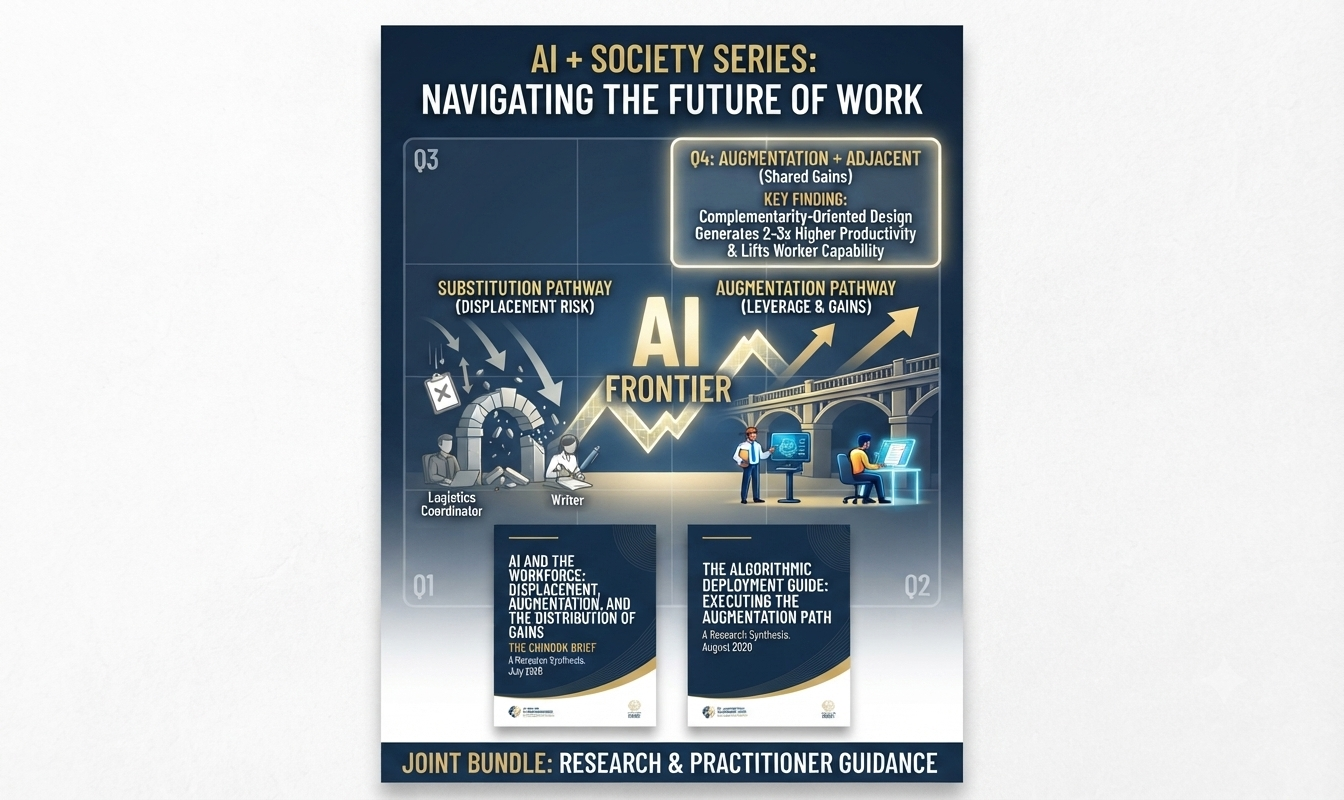
AI AND THE WORKFORCE + THE ALGORITHMIC DEPLOYMENT GUIDE — BUNDLE
AI productivity gains are real. Who captures them is a design choice that gets made before AI touches a single worker — and the choice doesn't stop at the diagnosis. This bundle gives you both halves: the framework that tells you which path you're on, and the playbook for actually building it.
The research is unambiguous on task-level gains: +40% performance improvement inside the AI capability frontier, 2 to 3 times long-run productivity for firms that invest in augmentation, 14% productivity gains in AI-assisted knowledge work with the largest gains going to lower-skilled workers. None of that goes to workers by default. It goes to whoever controls the implementation decision — and once you've made that decision, it goes to whoever builds the mechanism that routes the gains, or it goes nowhere at all.
*AI and the Workforce* builds the diagnostic: a 4-quadrant framework and a 3-question test (routing frame, role destination, surplus flow) that surfaces which path your organization is actually on before deployment momentum makes it structural. *The Algorithmic Deployment Guide* picks up exactly where the diagnostic ends. If you've run the test and landed on augmentation, this is the discipline the diagnosis doesn't cover on its own: how to redesign roles so the AI gets delegation authority at the task level, what to write into a vendor contract so you're buying augmentation instead of headcount reduction with better branding, how to measure capability expansion instead of just throughput, and how to make sure the productivity surplus actually reaches the people who generated it instead of disappearing into the organization by default.
WHAT'S INSIDE
From *AI and the Workforce*:
- The 4-quadrant framework: worker outcomes mapped across task-frontier proximity (market-determined) and implementation design (organizational choice).
- The jagged AI frontier, visualized: a figure showing why AI impact is binary and irregular across task types.
- Frontier-adjacency (Q3) identified as the dominant structural risk for middle-skill workers — more prevalent than displacement, less visible, and entirely determined by implementation design.
- The empirical case that augmentation-oriented design raises non-executive worker productivity and narrows skill gaps, anchored in a call-centre field study.
- The 3-question diagnostic: routing frame, role destination, and surplus flow.
- 29 independently verifiable peer-reviewed and institutional sources, cited in full APA 7.0.
From *The Algorithmic Deployment Guide*:
- A task-level delegation framework — grounded in controlled experimental research on human-AI collaboration — for deciding exactly where the AI gets authority and where the human stays in charge, plus a downloadable worksheet to run it against your own role portfolio.
- A vendor-contract clause template adapted from public-sector AI procurement standards, built to make "augmentation" a measurable, verifiable contract term instead of a sales-deck assumption.
- A capability-measurement framework that captures skill-gap convergence, not just throughput — with an explicit account of why most organizations can't measure it because they didn't instrument for it from day one.
- The surplus-flow chapter: the compensation and bargaining mechanisms — gainsharing, contractual voice, career-ladder design — that determine whether productivity gains reach your workforce or stay with the organization by default.
- A direct, disclosed account of where the evidence is thin (vendor contracts, sector-specific Alberta data) and where it's solid (role redesign, surplus flow) — no chapter is dressed up as more certain than it is.
Delivered as PDF. Instant download. Personal-use license. 30-day refund if not as described.
A NOTE ON HOW THIS WAS MADE
Both pieces in this bundle were produced with AI assistance, and I want to be direct about that because the process is the quality signal. Agentic AI systems handle the cross-categorization and analysis of the peer-reviewed literature. Every citation in both documents is human-verified against the actual source — including a direct check against the controlling legal case behind the Guide's gainsharing claim, and a direct check on a citation's publication status before it went into the text. Where the evidence is thin, the text says so plainly instead of writing around it. You will find the full AI disclosure on the first page of each document.
This is the diagnostic and the execution, together, because running one without the other leaves the harder half of the work undone. The diagnostic tells you which quadrant you're aiming for. The guide is what it takes to actually get there.