
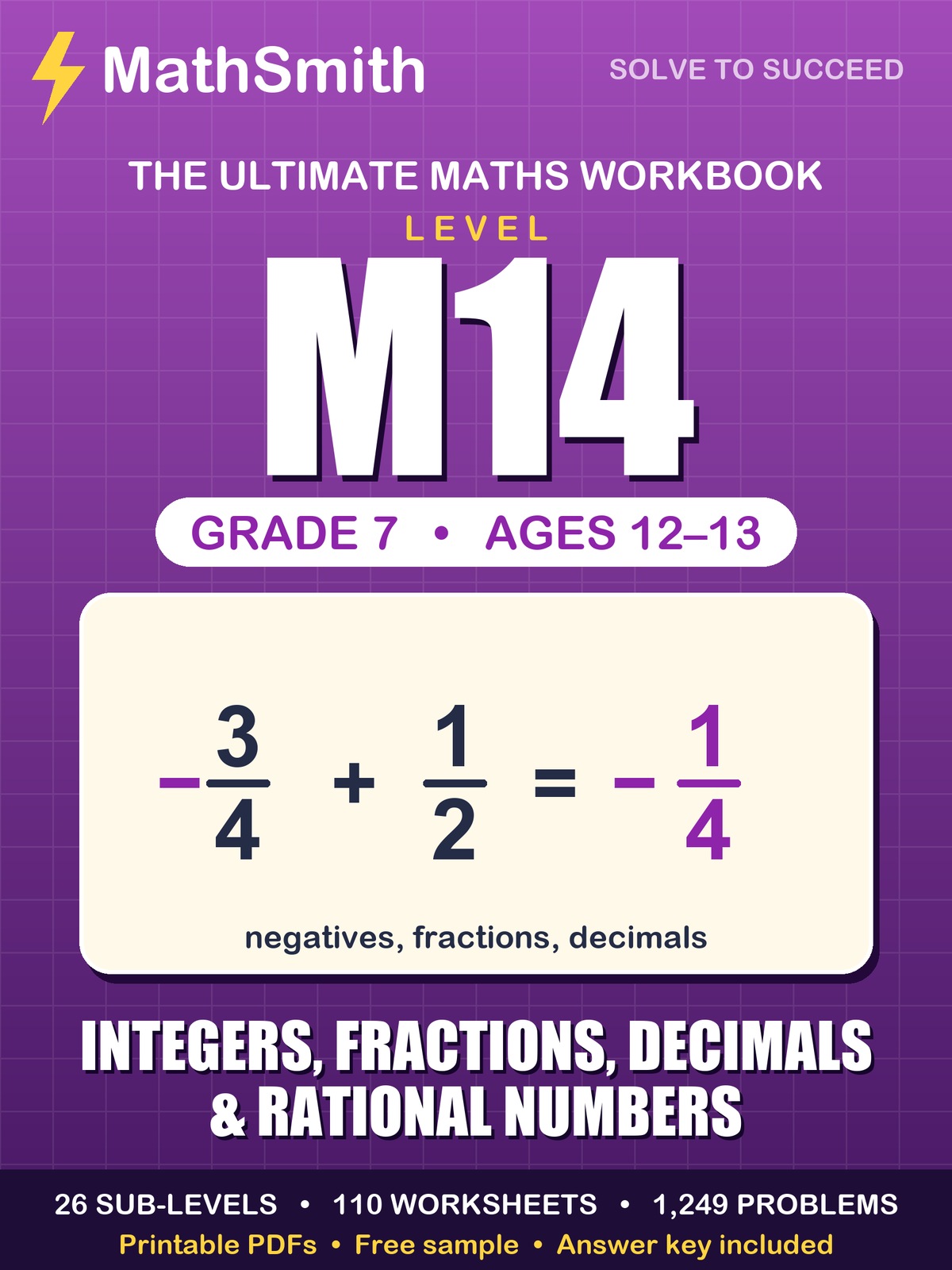
Gr 7 Maths Worksheets (Ages 12-13) | Level M14: Integers, Fractions, Decimals & Rational Numbers
🎓 Launch offer: 80% OFF every MathSmith workbook with code LAUNCH80 (first 1000 orders). Click Add to Cart, then enter LAUNCH80 in the discount box before you pay.
Not sure which level your child needs? Take the free 40-question placement test: https://ebooks.thecodecrafters.net/placement
See free sample pages first: https://ebooks.thecodecrafters.net/
Help your child build absolute confidence and mastery in mathematics. This comprehensive workbook from MathSmith takes a highly structured, "one-rung-at-a-time" approach to Integers, Fractions, Decimals and Rational Numbers, ensuring students fully understand concepts before moving forward.
Instead of overwhelming learners with random equations, this workbook uses a carefully scaffolded, predictable learning ladder. It is perfect for homework, structured independent study, or mastery practice.
📊 What Is Included?
1 Complete Level (Level M14)
26 Structured Sub-levels for gradual progression
110 Printable Worksheets
1,249 Total Problems for thorough practice
Full Answer Key online, unlocked by the order ID on your Payhip receipt, for quick, stress-free marking
🗺️ Curriculum Breakdown
This collection focuses deeply on mastering Integers, Fractions, Decimals and Rational Numbers through a carefully curated system:
The sign, and where it comes from (6 Sub-levels): M10 put a number below zero on a line and every operation it had was a jump along that line. Multiply two of them and the line has nothing to say: there is no jump that explains (-3) x (-4), and a child who reaches for one gets stuck. What there is instead is a count - how many of the factors are negative - decided before a single digit is multiplied. So the sheets pin that count rather than leaving it to chance, because a rung promising two minus signs and drawing four problems with one has not drilled what it says. The laws close the strand, asked about numbers printed in the question rather than about their names: a child who can say "commutative" and cannot say whether 8 - 3 is 3 - 8 has learnt a word.
Multiplying and dividing, where the answers go the wrong way (6 Sub-levels): Six rungs on the one fact that contradicts everything before them. Multiplying has meant "more" since M4 and dividing has meant "less", and here two proper fractions multiply to something smaller than both while a whole number divided by a quarter comes to four times itself. The first rung is deliberately the one where repeated addition still works, because a child who has never seen the old method and the new one agree has no reason to trust the new one. Then "of" is shown to be a multiplication sign, the reciprocal is met before it is needed, and dividing by a fraction is counted - not asserted - on a strip.
The point, when it moves and when it does not (6 Sub-levels): Three pairs. Ten, a hundred and a thousand slide the digits and calculate nothing, and the reverse ask - which power of ten was it? - is what shows whether a child is counting places or remembering that a hundred means two jumps. Multiplying ADDS the places, which is why 1.2 x 0.4 has two of them and is smaller than either. Dividing by a whole number brings the point straight up through the rule, so the bus stop gives it a column of its own and the quotient's point lands in that same column. Dividing BY a decimal is the only one with no frame at all: the first thing written is the same division with both points moved, and a bracket drawn round the question as printed would show a child a thing they must never copy.
The number that closes the four operations (8 Sub-levels): Eight rungs on what all of the above has built: a number written as one whole number over another, which can always be added, subtracted, multiplied and - except by zero - divided, with the answer still one of them. The notation is the level's own. A minus written above the bar is 3/-4, which is a different way of writing the same number; lowest terms moves it in front of the bar where it covers both ends, and every row on these rungs whose answer's SIGN is part of the question ends in a box for the sign and then a blank fraction. A fraction's two boxes have nowhere to put a mark that belongs to neither. One rung is drawn, for M10's reason: a negative fraction counts nothing, so the only honest answer to what it is, is where it is.
🎯 Who Is This For?
Parents looking to provide structured math support at home.
Homeschoolers searching for a sequential curriculum to guarantee zero gaps in math skills.
Teachers & Tutors looking for bite-sized, scaffolded printables for classroom morning work or targeted intervention.
📖 How To Use This Workbook
Print the workbook, read each rung's method page, and let your child work inside the printed frame. Then check the answers your way: in the printable answer-key PDF included in this download, or online, one page at a time, with the order ID on your Payhip receipt (valid for six months). Please keep the answer key for the adult marking the work and do not share it with your child: the workbook only works if they have worked each answer out for themselves.
Step-by-step manual and video guide: https://ebooks.thecodecrafters.net/manual/
Check the answers: https://ebooks.thecodecrafters.net/answers
⚙️ Digital Delivery Details
Format: four instant-download PDFs (free sample, sample answers, workbook, full answer key). The answer key is also available online.
Print Ready: Easily printable on home or school printers.
Usage: Licensed for individual family or single-classroom use.