
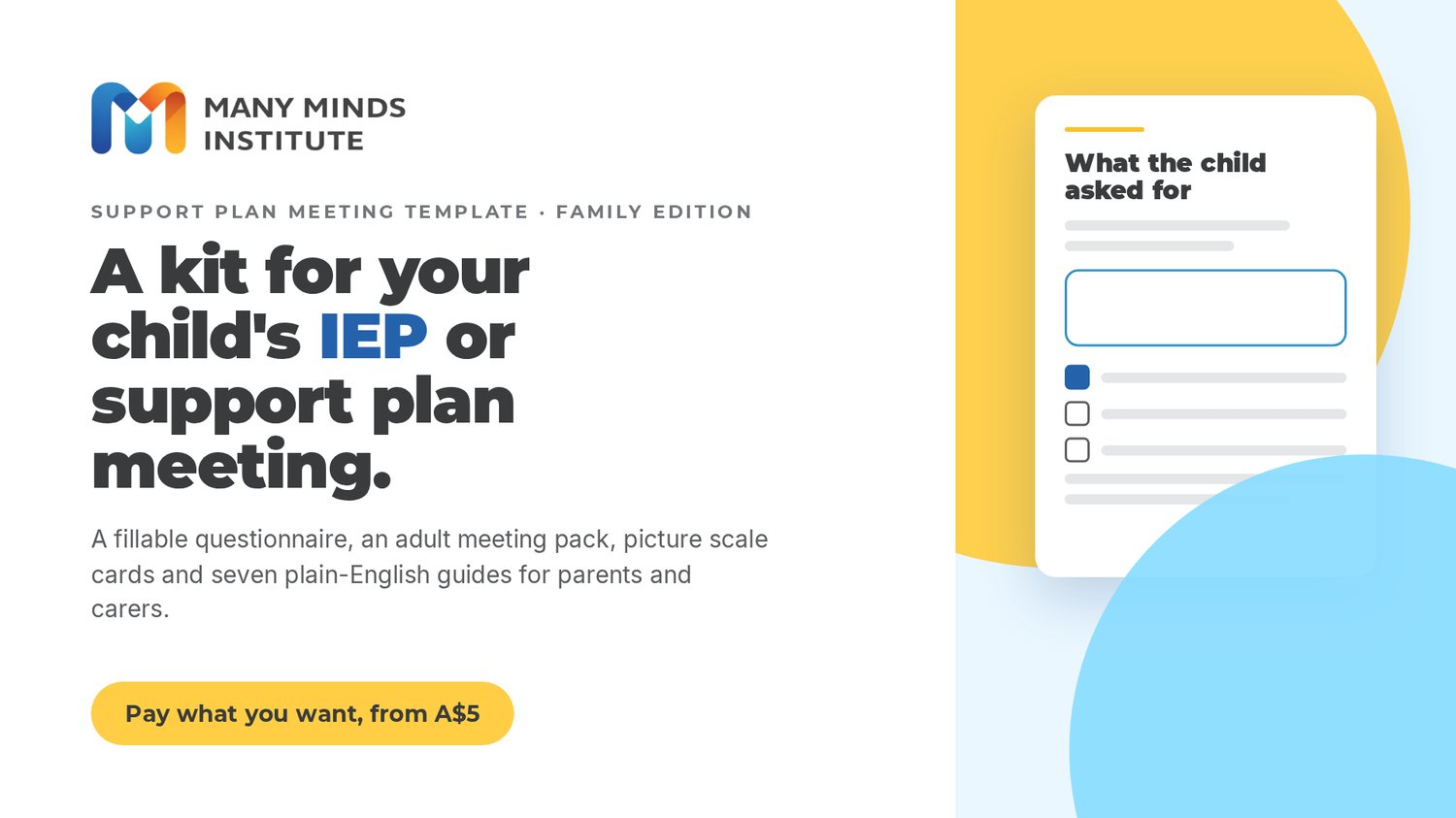
Support Plan Meeting Template: a child-first meeting kit for families
This kit helps you prepare for, run, and follow up a school support meeting about your child. Your child's questionnaire opens the meeting. The adults then review every support in the plan, and every decision gets a person, a start date, and a check-back date.
Most school meetings about a child start with the adults. The child's view arrives second-hand, if it arrives at all. The supports from last time get a general "that went okay". Nothing gets a start date. Everyone leaves with a vague plan.
This kit changes how the meeting runs.
Your child's questionnaire opens the meeting. Your child fills it in at home with you, in any way that works for them. They can talk, draw, point at pictures, use AAC (augmentative and alternative communication), or have you write down what they say. What your child asks for is the first thing the adults talk about.
The adults review every support. For each support from last time, the adults ask three questions. Did it happen? What did school notice? What did home notice? Then they keep it, change it, pause it, or try something new.
Every decision gets a name, a start date, and a date to check back. Vague agreements get forgotten. Specific ones tend to happen.
What you notice at home counts as evidence. Tiredness, recovery time, sleep, and how the afternoon goes all tell you something about the school day, even when school did not see it.
What you download
Ten PDF files. Three are the documents you use in the meeting, and seven are guides.
- The Pre-meeting Child Questionnaire (fillable PDF). This is your child's document. It uses tick boxes and picture scales, so it suits younger children and anyone who would rather point, draw, or tick than write. You can fill it in on a screen or print it.
- The Adult Meeting Pack (fillable PDF). This is your document. It has a meeting checklist, a page of notes to fill in before the meeting, the pages the note-taker fills in during the meeting, and a check-back log for afterwards. You can fill it in on a screen or print it.
- The Response Scales cards (printable PDF). These are the picture scales from the questionnaire, printed large. Tape them along a wall or across the floor so your child can walk to, jump on, stand on, or point to their answer.
- Start here. This short guide explains who fills in what, when they fill it in, and how the meeting usually runs.
- Reasonable adjustments, and how to ask for them. This guide explains, in plain language, what Australian schools can be asked to do for your child, with or without a diagnosis.
- After the meeting. This guide explains what to do with what you learned, and who can help you make sense of it.
- Looking after yourself in the meeting. This guide lists what to bring and what to ask for in the room, including how to use a visual timer.
- Talking with your child about school. This guide gives ways to get honest answers from children who are young, need to move, use AAC, or find questions uncomfortable.
- Email templates. Five emails you can copy, edit, and send: asking for a first meeting, asking for a check-in, sending your agenda, following up the same day, and following up a week later.
- The five-minute version. Three questions, three notes, and one email, for the week when there is no time for the full preparation.
Teachers and school staff: a teacher edition of this kit is sold separately. It covers the same meeting from the school side. Find it at manyminds.org.au/support-plan-template.
Who it suits
This kit is for parents and carers of children in Australian primary and secondary schools. It suits families especially well when the child is autistic, has ADHD, or experiences the school day in a way that calls for adjustments. Therapists can also use it to send families into school meetings with something concrete.
Who made it
Dr Kristyn Sommer, developmental scientist, and Amanda McCowan, occupational therapist, wrote this kit. Both are co-founders of Many Minds Institute. The kit builds on the Disability Standards for Education 2005 and the NCCD evidence requirements. It also builds on a lot of meetings that could have gone better.
Format and price
The files are PDFs. The three meeting documents are fillable on a screen, and every file prints on A4. The download is instant. You pay what you want, from A$5.
Want to work through it with someone?
Parents can book a consultation with Many Minds. We go through your child's questionnaire and your adult pack with you, help you think of adjustments and supports, and help you plan the next meeting. A consultation is general guidance from two practitioners. It sits alongside any therapy or clinical care your child already has. Book at manyminds.org.au/support-plan-template.
Feedback
Every document in the kit ends with a two-minute feedback form. What you tell us shapes the next version.
Refunds
If the kit is of no use to you, email info@manyminds.org.au within five days for a refund.