
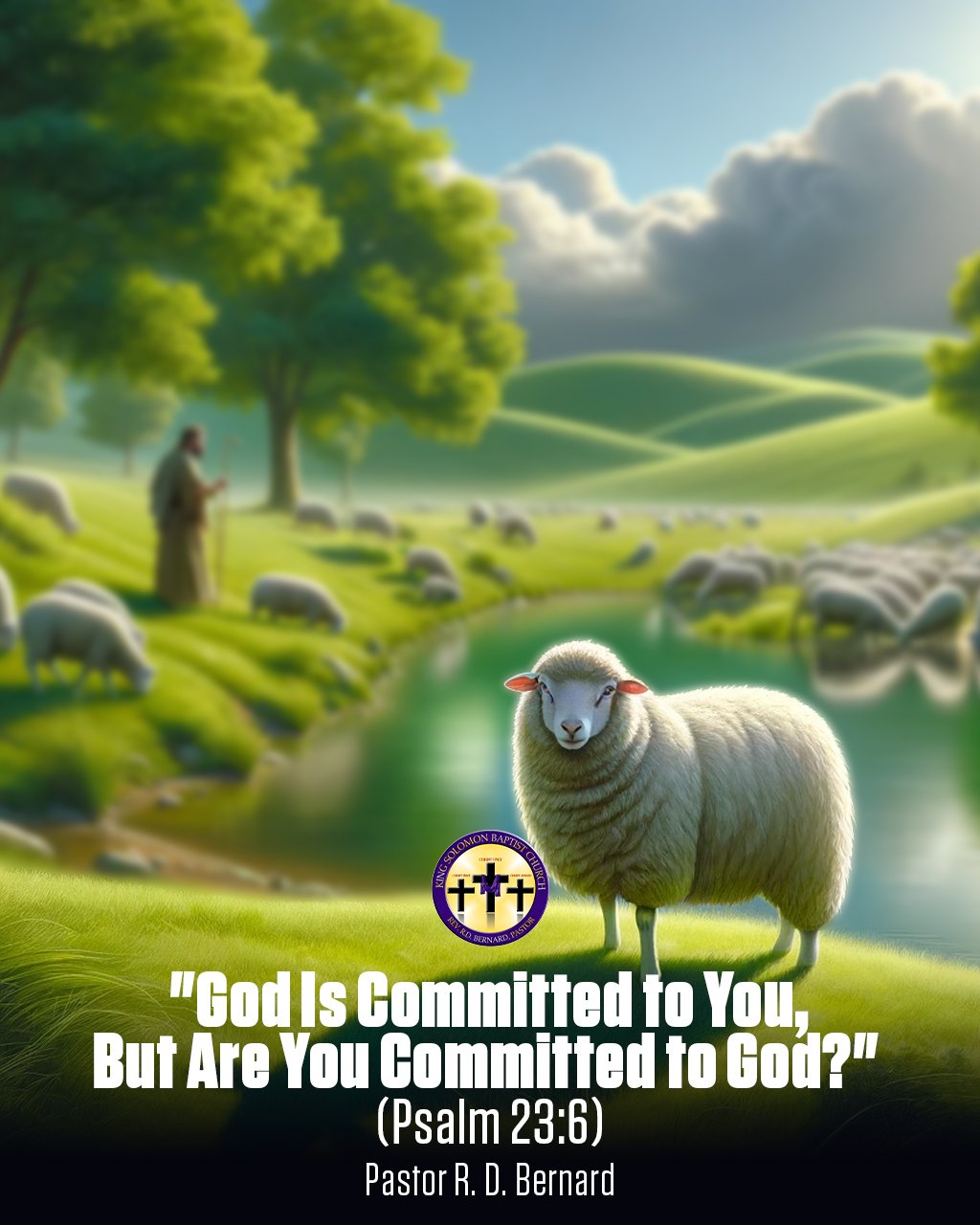
“God Is Committed to You, But Are You Committed to God?” (MP3 AUDIO)
“God Is Committed to You, But Are You Committed to God?” (Psalm 23:6)
The 23rd Psalm is often called "the Shepherd Psalm," even though it is written from the perspective of an individual sheep. This particular sheep, David, has it made because "the Lord is my [his] shepherd." Because the Lord is His shepherd, he doesn’t lack anything. The shepherd is expected to meet every need of the sheep. This is the meaning of the phrase "I shall not want."
The sheep has food to eat and a nap after eating ("He maketh me to lie down in green pastures," verse 2). The sheep not only has water to drink ("he leadeth me beside the still waters," also in verse 2), but leads a tranquil, peaceful life that refreshes his soul.
This picture of a shepherd and his care for this one sheep, is foundational to understanding God’s providential care for us. The Shepherd is committed to taking care of this sheep, just as God is committed to taking care of you.
Consider the following three points.
- The Lord was and is committed to you.
- a. In eternity, before God created anything, He knew you, His sheep, as being His (Ephesians 1:4). The Bible reads that He 'chose' us.
- b. In the 23rd Psalm, the psalmist traces his journey as a sheep, following a shepherd, all the way through life: through peaceful times (verse 2), through dealings with enemies (verse 5), and even through death (verse 4).
- i. The Psalmist sees himself as traveling through life, as a sheep following a shepherd, but his destination is not in this life; rather it is the "house of the Lord" where he will be "forever."
- ii. The verse under our consideration, verse 6, declares that the Lord’s goodness and mercy are the spiritual agents that follow him as a sheep, as he follows the shepherd through life to eternal life.
- c. The Old Testament Hebrew word for "mercy" in Psalm 23:6 is "kheh-sed" ("chesed") and it means God’s "covenant keeping love."
- i. John wrote in 1st John 4:19 that Christians can love God because "He [Christ] first loved us."
- ii. Paul wrote in Romans 5:8 that Christ "died for us while we were yet sinners."
- God’s goodness toward you, should cause you to commit to Him.
- a. Whatever good has been done in your life, or on your behalf, God is the author of it (James 1:17).
- i. Romans 2:4 indicates that it is all this goodness that He has shown toward us, that should make us want to commit to Him.
- ii. God was busy being faithful to us, while we were busy cheating on Him (James 4:4).
- b. God was and is so committed to us, that He blessed us with things that we never bothered to pray for (e.g., like good health, see Matthew 6:8) or even things that we have failed to thank Him for (e.g., like the health of our children, see Romans 1:21).
- c. God wants us to acknowledge just how good He has been to us (Matthew 10:32-33).
- Commit to God by obeying His Word.
- a. The Lord told His people in Jeremiah 31:3: "I have loved you with an everlasting love. I have drawn you with my loving-kindness."
- i. The word "loving-kindness" is translated from the same word from which the word "mercy" is translated from in Psalm 23:6.
- b. God loves us. Jesus said, "If you love me back (because He loved you first), obey me" (John 14:15).
“Christ First, Christ Only, Christ Always”