
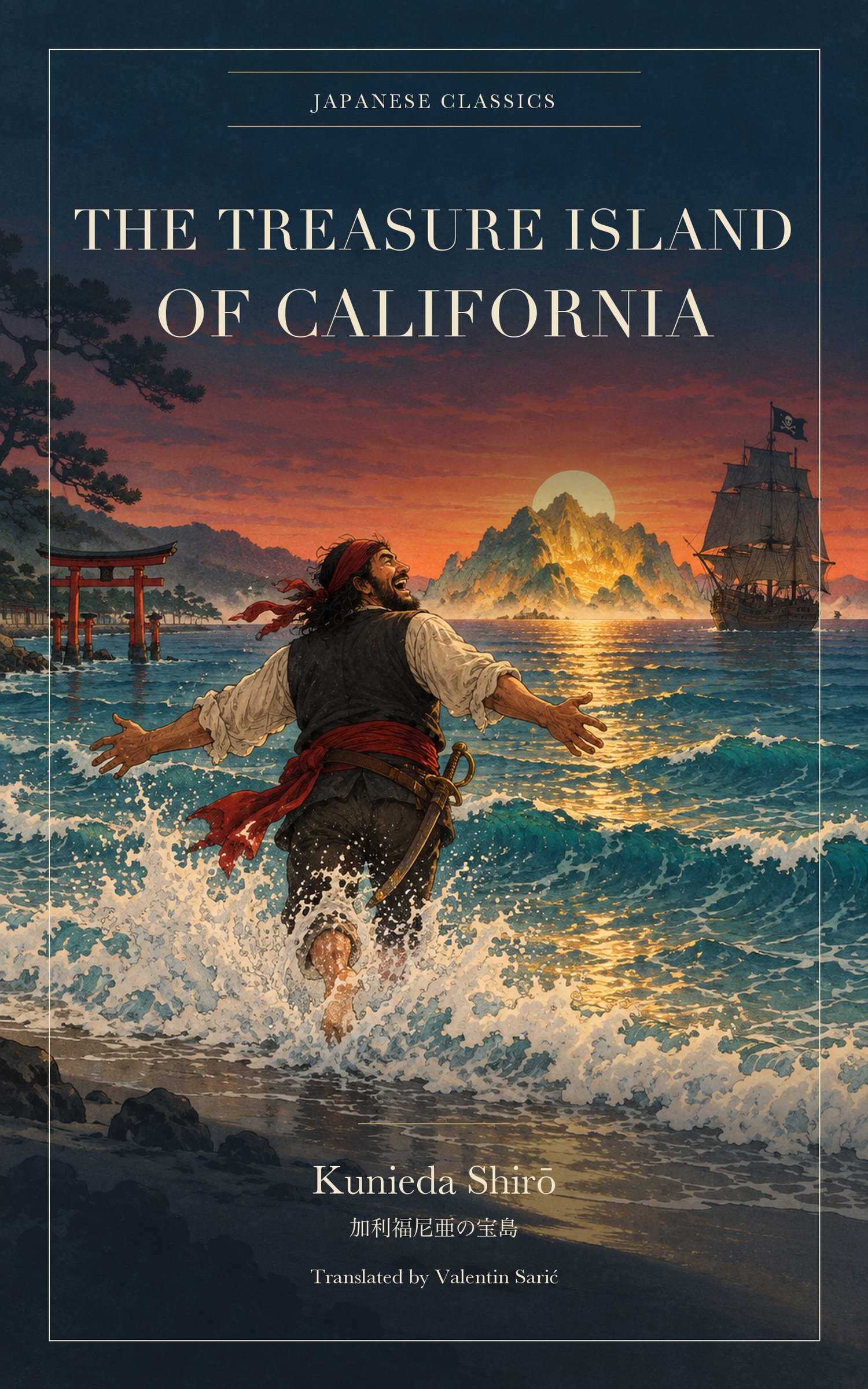
The Treasure Island of California
A pirate is beheaded on the beach at Sumiyoshi, his severed head rolls along the sand, leaps into the air and joins itself back onto his body; he laughs at the officers, runs into the sea and is gone. That is the first page. Azukishima Montayū goes on living for the rest of the book with a neck he has to hold on with both hands, and what he wants is a Dutch book of geography that names a treasure-house on Chiburon Island in the Gulf of California. Ten ships leave Japan under the banner of Hachiman; five arrive.
On the Sonora coast opposite the island, an English expedition under George Hawkin is already camped. Hawkin's twelve-year-old son John chases a peacock into the forest and is taken; his father walks into the snare set with him. Underneath the island there is a second country lit blue, with a shrine to a Living Sword, an inn whose best room holds a parchment volume called The Book of Discerning Wisdom, and a Japanese herbalist, Yamato Sessai, who vanished near Shanghai a decade ago and is living down there with his son Hideo. The two boys become inseparable, the two expeditions merge, and at the end the survivors take the treasure by force, elect a president, and settle the island as a joint colony.
Two shorter works follow. Two Machi-yakko is Edo at street level: two rōnin bands about to slaughter each other in the Asakusa temple precincts, broken up by a man who lifts a temple bell off its float and carries it on his shoulder — Tsurigane Yazaemon, Yazaemon of the Bell. Its second half turns on the murder of Banzuiin Chōbei and ends with Higoi no Tōbei performing, in the shōgun's garden and by command, the feat of daring befitting a townsman: he cuts his belly and lays his entrails on the ground. The Song of the Desert has the explorer Stanley telling, over a cigar, what he found at an oasis in Togo — a ruined mission house, a violin in a box, and a sheet of music titled “Song of Longing for My Homeland”.
These are period texts and they read like it. Kunieda's Africa is “the world's most savage country”; the word 土人, “natives”, falls roughly a hundred and fifty times; the islanders are drawn as cannibals and sing over a captive child; the treasure story ends by founding a colony and reports that the government of it was carried on in harmony. This edition renders all of it literally, with the terms kept and footnoted rather than softened or cut. First English translation, complete and unabridged.
English-language digital edition. Translated by Valentin Sarić.
You receive: a 99-page PDF and an EPUB edition.
Digital download only. No physical book is shipped.