
Money Flash Cards: 50 Money Words Every Family Should Know
Nobody taught you money words growing up? Start here.
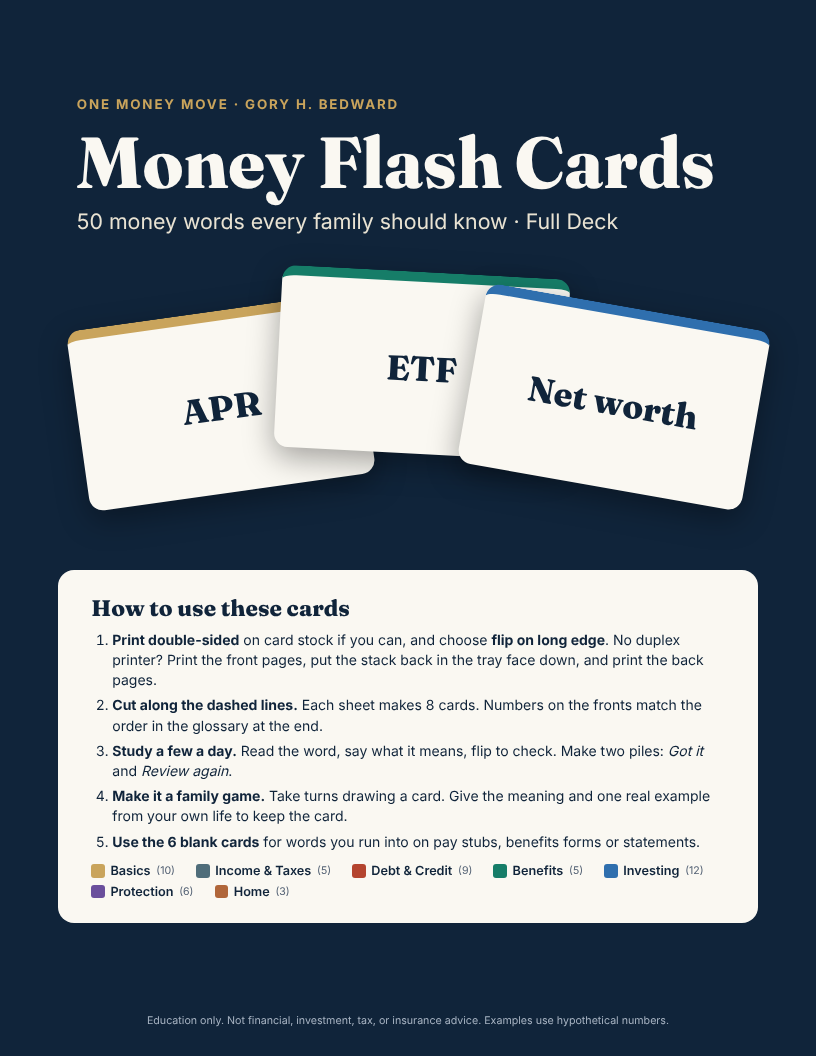
These 50 printable flash cards explain the words on your pay stub, benefits forms, loan papers and investment statements in plain English. Every card has a real-life example. Learn a few a day and you'll understand what your money is doing and why.
What's inside
Basics (10): net worth, pay yourself first, budget, emergency fund, sinking fund, high-yield savings account, inflation, compound interest, Rule of 72, opportunity cost
Income & Taxes (5): gross vs. net pay, W-4, tax bracket, deduction vs. credit, capital gains
Debt & Credit (9): APR, minimum payment, principal, amortization, credit score, credit utilization, debt-to-income ratio, debt snowball, debt avalanche
Benefits (5): employer match, vesting, 401(k) / TSP, Traditional vs. Roth, HSA
Investing (12): IRA, stock, bond, index fund, ETF, expense ratio, diversification, asset allocation, rebalancing, dividend, dollar-cost averaging, risk tolerance
Protection (6): premium, deductible, disability insurance, term life insurance, beneficiary, will & estate plan
Home (3): down payment, PMI, home equity
You get
7 sheets of cut-out cards, 8 cards per sheet. Each front shows the word, and each back shows the meaning and an example.
6 blank cards for your own words
A 2-page glossary with all 50 terms
Instructions for double-sided printing, with or without a duplex printer
A family game version: take turns drawing a card, and keep it if you can explain the word and give an example from your own life
Great for: families teaching teens about money, new employees going through benefits enrollment, military and federal families learning the TSP, and anyone starting their first budget.
The cards were created by Gory H. Bedward, U.S. Navy veteran and founder of One Money Move.
Instant PDF download. Print at home on card stock.
Education only. This isn't financial, investment, tax, legal, or insurance advice. Examples use hypothetical numbers. Tax rules and limits change, so check current figures.