
Concrete Defects - Sounding and Chain-Drag
Sounding & Chain-Drag Guide —
Find hidden delamination before it breaks loose, spalls, spreads, or turns into a larger repair problem.
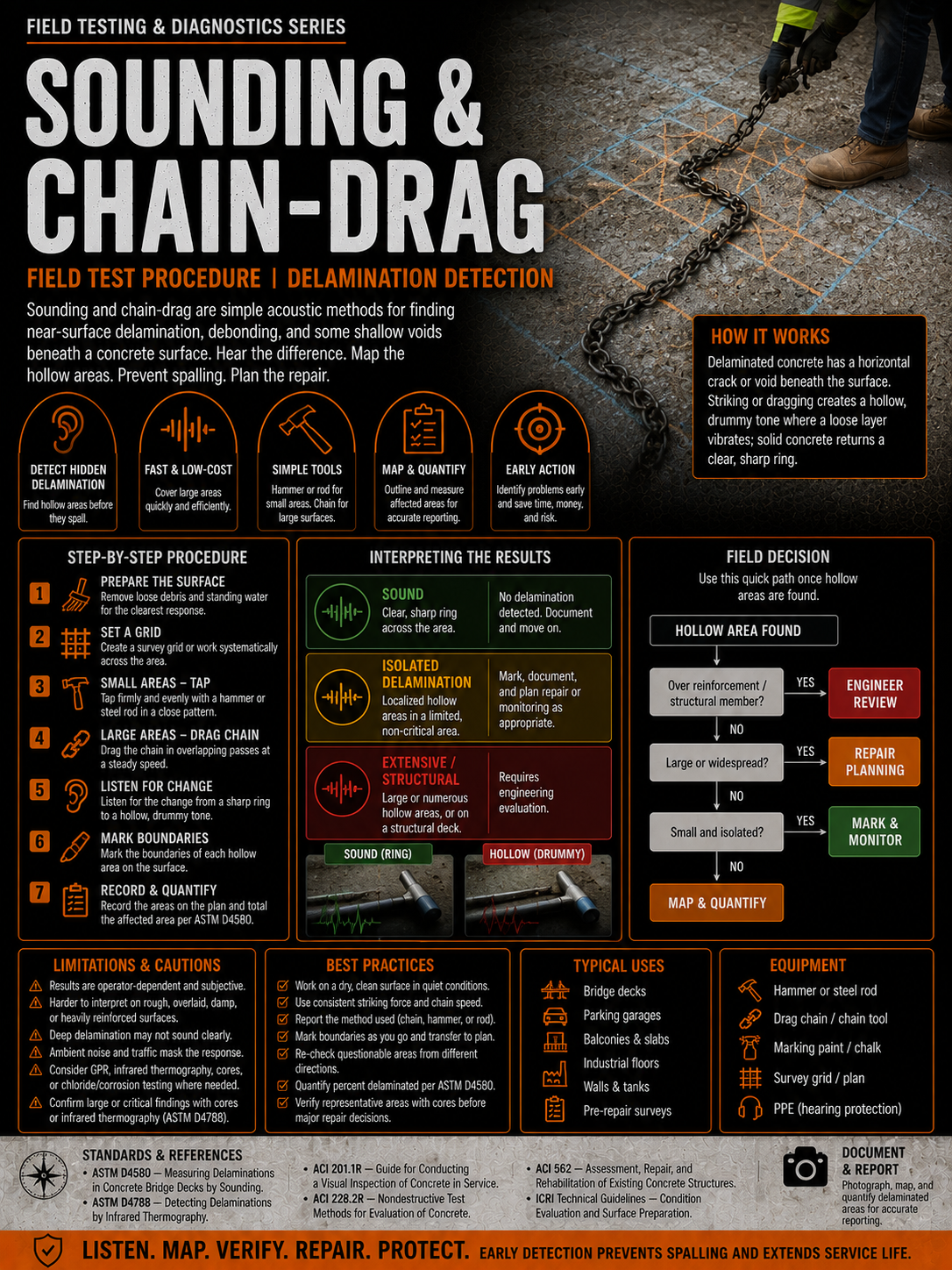
The Sounding & Chain-Drag Guide is a practical field testing reference for detecting hollow, drummy, delaminated, debonded, or weakly bonded areas beneath a concrete surface. Sounding and chain-drag are simple acoustic methods: sound, well-bonded concrete gives a sharp, clear ring, while delaminated concrete produces a hollow or drummy tone because the loose layer vibrates beneath the surface.
This guide is built for inspectors, contractors, repair crews, QC professionals, field technicians, engineers, bridge deck inspectors, parking garage inspectors, and anyone evaluating concrete surfaces before repair.
Tapping with a hammer or steel rod works well for small or localized areas. Dragging a chain is useful for covering larger surfaces such as bridge decks, parking garages, balconies, slabs, overlays, and other concrete wearing surfaces. The guide walks users through how to prepare the surface, survey systematically, listen for changes in sound, mark hollow areas, map the boundaries, and quantify the affected area for reporting.
What’s Included
- Clear explanation of what sounding and chain-drag testing is
- Field procedure for detecting near-surface delamination, debonding, and shallow voids
- Explanation of sharp ringing vs. hollow / drummy response
- Guidance on when to use hammer sounding, rod sounding, or chain-drag
- Equipment list for field surveys
- Step-by-step procedure for preparing, sounding, marking, mapping, and reporting
- Interpretation guidance for sound concrete, isolated delamination, and extensive / structural delamination
- Quick field decision path once hollow areas are found
- Guidance on when to mark and monitor, plan repairs, map and quantify, or request engineering review
- Limitations and cautions for rough, overlaid, damp, noisy, or heavily reinforced surfaces
- Best practices for clean, dry, quiet survey conditions
- Recommendations for verifying critical findings with cores, infrared thermography, GPR, or corrosion testing where needed
- ASTM / ACI / ICRI reference list
- Sounding at-a-glance table
- Printable field checklist
Built for Real Field Use
This guide helps answer the questions that matter during a concrete condition survey:
Is the surface truly sound, or is there hidden delamination below it?
Are hollow areas small and isolated, or large and widespread?
Is the hollow area over reinforcement or part of a structural member?
Does this need monitoring, repair planning, mapping, quantification, or engineering review?
The guide focuses on practical field execution: clean the area, establish a grid, use consistent technique, listen for the sound change, outline the hollow boundaries, transfer the areas to a scaled plan, and quantify the delaminated area using ASTM D4580-style reporting.
Best For
- Concrete inspectors
- Bridge deck inspection teams
- Parking garage inspectors
- Repair contractors
- Field technicians
- Ready-mix and QC professionals
- Engineers and engineering support staff
- DOT and infrastructure inspection crews
- Facility maintenance teams
- Anyone evaluating delamination, debonding, overlays, spalls, or hollow concrete
Why This Guide Matters
Delamination is often hidden until the surface fails. A slab, deck, overlay, or repair area can look acceptable from above while hollow areas are already developing underneath. Sounding and chain-drag give the field team a fast, low-cost way to locate those areas before they break through, spall, or create safety and durability problems.
The Sounding & Chain-Drag Guide helps users move from “I think this sounds hollow” to a documented survey with marked boundaries, mapped locations, quantified areas, and better repair planning. It also reinforces when additional investigation is needed — especially when hollow areas are large, widespread, over reinforcement, on structural members, or difficult to interpret.
Important Note
Sounding and chain-drag results are field screening results. They can be affected by operator technique, surface texture, overlays, moisture, ambient noise, traffic, reinforcement density, and delamination depth. Large, critical, or unclear findings should be confirmed with additional testing, cores, infrared thermography, GPR, corrosion testing, or engineering evaluation before final repair decisions are made.
Listen for the hollow. Map the damage. Verify before repair.