

Political Thought Explorer | Interactive A Level Politics Study Tool | Ideologies, Thinkers & Debates
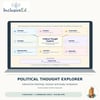
Political ideas are easier to study when you can see how they connect. Political Thought Explorer is an interactive teaching, revision and study companion for exploring political ideologies, key thinkers and the debates between them. Start with the bigger picture, follow a branch into more detail, then compare how different traditions answer the same question.
Use it alongside AQA or Edexcel A Level Politics, or as a visual starting point for introductory BA Politics, International Relations and political theory study. It brings connected mind maps, simpler explanations and source-linked evidence together in a downloadable tool you can open in your browser.
WHAT YOU CAN EXPLORE
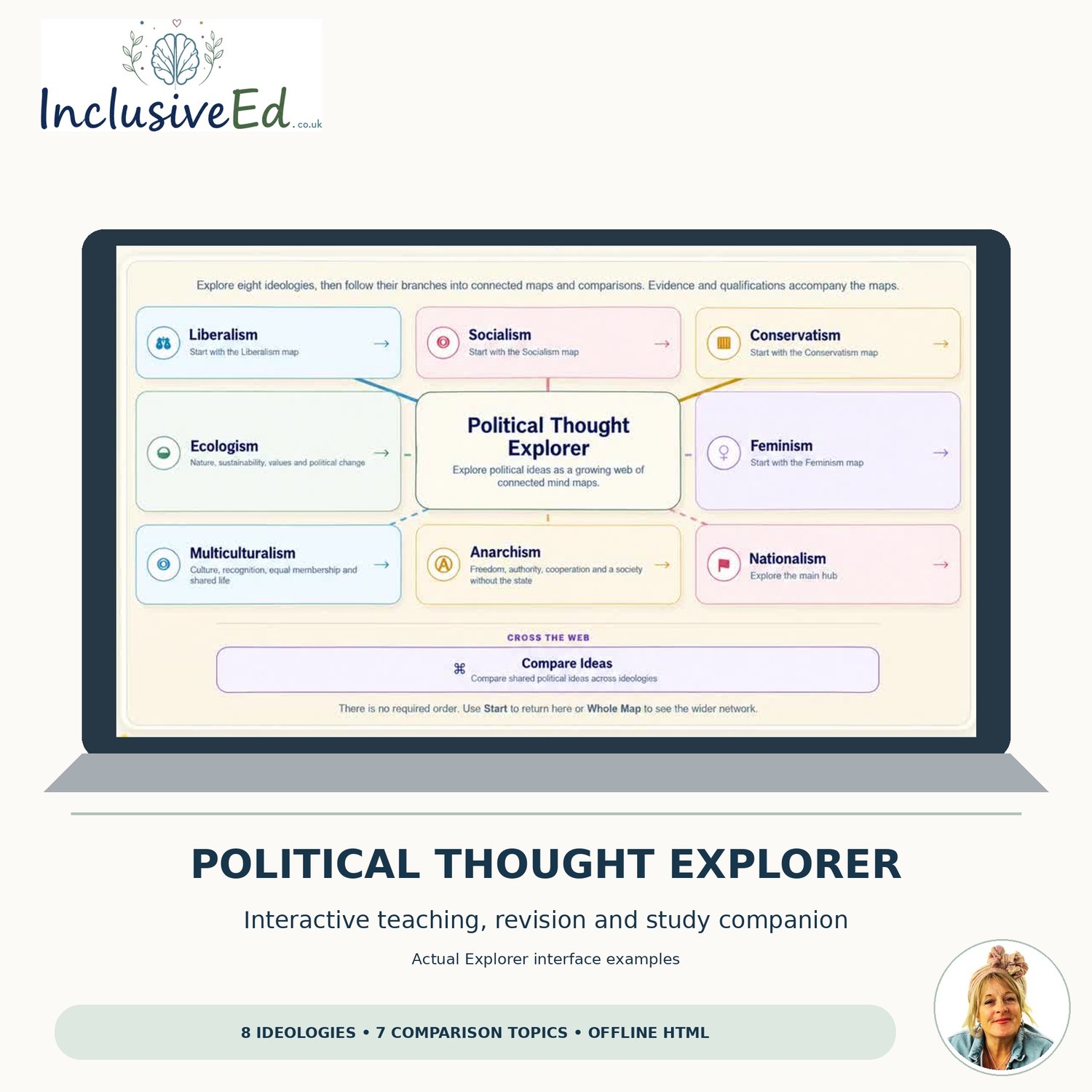
Eight political ideologies: liberalism, conservatism, socialism, feminism, nationalism, ecologism, anarchism and multiculturalism.
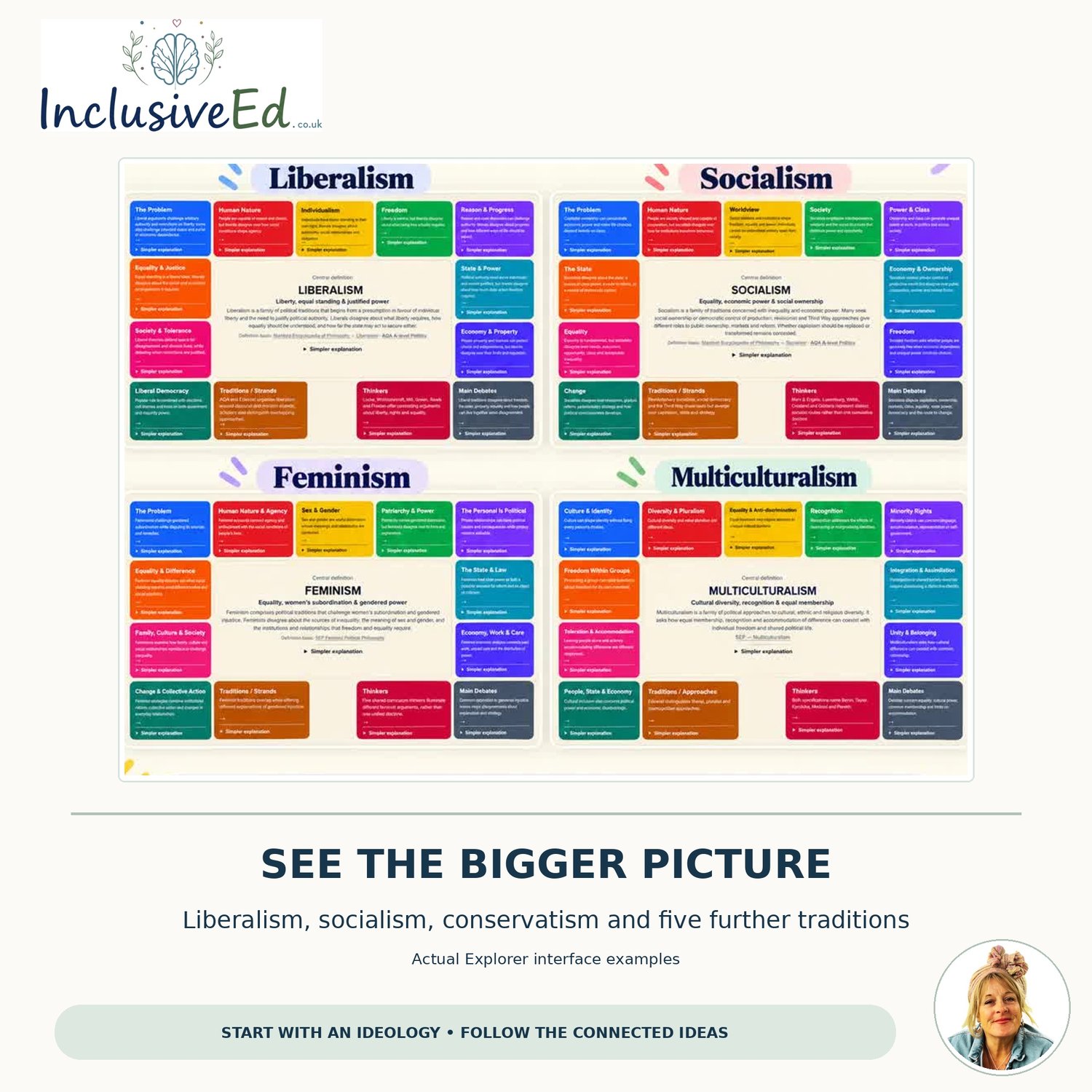
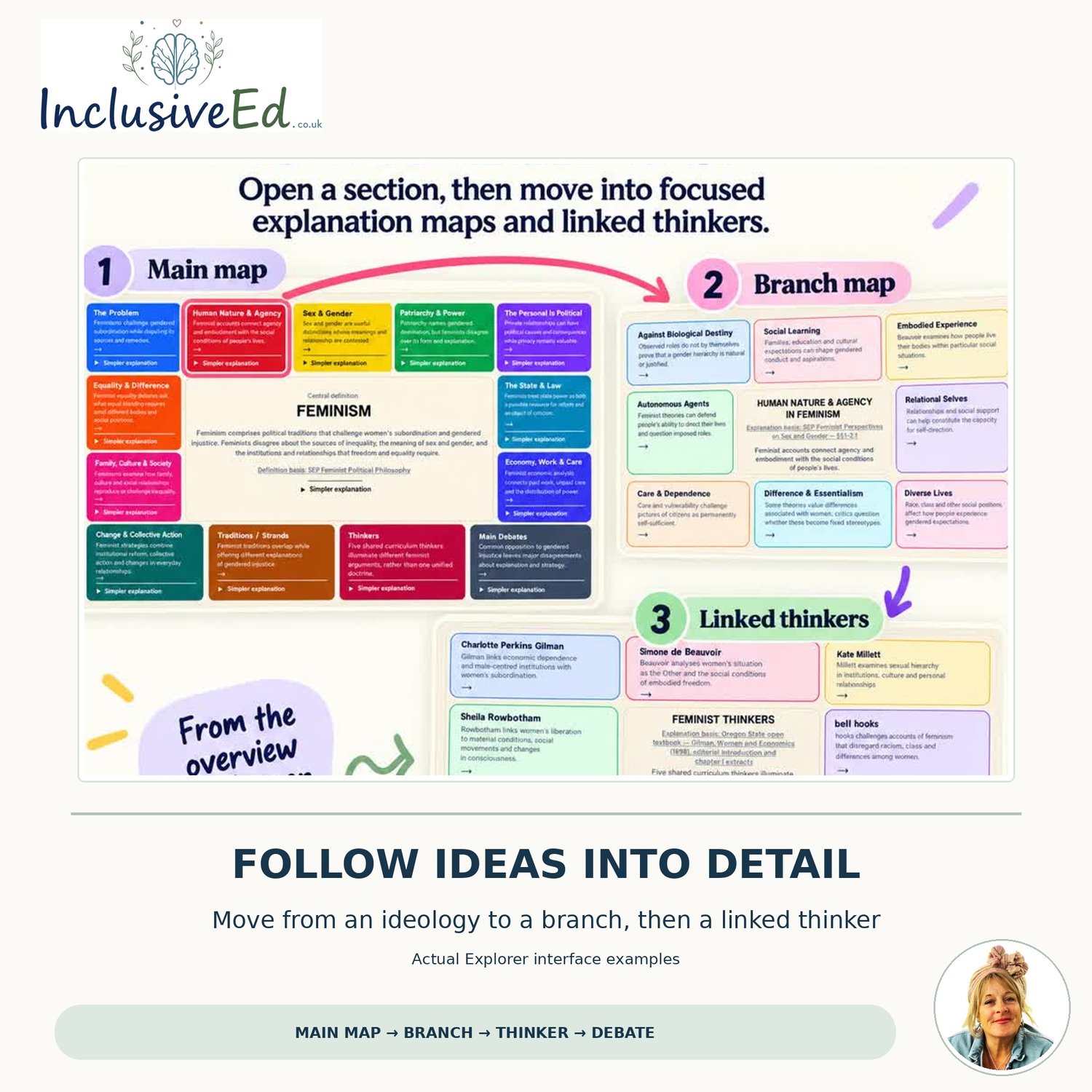
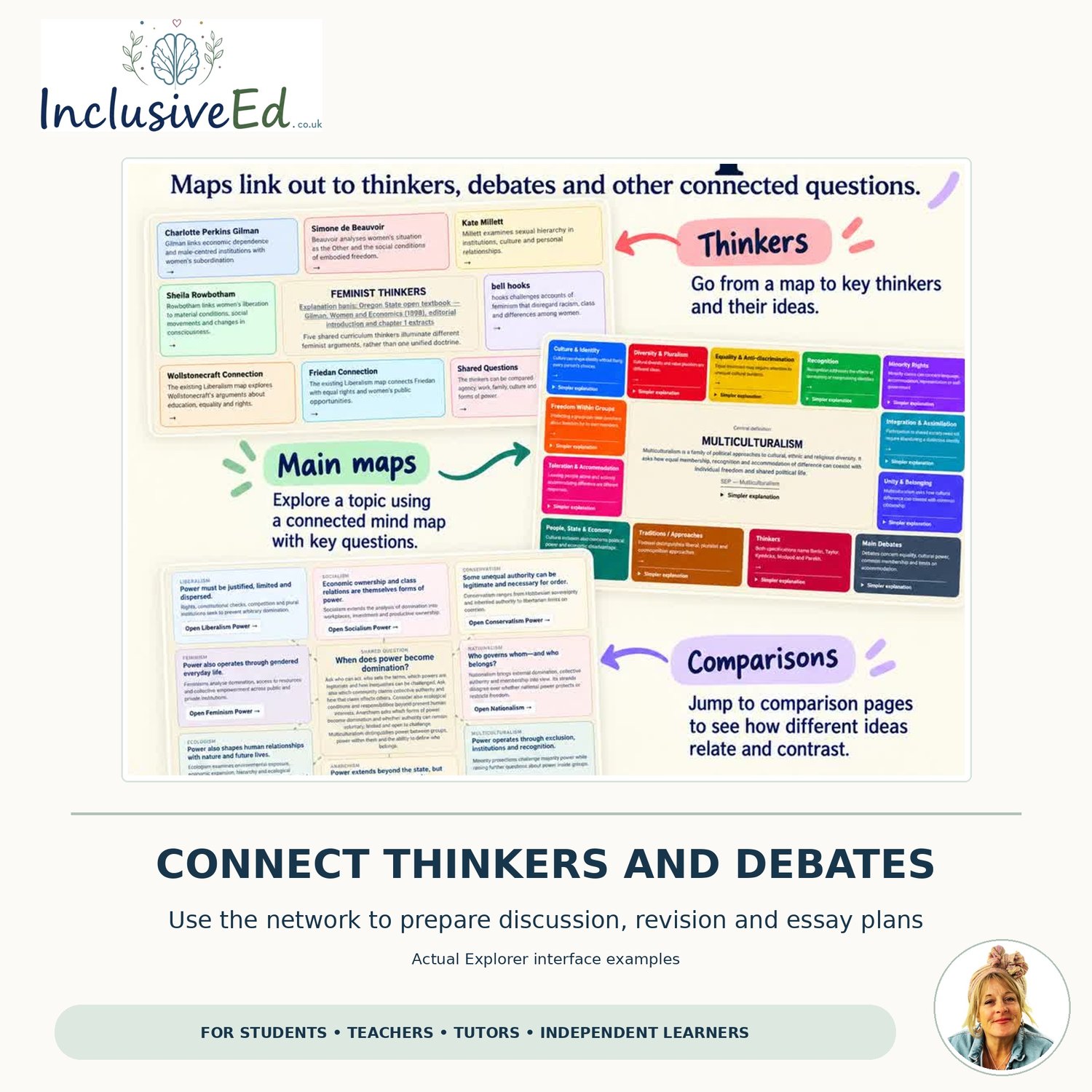
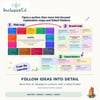
Each ideology has a main map and routes into its ideas, traditions or strands, thinkers and main debates. Follow the links to explore questions about human nature, freedom, equality, government, property, authority, identity and political change. Move between an overview and a focused explanation without treating an ideology as one fixed set of answers.
KEY POLITICAL THINKERS
Explore the ideas you are studying, then follow their connections across the maps. The network includes thinker maps for:
Liberalism: John Locke, Mary Wollstonecraft, John Stuart Mill, T. H. Green, John Rawls and Betty Friedan.
Conservatism: Thomas Hobbes, Edmund Burke, Michael Oakeshott, Ayn Rand and Robert Nozick.
Socialism: Karl Marx and Friedrich Engels, Rosa Luxemburg, Beatrice Webb, Anthony Crosland and Anthony Giddens.
Feminism: Charlotte Perkins Gilman, Simone de Beauvoir, Kate Millett, Sheila Rowbotham and bell hooks.
Nationalism: Jean-Jacques Rousseau, Johann Gottfried von Herder, Giuseppe Mazzini, Charles Maurras and Marcus Garvey.
Ecologism: Aldo Leopold, Rachel Carson, E. F. Schumacher, Carolyn Merchant and Murray Bookchin.
Anarchism: Max Stirner, Pierre-Joseph Proudhon, Mikhail Bakunin, Peter Kropotkin and Emma Goldman.
Multiculturalism: Isaiah Berlin, Charles Taylor, Will Kymlicka, Tariq Modood and Bhikhu Parekh.
The thinker maps offer routes into contrasting arguments, not just a list of names to memorise. Check your course specification for the particular thinkers you need: the network includes both course-related material and wider contextual study.
COMPARE IDEOLOGIES AND BUILD AN ARGUMENT
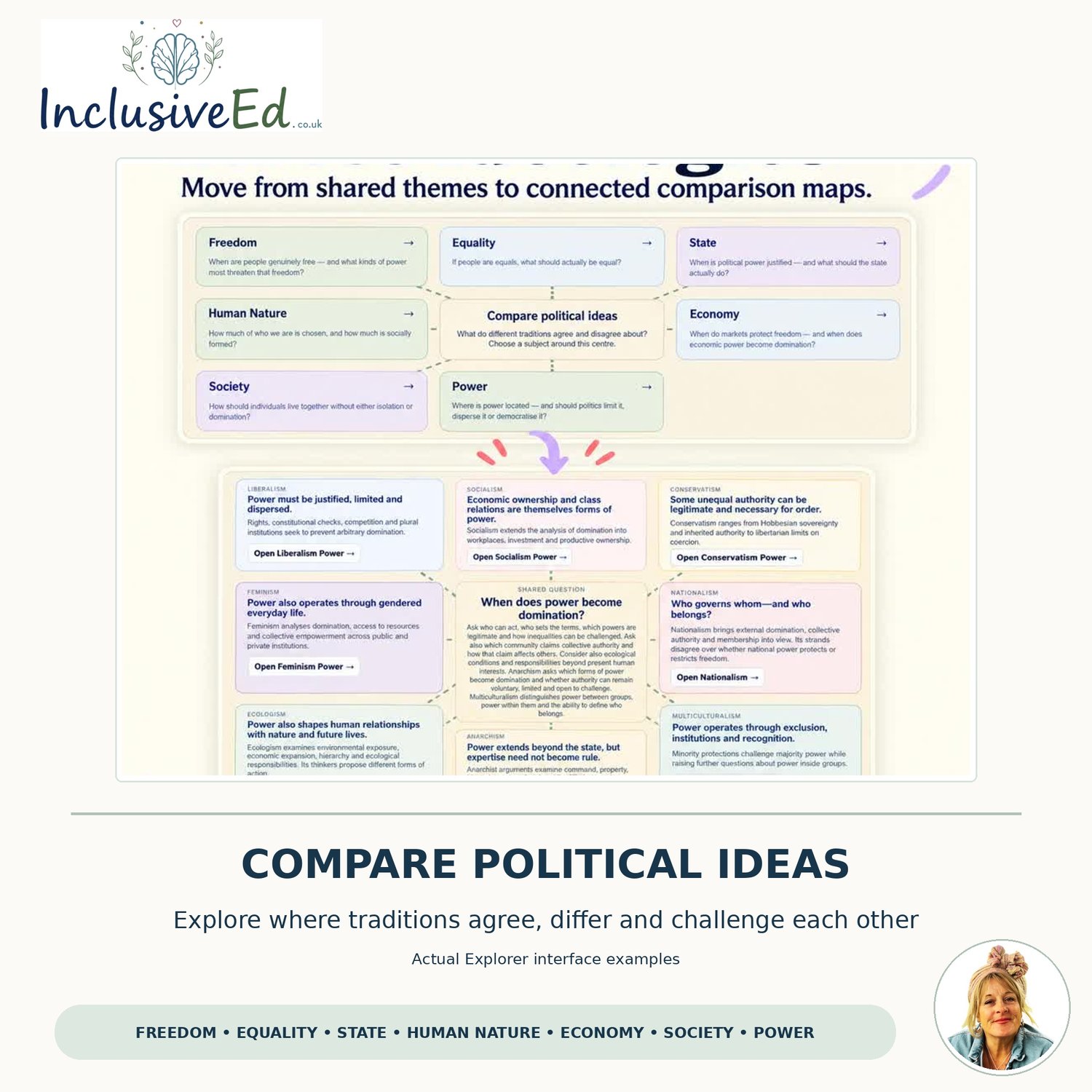
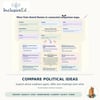
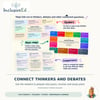
Seven comparison topics connect the eight traditions: freedom, equality, the state, human nature, the economy, society and power. Choose a shared political question and explore where perspectives meet, where they differ and what those disagreements depend on.
For example, use the maps to prepare a discussion or essay plan about whether freedom needs a limited state or active government, whether equality requires economic redistribution, how far human nature shapes political beliefs, or whether political change should come through reform or revolution.
Follow a thinker, tradition or debate from the map, identify a possible argument, consider a contrasting view and decide what evidence you would need. This makes the tool useful for political ideas revision, classroom debate, seminar preparation and comparative essay planning.
SIMPLER EXPLANATIONS WHEN YOU NEED THEM
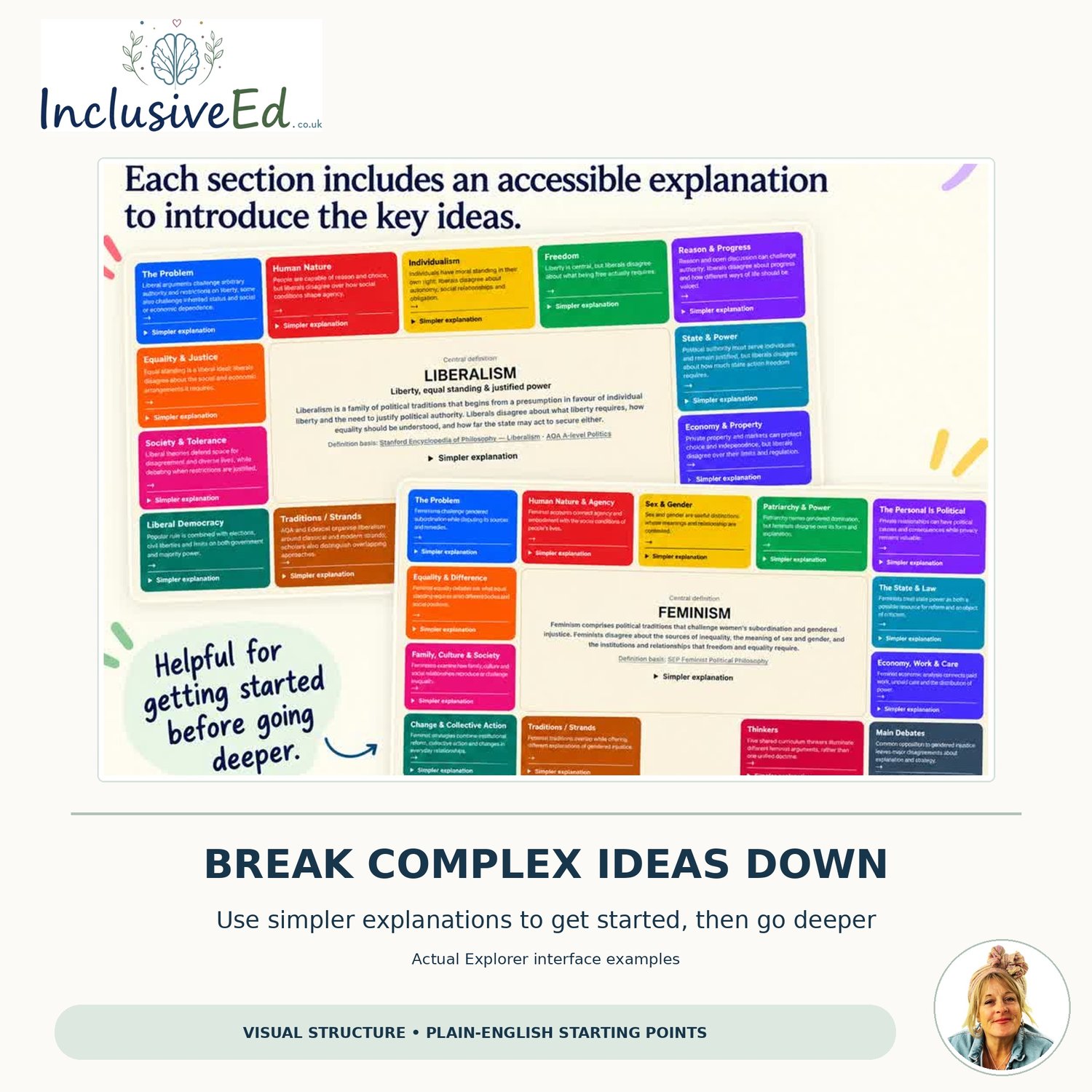
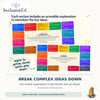
Selected sections include a “Simpler explanation” option, with plain-English introductions that help you get started before returning to the more detailed ideas. Visual organisation and shorter explanations provide another route into dense political theory, particularly if you prefer to see the overall structure first.
These features may be helpful for students with dyslexia or anyone who benefits from breaking complex reading into smaller parts. They support access to the ideas without replacing the original texts or the depth of your course reading.
FOLLOW THE EVIDENCE
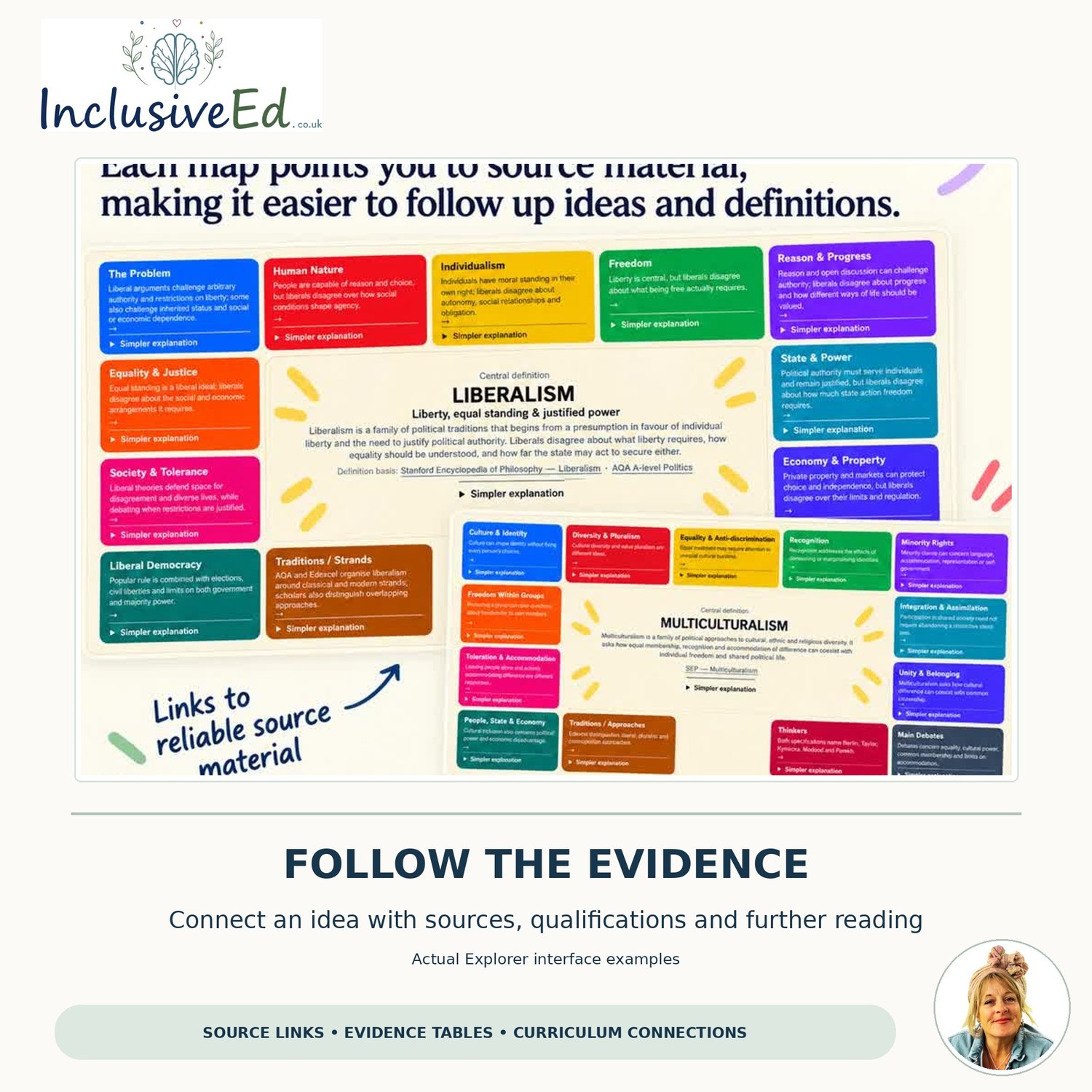
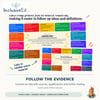
Source links and expandable evidence tables connect ideas with supporting material, qualifications and AQA or Edexcel curriculum connections where provided. Use them to move from an overview towards closer reading and to notice limits or disagreements in an interpretation. An internet connection is needed to open external sources.
FOR STUDENTS
Use the whole-map view to orient yourself, choose one ideology or concept, then follow the branches at your own pace. Revisit the same concept across traditions, explain an argument in your own words and use your findings to organise revision notes, a discussion contribution or an essay plan. Start, Whole Map, Comparison Map and back links help you move around the network.
FOR TEACHERS, TUTORS AND HOME EDUCATORS
Choose a map for a lesson introduction, a focused concept check or a discussion prompt. Ask learners to compare two perspectives, trace a thinker’s argument or explain an internal disagreement. Use a simpler explanation to establish a starting point, then open the evidence and deeper branches for further study. The tool is a flexible companion, rather than a presentation that has to be followed from beginning to end.
COURSE AND LEVEL
Relevant to political ideas study within AQA and Pearson Edexcel A Level Politics, including core ideologies and wider traditions. Independent of, and not endorsed by, either exam board. It supports selected content and comparison skills; it is not a complete A Level specification, exam question bank or mark-scheme service.
For BA Politics and International Relations students, use it as an introductory political thought and political theory companion alongside your module reading, primary texts and academic scholarship. It is not a complete International Relations theory course or a substitute for degree-level reading.
WHAT YOU RECEIVE AND HOW TO OPEN IT
One ZIP containing the full standalone interactive HTML Explorer and a START HERE text guide. Save and extract the ZIP, then open “Open Political Thought Explorer.html” in a browser. The maps and explanations run locally and work offline; external source links need internet access. A desktop or laptop is recommended for exploring the larger maps comfortably.
This listing is for the interactive browser tool. The separate 264-slide PowerPoint teaching pack, printable workbook packs, book chapters and The Ideology Game are not included. No physical item will be posted.
TRY THE APPROACH BEFORE BUYING
The separate online preview lets you try selected Liberalism maps and the equality comparison. This purchase provides the downloadable full edition with all eight ideologies and seven comparison topics. Preview access is not an exclusive paid benefit.
Created by Jennifer Darch, InclusiveEd. A visual way to connect political ideas, compare arguments and make your next step in study clearer.
WATCH THE INTERFACE TOUR
Use the Preview button above to download the 28-second interface tour. It demonstrates the Explorer’s navigation and approach using the online version. The downloadable full edition supplied here contains the eight-ideology network described above.