

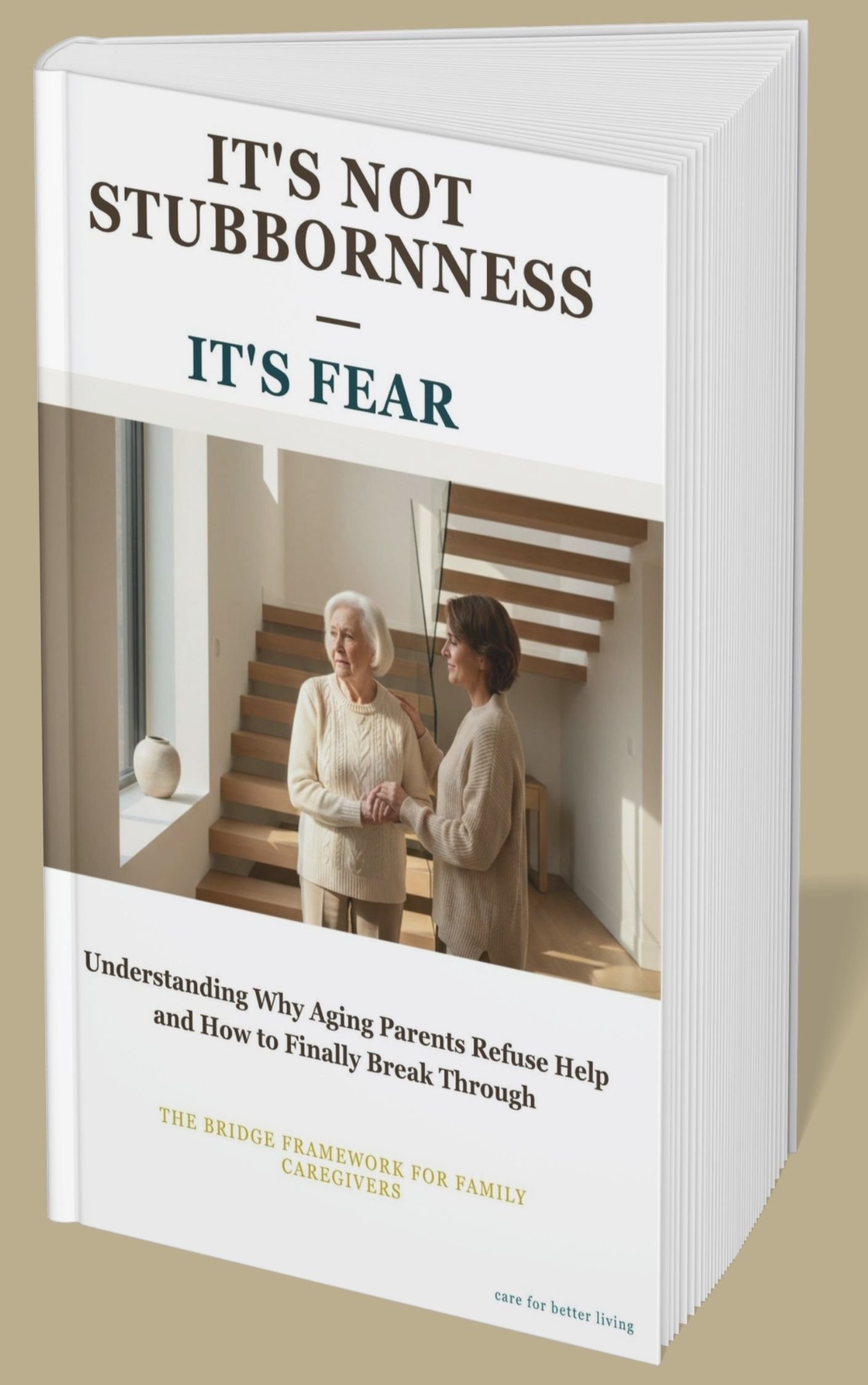





It's Not Stubbornness — It's Fear
When You've Tried Everything and Your Parent Still Says "I'm Fine"
There's a reason nothing has worked. And it's not what you think.
You know the moment.
You've chosen your words carefully. You've picked the right time, the right place. You've rehearsed what you're going to say on the drive over. You've been patient — genuinely patient — in a way that has cost you something.
And then your parent looks at you and says the two words that end every conversation before it really begins.
"I'm fine."
Maybe they say it gently. Maybe they say it firmly. Maybe there's a flash of something behind their eyes — hurt, or fear, or the particular kind of anger that comes from feeling managed by the child they raised.
Either way, the door closes. Again.
You drive home carrying everything you came with — the fear, the frustration, the guilt of wanting to push harder and the guilt of not pushing hard enough. You wonder what you're missing. You wonder if you're doing something wrong. You wonder, in the quiet moments you don't say out loud, whether anything is ever going to change before something terrible happens.
If that is where you are right now — this page is for you.
Here's What Nobody Is Telling You
Every article you've read about this says the same things.
Choose the right time and place. Use "I" statements instead of "you" statements. Bring in a doctor they trust. Give them choices so they feel in control. Be patient and try again.
You've tried most of these. Some of them more times than you can count.
And your parent is still saying no.
Here's why.
Every piece of advice you've been given is treating the wrong problem.
It's treating your parent's refusal as a communication problem — something to be solved by finding the right words, the right approach, the right combination of patience and persuasion that finally produces the result you need.
But your parent's refusal is not a communication problem.
It is a fear problem. An identity problem. A loss problem.
When your parent refuses a home aide, they're not evaluating the practical merits of having someone come in. They're measuring themselves against a standard they've carried for seven decades — and finding that accepting help means failing that test.
When your parent refuses a walker, they're not being reckless about safety. They're fighting to remain the person they've always known themselves to be. A person who doesn't need a walker.
When your parent refuses to talk about the future, they're not in denial. They're protecting themselves from the unbearable weight of everything that word implies.
Your parent is not refusing help because they're stubborn.
Your parent is refusing help because they're afraid.
Afraid of losing their independence. Afraid of becoming a burden. Afraid of what it means about who they are becoming. Afraid of the story they can see you telling about them — a story they are not yet ready to accept as their own.
That distinction — between stubbornness and fear — changes everything.
It changes what the problem actually is. It changes what a solution looks like. And it changes what your role is in finding one.
You are not trying to overcome resistance. You are trying to reach a frightened person who loves you and is doing the only thing available to them — holding on.
What Staying Stuck Is Actually Costing You
This isn't just frustrating. It's costing you things you may not have fully named.
It's costing you sleep. You lie awake running through scenarios. The fall that hasn't happened yet. The phone call you're waiting for. The version of the future you can see from here, even if you can't bear to look at it directly.
It's costing you presence. The worry follows you. Into work, into dinner, into the moments with your own children or partner that deserve your full attention. You're there and not there at the same time, and the people around you can feel the difference.
It's costing you the relationship. Every failed conversation adds a layer of tension between you and your parent. Every visit carries the weight of the unspoken conflict. The warmth that should be there — the ordinary pleasure of being together — is getting crowded out by the thing neither of you can resolve.
It's costing you time. Time that is running out — not in the catastrophic sense, but in the simple, irreversible sense that every week without progress is a week further into a situation that is not standing still.
And underneath all of it, it's costing you something harder to name.
It's costing you the version of this relationship you most want. The one where you and your parent are on the same side. Where the love between you is uncomplicated by the conflict. Where the time you have left together is not organized around the unresolved thing that sits between every visit.
That version of the relationship is still possible. But not with the approaches you've been using.
WHY MOST SOLUTIONS FAIL
Why Everything You've Tried Keeps Backfiring
You haven't been doing nothing. You've been trying — probably for longer than you want to admit, and harder than anyone outside this situation fully understands.
So why hasn't it worked?
Because the five approaches most caregivers rely on all share the same fundamental flaw: they are designed to change your parent's mind. And your parent is not resisting because of a gap in their reasoning. They are resisting because of something happening in their identity — in their deepest sense of who they are and what accepting help means about that.
Here's what the most common approaches actually produce:
The Logical Case — presenting facts and evidence — triggers defensiveness. You're not filling a knowledge gap. You're confirming their fear that you see them as someone who needs to be informed about their own decline.
The Guilt Approach — "I worry about you constantly" — produces shame and the desperate need to reassure you. They don't become more open. They become more focused on managing your anxiety so you'll stop.
The Ambush — the family meeting they didn't know was coming, the doctor who has been briefed in advance — destroys trust. Sometimes permanently. The parent who feels ambushed doesn't become more cooperative. They become more defended.
The Slow Drip — raising it every visit, every call — trains your parent to expect pressure from you. They prepare before you arrive. They're defended before you've said a word. And they become gradually less candid about how things are actually going.
The Ultimatum — "If you won't accept help, I'm calling Adult Protective Services" — removes the last thing your parent is fighting to preserve: control over their own life. And a person with nothing left to lose has nothing left to cooperate with.
None of these approaches are wrong because you used them. They're wrong because they're all aimed at the surface — at the refusal — rather than at what's actually driving it.
You need a different approach entirely. One that starts where the resistance actually begins.
BOOK INTRODUCTION
Introducing: It's Not Stubbornness — It's Fear
Understanding Why Aging Parents Refuse Help and How to Finally Break Through
This book begins with a single insight that changes everything:
Your parent is not refusing help because they're stubborn. They're refusing it because accepting help feels like losing themselves — and they are not ready to lose themselves.
Once you understand that — really understand it, not just intellectually but in the felt sense of what your parent's daily interior experience is actually like — the entire situation shifts.
You stop trying to overcome resistance and start trying to understand a person.
You stop presenting arguments and start creating the conditions in which genuine openness becomes possible.
You stop approaching these conversations as negotiations and start approaching them as what they actually are: opportunities to reach a frightened person with love and patience and a genuinely different kind of presence.
It's Not Stubbornness — It's Fear is not a book of scripts. It will not give you magic words that make your parent suddenly compliant. If that's what you're looking for, this isn't your book — and honestly, that book doesn't exist.
What this book will give you is something more valuable and more durable: a genuine understanding of what is actually happening, and a practical framework — built from real human psychology rather than generic communication advice — for navigating it in a way that creates real progress without destroying the relationship you most want to preserve.
THE FRAMEWORK EXPLANATION
The BRIDGE Framework: Your Six-Step Path Through This
At the heart of this book is the BRIDGE Framework — a six-component approach to moving from conflict and distance to genuine connection and real progress.
Each letter stands for one essential component. Each component builds on the one before it. Together they create an approach that is genuinely different from anything you've tried — because it begins in a genuinely different place.
Not with what you need your parent to do. With who your parent actually is.
B — Beneath the Resistance
Before any conversation, before any approach, you need to understand what the refusal is actually about. Not the stated reason — the real one. The fear being protected. The identity at stake. The meaning that accepting help carries for this specific person, with this specific history, at this specific moment in their life.
Most caregivers are solving the wrong problem. B teaches you to find the right one.
R — Reclaim Your Calm
Your emotional state doesn't stay inside you. It travels. It fills the room before you speak and shapes what is possible in the conversation before a single word has been exchanged.
Reclaiming your calm is not about performing patience. It's about genuinely regulating your own fear and urgency before you walk through your parent's door — because your calm is not a nicety. It is a prerequisite.
I — Identity First
People accept change more readily when they feel securely seen in who they already are.
Before you raise any concern, before you make any request, you honor who your parent has always been — the values, the roles, the history that still define them even as the current chapter is hard. And from that foundation, everything that follows lands differently.
D — Door-Opening Conversations
The difference between a conversation that opens a door and one that closes it is not the words. It is the stance.
This component gives you specific conversation structures — not scripts — for entering these conversations as a partner rather than a persuader. For asking questions you actually want to know the answer to. For staying in the opening when your parent says something real, rather than redirecting it toward the agenda you came with.
G — Gradual Engagement
Real progress doesn't happen in single breakthroughs. It happens through small agreements that build on each other — micro-yeses that create momentum, that update your parent's sense of themselves as someone who can cooperate, and that make the next small agreement more available than the last.
G teaches you to stop chasing the breakthrough and start building the direction.
E — Enlist the Right Allies
You are not always the most effective messenger for your own parent. That's not a failure — it's a feature of how relationships work, particularly in families with decades of history.
This component helps you identify who your parent trusts, what each ally can genuinely offer, and how to engage them in a way that feels like care rather than conspiracy.
What Changes When You Read This Book
You will finally understand what is actually driving your parent's refusal — not the surface reason, but the real one. The fear. The identity. The loss. And that understanding will change how you see them in a way that no communication technique ever could.
You will stop having conversations that close doors — because you'll know the specific stances, patterns, and approaches that have been producing resistance, and you'll be able to step out of them deliberately rather than repeating them automatically.
You will have a framework you can actually use — not a list of tips to remember under pressure, but a structured, sequential, memorable approach that you can return to every time the situation shifts.
You will know how to respond to a partial yes — one of the most important and most consistently missed skills in caregiving. When your parent offers something less than what you asked for, you'll know how to receive it fully rather than advancing past it toward the next demand.
You will understand the family dimension — the sibling who minimizes, the sibling who catastrophizes, the family that cannot align before approaching the parent. You'll have practical guidance for creating coordination rather than conflict.
You will know what to do when nothing is working — because sometimes even the right approach takes longer than you need it to. This book tells you the honest truth about genuinely stuck situations, including when professional support is warranted and how to protect yourself through the long arc of a situation that doesn't resolve quickly.
You will be less alone in this — because this book sees not just your parent's situation but yours. The grief that has no name. The guilt that costs more than it earns. The exhaustion that doesn't fix itself with sleep. All of it is here, named and held honestly.
WHAT'S INSIDE
A Complete Look at What You're Getting
INTRODUCTION: The Conversation That Keeps Failing
Why the same conversation keeps producing the same result — and what this book offers that is genuinely different.
PART ONE: Understanding What Is Really Happening
- Chapter 1: It's Not Stubbornness. It's Survival. — The central reframe that changes everything. Your parent's resistance is not a personality trait to be overcome. It is a person trying to remain themselves.
- Chapter 2: The Geography of Aging Fear — A detailed map of the specific fears driving most aging parents' resistance: loss of independence, fear of burden, fear of control, fear of institutional care, fear of being seen as diminished, and the fear that sits beneath all the others.
- Chapter 3: Why You Are Part of the Problem (And That's Okay) — The honest chapter most caregiving books don't write. How your own emotional state, relational patterns, and family history have been shaping these conversations in ways you may not have seen.
PART TWO: Why Everything You've Tried Has Failed
- Chapter 4: The Five Approaches That Backfire — The logical case, the guilt approach, the ambush, the slow drip, and the ultimatum. Why each one fails and what it costs the relationship.
- Chapter 5: The Hidden Dynamic No One Talks About — The relationship history that lives in every caregiving conversation. How decades of family patterns, roles, and unresolved dynamics shape what is possible between you and your parent.
PART THREE: The BRIDGE Framework
- Chapters 6–11 — One chapter per framework component, each with a full explanation, real composite examples, a practical exercise, and reflection questions.
PART FOUR: Practical Implementation
- Chapter 12: Putting BRIDGE Together — A complete walkthrough showing all six components in action through one detailed composite case study — including setbacks, partial progress, and realistic outcomes.
- Chapter 13: When the Stakes Are Immediate — What to do when gradual engagement is not enough. Falls, cognitive decline, unsafe home conditions, and the question of when professional or legal intervention becomes necessary.
- Chapter 14: Navigating Family Disagreements — The sibling who minimizes, the sibling who catastrophizes, the family that can't align — and what to do when family conflict is as much of an obstacle as the parent's resistance.
PART FIVE: Troubleshooting and Real-Life Challenges
- Chapter 15: When Nothing Is Working — The honest truth about genuinely stuck situations, including the most important and most difficult truth in the book: sometimes you do everything right and your parent still says no. That is not your failure.
- Chapter 16: Taking Care of Yourself Through This — The grief nobody names. The guilt that costs more than it earns. What depletion actually looks like — and what genuine support for the caregiver actually requires.
CONCLUSION: The Long Game — What real progress looks like. What this work is actually for. And the reminder that the love underneath all of this is not nothing — it is, in the end, the only framework that was ever really doing the work.
WHO THIS BOOK IS FOR
This book is for you if:
- Your aging parent is refusing help — a home aide, a walker, medication management, medical appointments, or conversations about the future — and nothing you've tried has made a difference.
- You have had the same conversation multiple times and it keeps ending the same way.
- You lie awake worrying about your parent's safety and feel helpless about what to do next.
- You love your parent and you're frightened for them and you're also, honestly, exhausted — and you feel guilty about the exhaustion.
- You've tried the logical approach, the emotional approach, the family meeting approach, and none of them have produced lasting change.
- You want to make real progress without damaging the relationship you most want to preserve.
- You are willing to look honestly at your own role in these conversations — not to blame yourself, but to understand what you can change.
- You want to understand what is actually happening, not just be told what to say.
WHO THIS BOOK IS NOT FOR
This book is not the right fit if:
- You are looking for scripts that will make your parent immediately comply. No book can guarantee that outcome, and this one won't pretend otherwise.
- Your parent has significant cognitive impairment that has already been professionally assessed and requires a clinical rather than relational approach.
- You are in a genuine emergency — your parent is in immediate danger and needs professional intervention today. In that case, please contact Adult Protective Services or your parent's physician first.
- You are not willing to examine your own approach. This book asks you to look honestly at what you bring into these conversations — and if that kind of honest self-examination feels wrong, this may not be the right moment for this book.
FREQUENTLY ASKED QUESTIONS
Will this book work if my parent is very stubborn or has always been difficult?
This book was written specifically for complicated situations — including parents who have always been resistant, controlling, or emotionally unavailable. Chapter 5, which addresses the relationship history that lives in every caregiving conversation, speaks directly to this. The BRIDGE Framework does not assume a warm, cooperative relationship as its baseline. It starts from wherever you actually are.
My parent has some memory issues. Will this still apply?
The book addresses early-stage cognitive changes directly and provides guidance on when and how the framework applies. For significant cognitive impairment that has already been professionally assessed, some sections will be more relevant than others — and the book is honest about where the relational approach has limits and professional support is warranted.
I've already tried everything. How is this different?
Most approaches treat refusal as a communication problem — something to be solved by finding better words. This book treats it as a fear and identity problem — which requires a fundamentally different response. The reframe at the center of the book is genuinely different from anything in the standard caregiving communication space. If you've tried everything else and it hasn't worked, this is worth trying precisely because it starts from a different place.
I'm not the primary caregiver — I'm a sibling who is worried about what's happening. Is this book for me?
Yes. Chapter 14, which addresses family dynamics and sibling conflict directly, is written as much for the non-primary caregiver as for the primary one. The book is useful for any family member who is navigating these conversations — whether you're the one doing most of the work or the one trying to understand what's happening from a distance.
How long will it take to see results?
This book is honest about the timeline: real change happens gradually, through small agreements that build on each other, not through single breakthroughs. Some readers report a meaningfully different conversation within days of reading. Others are working through a situation that will take months. What the book gives you is not a quick fix — it is a framework that remains useful across the full arc of the caregiving journey, however long that arc is.
Is there a physical book?
Currently the book is available as a digital ebook, which means you can begin reading within minutes of purchase. A print edition is planned — join the email list to be notified when it is available.