

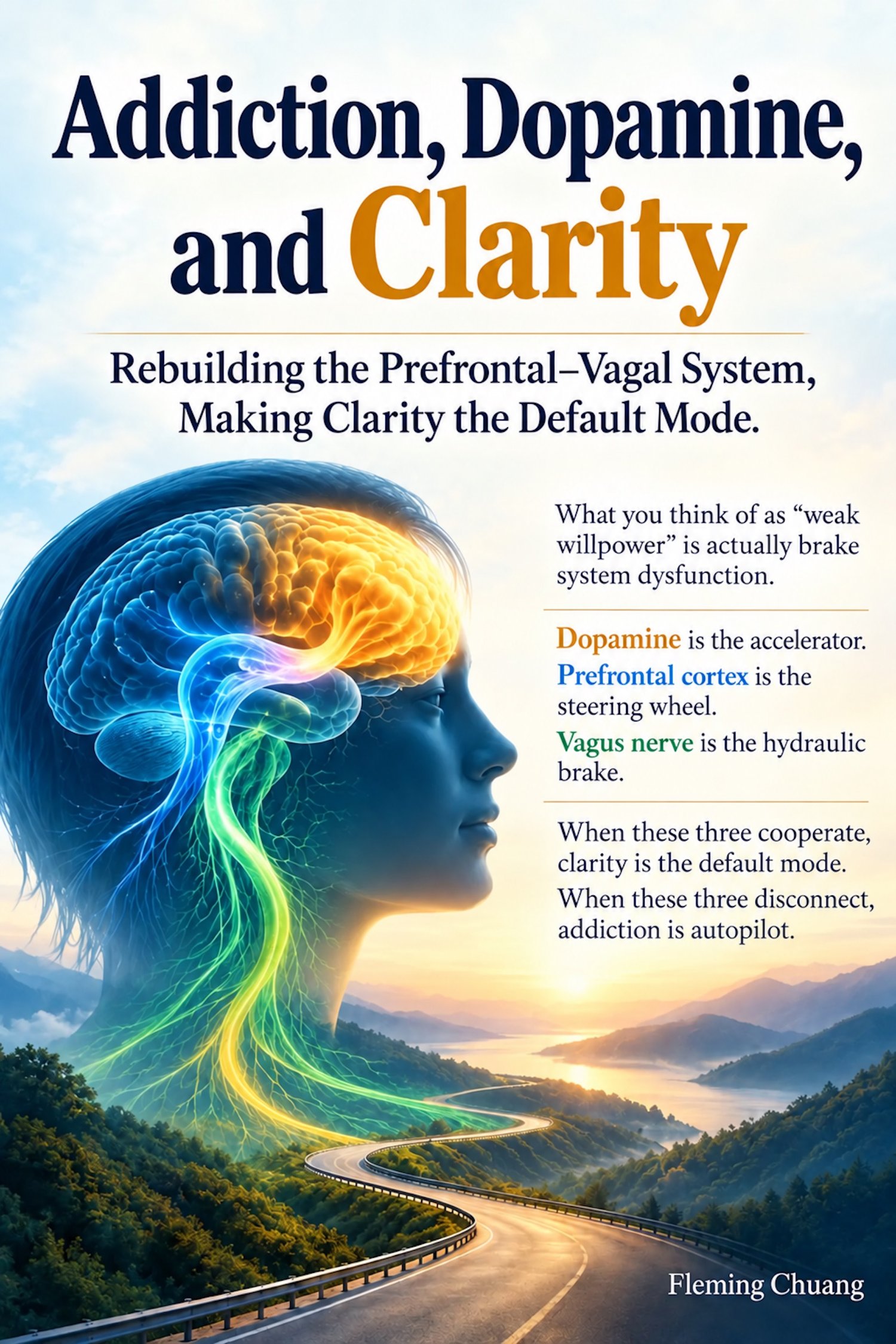
Addiction, Dopamine, and Clarity: Rebuilding the Prefrontal–Vagal System: Making Clarity the Default Mode
Why can you know you should stop—and still keep scrolling?
You tell yourself, “Just one more.” One more short video. One more notification. One more purchase. One more piece of sugar. One more refresh.
You know you should stop. But somehow, your finger keeps moving.
What if the problem is not simply a lack of willpower?
Addiction, Dopamine, and Clarity takes you beneath the familiar language of self-control and into the neuroscience of craving, impulse, and behavioral automaticity. Drawing on popular neuroscience, psychology, autonomic nervous system regulation, and neuroplasticity, this book presents a practical framework for understanding why modern environments can overwhelm the brain’s natural regulatory systems—and how those systems can be rebuilt.
The journey begins with dopamine.
Dopamine is not simply a “pleasure molecule.” It plays a central role in wanting, motivation, anticipation, and reward prediction. Short videos, social media, refined sugar, blind boxes, shopping platforms, and speculative environments can exploit these mechanisms through novelty, uncertainty, immediacy, and variable rewards.
But dopamine is only one side of the story.
The book then turns to the brain’s braking system: the prefrontal–vagal system. The prefrontal cortex provides cognitive control, goal maintenance, valuation, and inhibition. The vagus nerve provides a crucial physiological pathway linking brain and body. Together with the central autonomic network, insula, brainstem pathways, and heart-rate variability, these systems form a dynamic loop connecting cognition, emotion, physiology, and behavior.
The book then introduces three patterns of dysregulation:
• Dopamine Overload Type—the tyranny of craving
• Chronic Stress/Exhaustion Type—the abyss of powerlessness
• Dorsal Vagal Collapse Type—the numb void
Rather than treating every impulse as a moral failure, the book asks a different question: What state is your nervous system in, and what kind of intervention does that state require?
From there, “clarity” is redefined.
Clarity is not the absence of desire. It is not permanent abstinence, suppression, or heroic willpower. It is the ability to create a gap between stimulus and response—to notice the impulse without automatically becoming the impulse, and to regain the capacity to choose.
The second half of the book turns this idea into practice.
You will explore Urge Surfing, affect labeling, physiological sighs, resonance breathing, goal restatement, dlPFC micro-commands, environment design, friction management, dopamine reduction, distress tolerance, and a structured 28-day / 8-week rebuilding plan.
The final section focuses on maintenance: sleep, exercise, diet, social connection, HRV, co-regulation, relapse, neuroplasticity, and the creation of a Personal Neural Dashboard.
The central message is simple:
You do not need to eliminate every impulse.
You need to rebuild your ability to respond rather than automatically react.
The goal is not to escape the modern world, but to develop a nervous system capable of remaining clear within it.
Your brain can learn. Your patterns can change. Your capacity for choice can be strengthened.
Make clarity the default mode.