
Lean Six Sigma in Security and Loss Prevention
In over 20 years of activity in the field of (SLP) security and loss prevention, I have always heard concepts like Lean, Six Sigma or a mixt of both, (LSS) Lean Six Sigma, being talked about around me. They were usually brought up by line of business managers.
And I started looking for LSS documentation applicable to the field of security and loss prevention. In over 20 years of searching, I have not found any document that demonstrates the applicability of these concepts in security and loss prevention services. So I tried my best to design such a document.
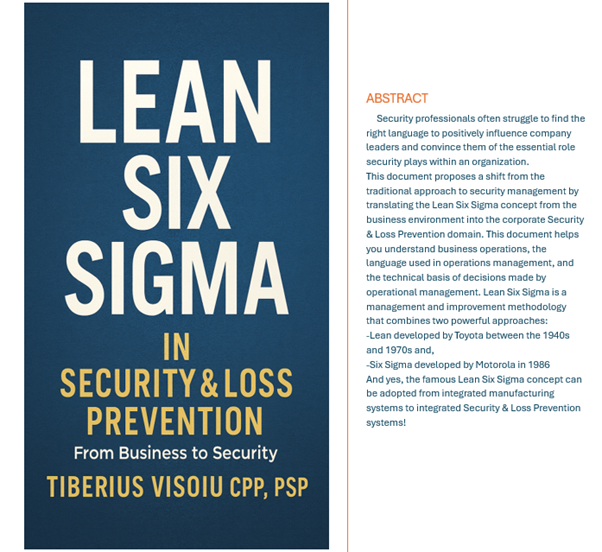
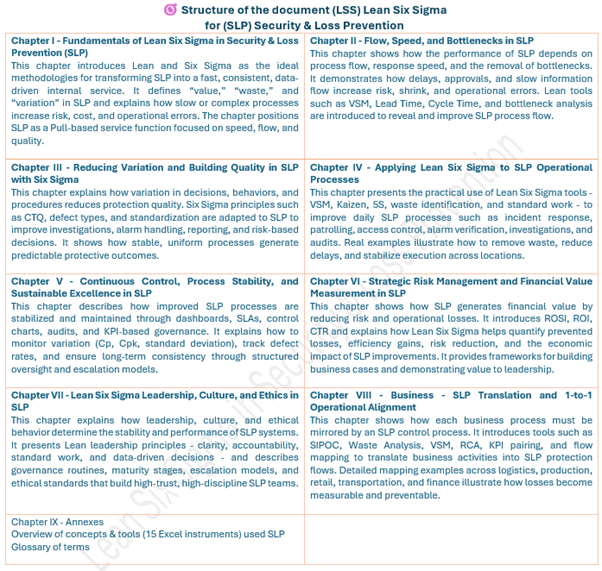
In the over 150 pages you will find the main concepts used in Lean Six Sigma applied to security and loss prevention, eloquent examples of using the methodology, but also attached to the document you will find a number of over 15 excel tools adapted from LSS to SLP that will make your work easier.
Could I have made a more complex and better document? Maybe so, but it is a first step taken on a territory that is somewhat "virgin". Taking highly technical concepts used predominantly in complex production industries where process stability must be perfect, deviation non-existent and speed at high parameters and trying to translate them into the field of security and loss prevention is not exactly easy to do.
This pdf document comes with a suite of a suite of Excel tools adapted to the Security and Loss Prevention, providing a structured overview of how Lean Six Sigma principles can be applied within Security and Loss Prevention (SLP) environments. By organizing multiple operational domains into clear categories, it highlights where continuous improvement tools - such as process mapping, CTQ identification, bottleneck analysis, lead time measurement, waste reduction, and root-cause methodologies - can generate measurable impact.
All Excel tools demonstrate that Security and Loss Prevention are not only protective or reactive functions but also process-driven disciplines that benefit from Lean optimization, standardization, and data-based decision-making. Each domain illustrates the potential to reduce inefficiencies, eliminate non-value-added work, shorten response and resolution times, and increase the overall quality and consistency of security operations.