
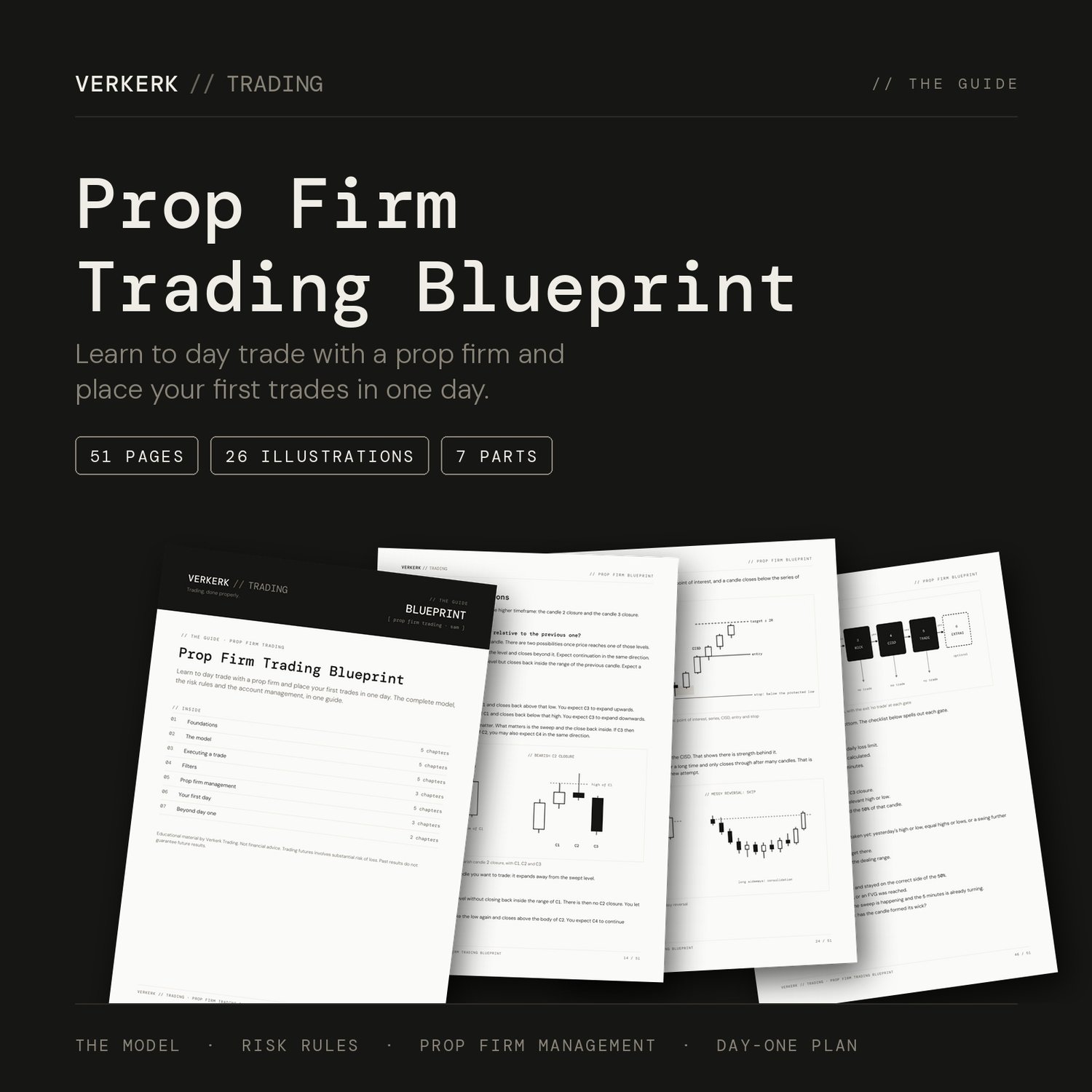
Prop Firm Trading Blueprint
Learn to day trade with a prop firm and place your first trades in one day.
Most new traders don’t fail because they lack a strategy. They fail because they trade without rules, without a plan and without understanding how a prop firm account actually works.
The Prop Firm Trading Blueprint gives you all three in one guide: a complete trading model, the risk rules that keep an account alive, and a step-by-step plan for your first day.
What’s inside
- Part 1 — Foundations. How prop firms work, the rules that end accounts (drawdown, daily loss limit, consistency), ES and NQ contract specs, and how to size your position from your stop.
- Part 2 — The model. The Swing Anticipation Model (SAM): one pattern to spot a turning point early, confirm it and trade the move that follows. It works on every timeframe.
- Part 3 — Executing a trade. Bias, entry, stop, targets and trade management, step by step.
- Part 4 — Filters. Sessions, correlated markets and the situations where you stay out.
- Part 5 — Prop firm management. Passing the evaluation, building a buffer in a funded account, payouts, running multiple accounts, and treating it like a business.
- Part 6 — Your first day. The standard recipe, a printable checklist and an hour-by-hour schedule.
- Part 7 — Beyond day one. Common mistakes and a practice plan for the weeks after.
51 pages · 26 illustrations · 7 parts · instant PDF download
Who this is for
- Beginners who want to start with a prop firm the right way
- Traders who keep failing evaluations on rules, not on setups
- Anyone who wants one clear model instead of a hundred YouTube videos
What this is not
This is not a get-rich-quick system and it does not promise profits. Day one is about placing correct trades by following a checklist. Becoming consistent takes practice, and this guide shows you how to practise.
Delivery
You receive the PDF by email immediately after purchase. No account needed.
Educational material only. Not financial advice. Trading futures involves substantial risk of loss. Past results do not guarantee future results. Always check the current rules of your own prop firm.